
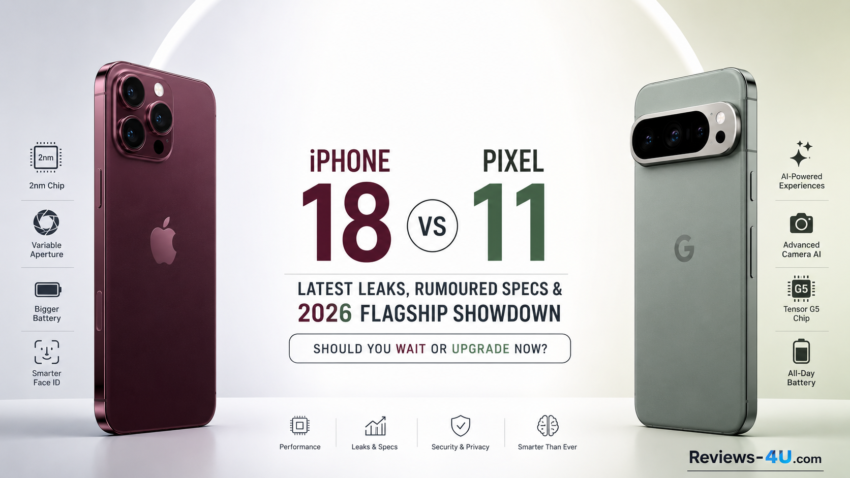
If you’re currently shopping for a flagship phone, you’ve probably noticed something: a lot of buyers are holding off. Instead of grabbing the latest iPhone or Pixel the moment it lands in stores, many shoppers are searching for “what’s coming next” before they commit to a purchase that could cost upwards of ₹80,000 to ₹1,50,000.
That’s exactly why the iPhone 18 and Google Pixel 11 are already generating buzz, months before either device has been officially announced. Leaks from supply chain sources, dummy unit photos, benchmark listings, and industry analysts give us an early though incomplete picture of what both companies are planning.
It’s worth being upfront about something important: leaks are not announcements. Specifications change during development, launch timelines shift, and features that look confirmed in March can quietly disappear by September. With that in mind, this guide walks through what’s currently being reported about both phones, how credible each rumour appears, and most importantly, who should actually consider waiting versus buying now.
Apple’s next flagship cycle appears to be taking an unusual shape, with reports suggesting a split release across Pro and standard models rather than a single September launch. Google, meanwhile, looks to be sticking with its now-familiar August launch window for the Pixel 11 series, continuing its push toward AI-first hardware built around its custom Tensor chips.
Let’s break down what we know and what we don’t, about both devices.
And if you’re weighing whether to hold onto your current phone a little longer or pick up a discounted previous-generation model in the meantime, our guide on refurbished vs new gadgets can help you decide when buying refurbished actually makes sense.
What We Know About the iPhone 18 So Far
A20 and A20 Pro Chipsets
One of the most consistently reported details across multiple outlets is Apple’s planned shift to a 2-nanometre manufacturing process for its next chip generation. Smaller nanometre processes generally mean better performance per watt, which translates to either longer battery life, more processing headroom, or both.
Reports suggest Apple may use two variants: a standard A20 chip for the more affordable models, and an A20 Pro for the higher-end Pro and Pro Max devices, possibly built using more advanced wafer-level packaging that integrates memory closer to the processor.
How realistic is this? Apple has followed a fairly predictable cadence of process node upgrades over the years, and multiple supply chain sources are pointing in the same direction. This rumour sits on the more credible end of the spectrum, though the exact performance gains won’t be known until independent benchmarks arrive after launch.
Display and Design Changes
Leaks point to a smaller Dynamic Island on the Pro models, potentially achieved by moving some Face ID components under the display. However, this is one of the more contested rumours some reports suggest this under-display Face ID technology may not be ready in time and could slip to a future generation, meaning the Dynamic Island might look similar to the iPhone 17 Pro for now.
Colour-wise, a “Dark Cherry” shade has been mentioned as a possible replacement for the Cosmic Orange option seen on the iPhone 17 Pro, alongside Light Blue, Dark Gray, and Silver variants.
Realism check: Design tweaks like new colour options are low-risk rumours that tend to hold up reasonably well, since they’re often based on early case and accessory leaks. The under-display Face ID claim is more speculative and could easily be pushed to a later cycle.
Camera Enhancements
A recurring theme in iPhone 18 Pro leaks is the introduction of a variable aperture on the main camera something Apple has never offered before. A variable aperture allows the camera to physically adjust how much light enters the lens, giving photographers more creative control over depth of field and exposure, similar to features seen on some Samsung and Sony devices in the past.
Additional camera sensor upgrades are also rumoured for the ultra-wide and telephoto lenses, particularly on the Pro Max.
Realism check: Variable aperture has appeared in multiple independent reports, lending it more credibility than a single-source rumour. That said, implementing this in a phone-sized module is technically demanding, so it’s worth treating this as “likely planned” rather than “guaranteed to ship.”
Battery and Charging
A larger battery is expected on the iPhone 18 Pro Max, partly enabled by internal layout changes and the smaller Dynamic Island freeing up space. Some leaks suggest the Pro Max could become slightly thicker and heavier as a trade-off for the bigger cell.
Realism check: Battery size increases are common year-over-year and tend to be among the more reliably leaked details, since they’re tied to physical component sourcing that’s harder to keep secret.
Face ID and Security
Beyond the under-display Face ID speculation, Apple’s next-generation C2 modem is rumoured to bring a privacy-focused location feature that limits how precisely carriers can track a device’s location, useful context for users concerned about data privacy.
AI and Apple Intelligence Upgrades
This is arguably the area generating the most anticipation. Reports suggest Apple’s next major software update will bring a significantly upgraded Siri, potentially restructured as a standalone app with the ability to reference past conversations, something that would represent a meaningful shift from how Siri currently works.
Realism check: Apple has publicly acknowledged that its AI ambitions have lagged behind competitors, and there’s significant pressure on the company to deliver a more capable assistant. This rumour aligns with Apple’s own stated direction, making it more plausible than purely speculative leaks, though software timelines are notoriously prone to delays.
Launch Timeline Surprise
Perhaps the most unusual rumour is about timing itself. Multiple reports now suggest Apple may split its 2026-2027 iPhone lineup: the Pro, Pro Max, and a first-ever foldable iPhone could launch around September 2026, while the standard iPhone 18 and a more affordable iPhone 18e may not arrive until spring 2027.
Realism check: This is one of the more significant claims because it affects buying decisions directly. It’s been reported by multiple established outlets tracking Apple’s supply chain, which adds weight to it, but a launch timeline shift this dramatic would be unusual for Apple, so it’s worth treating as “likely but not certain” until closer to the announcement window.
What We Know About the Google Pixel 11 So Far
Tensor G6 Chipset
The Pixel 11 series is widely expected to run on Google’s Tensor G6 chip, manufactured on TSMC’s 2-nanometre process, a jump from the 3-nanometre node used for the Tensor G5. Leaked details point to a 7-core CPU configuration (down from the usual 8-core layout), featuring one high-performance ARM C1-Ultra core alongside several efficiency-focused C1-Pro cores.
However, the same leaks suggest the GPU may not see a major upgrade, with reports pointing to a PowerVR GPU architecture that originally debuted several years ago.
How realistic is this? Several independent sources, including well-regarded leakers, have converged on similar CPU details, which makes the core chipset rumour fairly credible. The GPU concern has also been echoed across multiple reports, suggesting Google may be prioritising AI processing and efficiency over raw graphical horsepower, consistent with the Tensor line’s history.
AI-Powered Features
Google’s Tensor chips have always been marketed around on-device AI and machine learning capabilities, and the Tensor G6 is expected to continue that trend with upgraded hardware specifically for AI tasks. This would tie closely into Gemini, Google’s AI assistant, which is expected to be deeply integrated across the Pixel 11 software experience.
Camera System Improvements
The Pro models are rumoured to receive new camera sensors, though specific sensor models haven’t been widely confirmed yet. One interesting design change being reported is the replacement of the thermometer sensor (found on recent Pixel Pro models) with an RGB LED array built into the camera bar, referred to in leaks as “Pixel Glow,” an ambient lighting feature for notifications.
Realism check: The Pixel Glow feature has appeared in detailed leaks from multiple sources, giving it reasonable credibility, though how useful this feature proves in daily use remains to be seen.
Android Integration
The Pixel 11 series is expected to launch with the latest version of Android, continuing Google’s tradition of pairing new Pixel hardware with the newest OS release and several months of exclusive feature drops before they reach other Android phones.
Connectivity and Modem
One of the more significant rumoured changes is a switch to a MediaTek M90 modem, replacing the Samsung modems used in recent Tensor chips. Connectivity has been a persistent complaint for Pixel devices for years, and this change, if accurate, could address long-standing issues with signal reliability and network handoffs.
Realism check: This rumour has been corroborated across several publications and represents a logical move for Google, given the consistent criticism of previous modem choices. It’s one of the more credible claims in this round of leaks.
Battery and Charging Expectations
Somewhat surprisingly, some leaks suggest smaller battery capacities across the Pixel 11 lineup compared to the Pixel 10, with the efficiency gains from the 2nm Tensor G6 expected to offset this. Some reports estimate up to 25% better efficiency as a result of the chip transition.
Design Changes
Beyond the Pixel Glow lighting feature, leaks suggest a refined design rather than a dramatic overhaul, new Samsung-made OLED panels on the Pro models, and brighter displays are among the most repeated claims.
Google’s Recent Flagship Trends
It’s worth noting the context here: Google has spent the last few generations trying to differentiate Pixel phones through software and AI rather than competing purely on hardware specs. The Tensor G6 leaks suggest this strategy is continuing; Google appears to be prioritising chip efficiency and AI capability over chasing benchmark scores against Snapdragon-powered competitors.
iPhone 18 vs Pixel 11 Feature Comparison
All figures below are based on current leaks and rumours. Nothing here is officially confirmed by Apple or Google.
| Feature | iPhone 18 (Pro/Pro Max) | Pixel 11 (Pro/Pro XL) |
| Processor | A20 / A20 Pro (2nm) | Tensor G6 (2nm, 7-core) |
| Display | Possibly smaller Dynamic Island; similar sizes to iPhone 17 Pro lineup | New OLED panels, brighter displays on Pro models |
| Cameras | Variable aperture main camera (Pro), upgraded ultra-wide/telephoto | New sensors on Pro models; ambient “Pixel Glow” lighting |
| AI Features | Major Siri overhaul, Apple Intelligence expansion | Gemini deeply integrated, enhanced on-device AI via Tensor G6 |
| Software | iOS 27 (rumoured) | Latest Android version at launch |
| Battery | Larger battery on Pro Max (rumoured) | Possibly smaller batteries, offset by chip efficiency |
| Charging | No major leaks on charging speed yet | No major leaks on charging speed yet |
| Design | Possible Dark Cherry colour, slightly thicker Pro Max | Refined design, new RGB lighting on the camera bar |
| Security | C2 modem with privacy-focused location limits | Titan M3 security chip (carried over) |
| Connectivity | Apple C2 modem (in-house) | MediaTek M90 modem (replacing Samsung modem) |
| Expected Price | From approx. ₹1,20,000 for base Pro variant (rumoured) | From approx. $799 / roughly ₹70,000+ for base model (rumoured) |
| Expected Release Date | September 2026 (Pro/Pro Max/Fold); standard models possibly spring 2027 | August 2026 (Pixel 11 series); Pro Fold around October 2026 |
Indian pricing is an approximate conversion of rumoured US figures and does not account for import duties, GST, or regional pricing adjustments Apple and Google typically apply in India.
AI Features Could Be the Biggest Battleground
If there’s one area where the iPhone 18 and Pixel 11 might genuinely differentiate themselves from their predecessors, it’s AI.
Apple Intelligence has had a rocky rollout, with several promised features delayed beyond their original announcements. Leaks now point to a more ambitious Siri overhaul, potentially restructured as a dedicated app capable of referencing earlier conversations, similar to how chat-based AI assistants work. For Apple, this would be less an upgrade and more a long-overdue catch-up.
Google Gemini, on the other hand, has had a head start. Google has been integrating Gemini across its ecosystem from Workspace apps to Android itself, and the Tensor G6’s architecture appears to be built with this in mind. On-device AI processing means certain tasks (like photo editing suggestions, summarisation, or smart replies) can happen without sending data to the cloud, which matters both for speed and privacy.
For Indian buyers specifically, on-device AI features can also be useful in areas with inconsistent internet connectivity, where cloud-dependent AI tools may lag or fail entirely.
Productivity tools on both platforms are expected to lean heavily on AI, think automatic email drafting, meeting summaries, and smarter notification handling. Voice assistants remain a key battleground, with Siri’s rumoured overhaul directly targeting the gap with Google Assistant/Gemini.
AI photography — features like automatically removing unwanted objects from photos, enhancing low-light shots, or generating multiple expression options from burst shots- is expected to improve on both platforms, building on tools already present in the iPhone 17 and Pixel 10 generations.
Privacy considerations remain a point of differentiation. Apple has built its marketing heavily around on-device processing and minimal data collection, while Google’s AI approach, though increasingly offering on-device options, has historically relied more on cloud processing. For privacy-conscious buyers, this distinction may matter more than raw AI capability.
In short, by 2026, “which phone has better AI” may become as important a buying consideration as camera quality or battery life, possibly more so for users who rely heavily on their phone for productivity.
Camera Expectations Based on Current Leaks
Camera performance remains one of the top reasons people upgrade their phones, and both companies appear to be investing here, though in different ways.
Computational photography — where software processes raw sensor data to produce the final image — continues to be central to both ecosystems. Apple and Google have both built strong reputations here, and incremental improvements are expected rather than dramatic overhauls.
Video recording improvements are rumoured for the iPhone 18 Pro’s camera system, building on Apple’s strong reputation for video quality. Specific details for Pixel 11 video capabilities haven’t been heavily leaked yet.
Low-light performance is expected to improve on both devices through a combination of new sensors (where applicable) and AI-assisted processing, an area where Pixel phones have traditionally performed strongly.
Portrait photography could benefit from the iPhone 18 Pro’s rumoured variable aperture, which would allow more control over background blur, a feature long associated with dedicated cameras rather than smartphones.
AI-assisted image editing is expected to expand on both platforms, with tools for object removal, reframing, and generative fill-style features likely to see refinements.
Camera Comparison Table (Based on Leaks)
| Camera Aspect | iPhone 18 Pro (Rumoured) | Pixel 11 Pro (Rumoured) |
| Main Camera Innovation | Variable aperture (first for iPhone) | New sensor (specifics unconfirmed) |
| Ultra-Wide/Telephoto | Possible sensor upgrades on Pro Max | Limited details available |
| Low-Light Performance | Expected incremental improvement | Historically, a Pixel strength; further AI refinement expected |
| Video Capabilities | Strong reputation continues; specific upgrades rumoured | Few specific leaks so far |
| AI Editing Tools | Expansion of existing Apple Intelligence photo tools | Deeper Gemini integration for editing |
Note: Camera leaks for both devices are less detailed than chipset or design leaks at this stage. Expect more specific sensor information closer to launch.
Performance Expectations
It’s important to set expectations clearly here: no real-world benchmarks exist yet for either chip. Everything in this section is based on architectural leaks, not tested performance.
A20 vs Tensor G6: Both chips are rumoured to use a 2-nanometre manufacturing process, which should bring efficiency improvements over their predecessors regardless of brand. Apple’s A-series chips have historically led in single-core CPU performance benchmarks, and there’s no strong signal yet that this pattern will change with the A20. The Tensor G6’s leaked CPU configuration suggests Google is focusing on a single very high-clock-speed core paired with multiple efficiency cores — a layout aimed at balancing AI workloads with everyday tasks rather than chasing peak performance numbers.
Gaming: Apple’s chips have generally had a GPU performance edge over Tensor chips in recent generations, and the Tensor G6 leaks suggest an aging GPU architecture could mean this gap persists or widens. If mobile gaming is a priority, this is worth watching closely as more details emerge.
Multitasking: Both platforms handle multitasking well at the OS level, and chip efficiency improvements from the 2nm process should help with running multiple apps and AI features simultaneously without excessive battery drain.
Efficiency: This is where both chips are expected to shine, given the shared move to 2nm manufacturing. Better efficiency typically translates into either longer battery life at the same battery size, or similar battery life with a smaller cell, which aligns with rumours of a smaller battery on the Pixel 11.
Thermal management: Smaller manufacturing processes generally run cooler, which could help with sustained performance during demanding tasks like gaming or video recording. Neither company has provided specific thermal design details yet.
Battery impact: As covered earlier, the iPhone 18 Pro Max is rumoured to get a larger battery, while the Pixel 11 may see a smaller one, with both changes potentially being net-neutral for actual battery life once efficiency gains are factored in.
Bottom line: Until independent reviewers get hands-on with both devices, treat any performance claims, including ones in this article, as informed speculation rather than fact.
Expected Release Dates and Pricing
Apple’s historical launch timeline: Apple has launched new iPhones in September for many consecutive years, typically announcing in the first half of the month with pre-orders following shortly after. The current round of leaks suggests this pattern holds for the iPhone 18 Pro, Pro Max, and the rumoured first foldable iPhone — but with a twist: the standard iPhone 18 and a more affordable iPhone 18e may be held back until spring 2027, breaking from Apple’s usual single-launch-event approach.
Google’s historical launch timeline: Google shifted its Pixel launch to August in recent years (moving away from the October launches of earlier Pixel generations), and leaks suggest the Pixel 11, Pixel 11 Pro, and Pixel 11 Pro XL will follow this August pattern, with the Pixel 11 Pro Fold arriving separately, likely in October.
Possible pricing scenarios: Rumoured starting prices for the Pixel 11 lineup begin around $799 for the base model, scaling up to roughly $1,199 for the Pro XL, with the foldable potentially exceeding $1,800. For the iPhone 18 Pro, an estimated starting price of around $999 has been mentioned, translating to roughly ₹1,20,000 in India, though Apple’s Indian pricing typically includes additional import-related costs that push prices higher than a direct currency conversion would suggest.
Factors that may influence pricing: Component costs for 2nm chips are generally higher than older process nodes, which could put upward pressure on prices for both companies. Currency fluctuations between the US Dollar and Indian Rupee can also affect final Indian pricing, sometimes significantly, between when a device launches in the US and when it becomes available in India.
Who Should Wait for the iPhone 18?
Existing iPhone users: If you’re using an iPhone 14 or older and your battery health has declined or you’re missing out on newer software features, the decision gets nuanced. If you primarily want the Pro Max with its rumoured larger battery, waiting for the September 2026 launch makes sense. However, if you’re interested in the standard iPhone 18, the rumoured spring 2027 timeline means a much longer wait — in that case, an iPhone 17 might be a more practical interim choice.
Android switchers: If you’re considering moving to iOS specifically because of the rumoured Siri overhaul and Apple Intelligence improvements, it may be worth waiting to see whether these features actually ship as described, since AI feature delays have been common for Apple recently.
Mobile photographers: The rumoured variable aperture camera on the iPhone 18 Pro is a genuinely novel feature for iPhones, and if photography is a primary use case, this could be worth waiting for — assuming the feature makes it to launch as currently rumoured.
Power users: If raw chip performance and a 2nm efficiency jump matter to you, the iPhone 18 Pro/Pro Max launching in September 2026 represents the more conventional upgrade path without the uncertainty around the split-launch standard models.
Who Should Wait for the Pixel 11?
Android enthusiasts: If you’re due for an upgrade and primarily use a Pixel for its clean software experience and fast Android updates, the August 2026 launch window is relatively close, making it a reasonable phone to wait for rather than buying a Pixel 10 at full price right now.
AI-focused users: Given Google’s consistent focus on Gemini integration and on-device AI through the Tensor chips, users who lean heavily on AI-powered features for productivity, search, or content creation may find the Pixel 11 a more mature AI experience at launch compared to Apple’s still-evolving Apple Intelligence rollout.
Photography enthusiasts: While specific camera leaks are less detailed for the Pixel 11 than for the iPhone 18, Pixel phones have a strong track record in computational photography and low-light performance — areas where incremental improvements tend to compound nicely.
Value-conscious flagship buyers: If the rumoured MediaTek modem switch genuinely improves connectivity — historically one of the most-criticised aspects of Pixel phones – the Pixel 11 could represent better value than recent generations meaningfully, assuming pricing stays roughly in line with the Pixel 10.
If waiting until August 2026 doesn’t fit your timeline or budget, you don’t have to compromise on a sluggish or outdated device in the meantime. Our guide to the best budget smartphones in 2026 covers options that handle everyday tasks comfortably and can easily tide you over until the Pixel 11 arrives.
Early Verdict Based on Current Leaks
It’s too early to call a winner, and frankly, doing so based on leaks alone wouldn’t serve readers well — specifications often change before launch, and real-world performance can differ significantly from leaked benchmarks.
Strengths of the iPhone 18 (as currently rumoured): A genuinely new camera capability with variable aperture, a meaningful AI overhaul to Siri that could close the gap with Google’s assistant, and continued strength in video recording. The 2nm A20/A20 Pro chips should also maintain Apple’s typical CPU performance advantages.
Strengths of the Pixel 11 (as currently rumoured): A more mature AI ecosystem through Gemini at launch, a potential fix for Pixel’s long-standing connectivity issues via the MediaTek modem switch, and continued efficiency gains from the Tensor G6’s 2nm process — all at a price point that has historically undercut Apple’s flagships.
Which users each device may suit best: Users already embedded in Apple’s ecosystem, who value camera versatility and are willing to wait for AI features that are still being finalised, may find the iPhone 18 Pro/Pro Max worth the wait — particularly given the split launch means Pro buyers won’t wait as long as standard model buyers. Android users who prioritise AI-driven software experiences and want better value relative to iPhone pricing may find the Pixel 11 series — especially given its closer August 2026 launch — the more practical near-term option.
As always, the safest approach is to wait for official announcements and independent reviews before making a final decision, especially for a purchase at this price point.
Frequently Asked Questions
When is the iPhone 18 expected to launch? Current leaks suggest the iPhone 18 Pro, Pro Max, and a rumoured foldable iPhone could launch around September 2026, while the standard iPhone 18 and iPhone 18e may not arrive until spring 2027. None of this has been officially confirmed by Apple.
What chipset will the iPhone 18 use? Leaks point to Apple’s next-generation chips — an A20 for standard models and an A20 Pro for Pro variants — both rumoured to be built on a 2-nanometre manufacturing process.
What processor is expected in the Pixel 11? The Pixel 11 series is rumoured to use Google’s Tensor G6 chip, also built on a 2nm process, featuring a 7-core CPU configuration.
Will the Pixel 11 have better AI features? Both phones are expected to push AI heavily. Google’s Gemini integration through Tensor G6 appears more mature based on current leaks, while Apple’s rumoured Siri overhaul is significant but carries more uncertainty given past delays to Apple Intelligence features.
Which phone may have the better camera? It’s too early to say definitively. The iPhone 18 Pro’s rumoured variable aperture is a notable potential advantage, while Pixel phones have traditionally excelled in computational photography and low-light shots. Detailed Pixel 11 camera leaks are still limited.
Is it worth waiting for iPhone 18? If you’re specifically interested in the Pro or Pro Max models and can wait until around September 2026, it may be worth it, particularly for the camera and AI upgrades. If you want the standard iPhone 18, the rumoured spring 2027 timeline is a much longer wait to weigh against your current phone’s condition.
Is it worth waiting for the Pixel 11? Given the rumoured August 2026 launch is relatively close, and if AI features and improved connectivity (via the rumoured modem switch) matter to you, waiting could be worthwhile rather than buying a Pixel 10 at full price now.
What are the biggest rumoured upgrades? For the iPhone 18: variable aperture camera, 2nm A20/A20 Pro chips, and a major Siri/Apple Intelligence overhaul. For the Pixel 11: 2nm Tensor G6 chip, a switch to MediaTek modems to address connectivity issues, and the new “Pixel Glow” ambient lighting feature.
Are these specifications confirmed by Apple or Google? No. Everything discussed here is based on leaks, supply chain reports, and analyst predictions. Neither Apple nor Google has officially confirmed specifications, pricing, or release dates for these devices.
Could prices change for Indian buyers? Yes. Rumoured pricing is typically based on US figures, and Indian pricing depends on additional factors like import duties, GST, and currency exchange rates at the time of launch, which often result in higher prices than a direct currency conversion suggests.
Prospective Feature Comparison Table
| Category | iPhone 18 (Rumoured) | Pixel 11 (Rumoured) |
| Chip | A20 / A20 Pro (2nm) | Tensor G6 (2nm) |
| Standout New Feature | Variable aperture camera | Pixel Glow ambient lighting |
| AI Focus | Overhauled Siri, Apple Intelligence expansion | Gemini integration via Tensor G6 |
| Modem | New C2 modem (Apple in-house) | MediaTek M90 (replacing Samsung) |
| Battery Trend | Larger (Pro Max) | Possibly smaller, offset by efficiency |
| Launch Window | September 2026 (Pro models); Spring 2027 (standard) | August 2026 (main lineup); October 2026 (Fold) |
Timeline Table: Expected Launch Windows
| Device | Rumoured Launch Window |
| iPhone 18 Pro / Pro Max | September 2026 |
| iPhone Fold (first foldable iPhone) | September 2026 |
| iPhone 18 / iPhone 18e (standard) | Spring 2027 |
| Pixel 11 / Pixel 11 Pro / Pixel 11 Pro XL | August 2026 |
| Pixel 11 Pro Fold | October 2026 |
Final Thoughts
The 2026 flagship cycle looks set to be one of the more interesting in recent years, with both Apple and Google making notable bets: Apple on camera innovation and a long-overdue AI assistant overhaul, and Google on chip efficiency and a more connected, AI-first software experience.
That said, every detail in this article comes from leaks, supply chain reports, and analyst predictions. None of these specifications, features, prices, or release dates have been officially confirmed by Apple or Google, and details can and often do change before launch. Treat this as a guide to what’s currently being discussed, not a final word on either device.
If you’re planning a flagship upgrade in 2026, the most sensible approach is to keep your current phone running a little longer if possible, and revisit this comparison closer to the actual launch events for updated, more accurate information.
For more buying guidance, check out our other comparison guides on Reviews-4U, including our laptop buying mistakes guide and our inverter vs non-inverter AC comparison, to help you make informed decisions across your next tech purchases.

Harry S is a digital marketing expert with 19+ years of experience. He created Reviews-4u.com to share simple, research-backed product insights that help users make better buying decisions.