
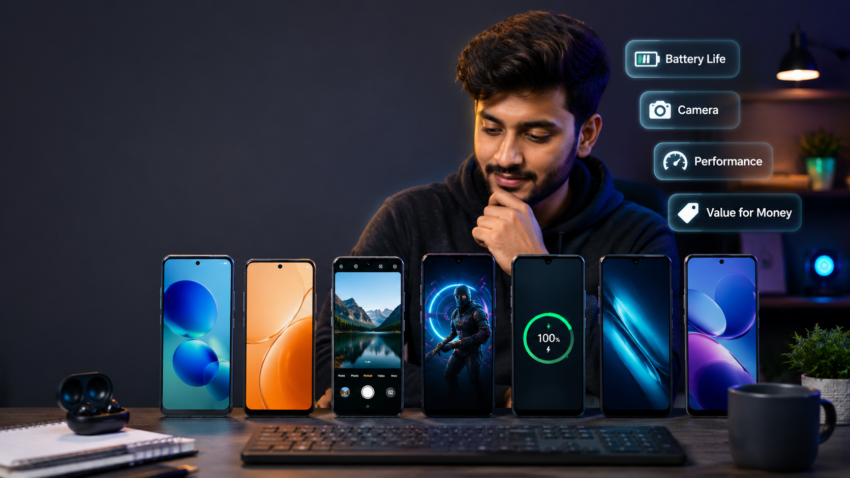
A few years ago, buying a budget smartphone meant accepting blurry cameras, laggy performance, and a battery that barely made it through lunch. That’s no longer the case. The best budget smartphones in 2026 have genuinely closed the gap with mid-range and even some flagship devices and for most people’s daily routines, you honestly won’t feel like you’re missing much.
Whether you’re a student watching your spending, someone who just needs a reliable daily driver, or a parent buying a first phone for their kid, there’s never been a better time to go affordable. This isn’t about settling. It’s about spending smart.
We put seven of the most talked-about affordable smartphones through real-world testing not just spec-sheet reading to help you figure out which one actually fits your life.
How We Selected and Tested These Phones
We didn’t just read the specs. Each phone on this list was used daily for at least two weeks. Here’s what we looked at:
- Performance: App loading speed, multitasking with 10+ open apps, gaming sessions, and general day-to-day smoothness
- Camera: Indoor shots, low-light photos, selfies, and video — because specs like “108MP” mean nothing if the photos look washed out
- Battery life: Real screen-on time across mixed usage (social media, video, calls, maps)
- Display: Colour accuracy, brightness under sunlight, refresh rate feel in daily scrolling
- Software experience: How clean the UI is, how much bloatware comes pre-installed, and how long software support lasts
- Value for money: Does the total package justify the price?
No phone on this list costs more than ₹20,000 (roughly $240), and every one of them earned its spot for a specific reason.
Top 7 Budget Smartphones in 2026
1. Redmi Note 14 Pro – Best All-Rounder Under ₹20,000
Overview
The Redmi Note 14 Pro continues Xiaomi’s habit of quietly making phones that punch well above their price. It’s not flashy, but after two weeks of heavy use, it became the go-to recommendation for most buyers who just want a phone that works, reliably, every single day.
Key Specifications
| Feature | Details |
| Processor | MediaTek Dimensity 7200 Ultra |
| RAM / Storage | 8GB RAM / 128GB or 256GB |
| Display | 6.67″ AMOLED, 120Hz |
| Main Camera | 200MP + 8MP ultrawide |
| Battery | 5500mAh, 67W fast charging |
| OS | MIUI 15 (Android 14) |
| Price (approx.) | ₹17,999 – ₹19,999 |
Real-World Performance
Day-to-day use is smooth. Scrolling through Instagram, switching between Chrome tabs, and running WhatsApp alongside YouTube felt effortless. Gaming on titles like BGMI ran at medium-high settings without noticeable heating over 30-minute sessions. The 120Hz display makes it feel snappier than phones twice the price.
The 200MP camera sounds marketing-heavy, but the output is genuinely impressive in good light. Low-light shots are decent, not flagship-level, but definitely social-media worthy. Charging from 15% to 100% took just under 70 minutes.
The downside? MIUI continues to ship with a handful of pre-installed apps that most people won’t use. You can uninstall most of them, but it’s an annoying first step.
✅ Pros
- Excellent AMOLED display with 120Hz
- Fast 67W charging that actually works as advertised
- Consistent performance across all workloads
- Solid camera for the price range
❌ Cons
- MIUI bloatware out of the box
- No official IP rating (though it has some splash resistance)
- 256GB storage variant nudges toward ₹20,000 ceiling
🎯 Best Suited For
Everyday users who want a reliable all-rounder without any compromises in core areas.
2. Realme 13 Pro – Best Camera Phone Under ₹20,000
Overview
If camera quality is your top priority and you’re working within a budget, the Realme 13 Pro is hard to beat. It’s built around Sony’s IMX890 sensor, the same one that appears in phones costing significantly more and the results show.
Key Specifications
| Feature | Details |
| Processor | Snapdragon 6 Gen 1 |
| RAM / Storage | 8GB RAM / 256GB |
| Display | 6.7″ AMOLED, 120Hz |
| Main Camera | 50MP Sony IMX890 + 32MP portrait |
| Battery | 5000mAh, 45W fast charging |
| OS | Realme UI 5.0 (Android 14) |
| Price (approx.) | ₹18,999 |
Real-World Performance
Portrait shots are genuinely impressive, subject separation is clean, skin tones look natural rather than over-processed, and low-light performance is better than expected for this price range. The 32MP portrait lens adds real depth variety, not just a software crop.
Performance is solid for everyday tasks. It doesn’t match the Redmi Note 14 Pro in gaming headroom, but for anything short of serious mobile gaming, you won’t feel constrained. Battery life gets you comfortably through a full day with moderate use. The 45W charging is a step behind some competitors, but it’s still respectable.
One honest limitation: the ultrawide camera is weaker than the main sensor, so wide-angle shots look noticeably softer.
✅ Pros
- Sony IMX890 sensor, a rare inclusion at this price
- Natural, consistent colour processing
- Great portrait mode for the range
- Clean software with fewer ads than Xiaomi’s MIUI
❌ Cons
- Ultrawide camera quality is average
- 45W charging is slower than rivals at the same price
- Snapdragon 6 Gen 1 is capable but not exceptional for gaming
🎯 Best Suited For
Photography enthusiasts and content creators on a budget who want the best camera phone in this price range.
3. Samsung Galaxy A35 – Best for Long-Term Software Support
Overview
Samsung’s budget line gets a lot of criticism for being overpriced, and sometimes that’s fair. But the Galaxy A35 earns its spot on this list for one reason most other budget phones can’t match: four years of OS updates and five years of security patches.
Key Specifications
| Feature | Details |
| Processor | Exynos 1380 |
| RAM / Storage | 6GB or 8GB RAM / 128GB |
| Display | 6.6″ Super AMOLED, 120Hz |
| Main Camera | 50MP OIS + 8MP ultrawide + 5MP macro |
| Battery | 5000mAh, 25W charging |
| OS | One UI 6.1 (Android 14) |
| Price (approx.) | ₹19,999 |
Real-World Performance
The Exynos 1380 won’t win any benchmark competitions, but real-world performance is smooth enough for everything non-gamers throw at it. Samsung’s One UI 6.1 is polished, intuitive, and, importantly, one of the cleanest Android skins available on a budget device.
The camera does a good job in daylight, and OIS (optical image stabilisation) helps when you’re shooting videos while walking. Low-light shots are average. The 25W charging is the most glaring weakness here, in a market where competitors offer 45W and above, waiting nearly two hours for a full charge feels outdated.
The IP67 rating (dust and water resistance) is a genuine differentiator. It’s the only phone under ₹20,000 that you can drop in water briefly without panicking.
✅ Pros
- IP67 water resistance, genuinely useful
- 4 years of OS updates, 5 years of security patches
- Clean One UI software experience
- Optical image stabilisation on the main camera
❌ Cons
- 25W charging is slow for 2026
- Exynos 1380 lags behind Snapdragon/Dimensity rivals in gaming
- 128GB base storage with no 256GB option at this price
🎯 Best Suited For
Buyers who prioritise long-term value, software reliability, and water resistance over raw performance.
4. POCO X6 – Best Budget Gaming Phone
Overview
POCO’s phones exist specifically for users who want performance above everything else. The X6 delivers that with a Snapdragon processor, high refresh rate, and aggressive cooling, all at a price that makes gaming-focused mid-rangers look overpriced.
Key Specifications
| Feature | Details |
| Processor | Snapdragon 7s Gen 2 |
| RAM / Storage | 8GB / 12GB RAM + 256GB |
| Display | 6.67″ AMOLED, 120Hz |
| Main Camera | 64MP + 8MP ultrawide |
| Battery | 5100mAh, 67W fast charging |
| OS | MIUI 14 for POCO (Android 13) |
| Price (approx.) | ₹17,499 – ₹18,999 |
Real-World Performance
Gaming is where the POCO X6 separates itself from the competition. BGMI runs at HD graphics and High frame rate without breaking a sweat. Extended sessions of 45–60 minutes showed very manageable heating, far better than budget phones typically handle sustained load. The Snapdragon 7s Gen 2 has noticeably better sustained performance than the MediaTek chips found in most phones at this price.
The 12GB RAM variant especially handles aggressive multitasking well, apps stay in memory longer, reducing reload times. For non-gaming use, everything else is competent: decent camera in daylight, fast charging, good display.
Camera quality is behind the Realme 13 Pro, and low-light photography is average. But if gaming is the priority, those trade-offs are easy to accept.
✅ Pros
- Best-in-class gaming performance under ₹20,000
- 67W fast charging
- Up to 12GB RAM for smooth multitasking
- Solid sustained performance without aggressive throttling
❌ Cons
- The camera is mediocre in low light.
- MIUI/POCO UI still carries bloatware.
- Software updates are not as timely as Samsung.
🎯 Best Suited For
Mobile gamers and power users who want maximum performance without paying mid-range prices.
5. iQOO Z9 Lite – Best Battery Life Phone
Overview
If you’ve ever ended a workday at 20% battery and wished you had just a bit more headroom, the iQOO Z9 Lite was built for you. Its 6000mAh battery is one of the largest in the budget segment, and it backs it up with a processor tuned for efficiency.
Key Specifications
| Feature | Details |
| Processor | MediaTek Dimensity 6300 |
| RAM / Storage | 4GB / 6GB / 8GB RAM + 128GB |
| Display | 6.74″ IPS LCD, 90Hz |
| Main Camera | 50MP + 2MP depth |
| Battery | 6000mAh, 44W fast charging |
| OS | Funtouch OS 14 (Android 14) |
| Price (approx.) | ₹10,999 – ₹13,499 |
Real-World Performance
Two full days on a single charge with moderate usage is entirely achievable. Even heavy users, video streaming, social media, occasional gaming, will comfortably end day one above 30%. In a market where phones boast 5000mAh but still need a nightly top-up due to inefficient chips, the iQOO Z9 Lite stands out.
The trade-off is the display, an IPS LCD at 90Hz feels a step behind the AMOLED screens on competing phones. Colours are decent but not vivid. The camera is functional for everyday photos but shouldn’t be your top pick if you care about image quality.
For its primary purpose, staying alive when other phones give up, it does exactly what it promises.
✅ Pros
- 6000mAh battery, genuinely impressive endurance
- 44W charging keeps refuelling time short
- Lightweight design for a large-battery phone
- Excellent value at under ₹14,000
❌ Cons
- IPS LCD display, not AMOLED
- 90Hz, lower than most competitors at this price
- Camera is strictly average
🎯 Best Suited For
Heavy users, travellers, field workers, and anyone who can’t afford to hunt for a charger mid-day.
6. Motorola Moto G85 – Best Software Experience on a Budget
Overview
Motorola doesn’t get enough credit for how clean its Android skin is. The Moto G85 runs near-stock Android, ships with almost no bloatware, and gets timely updates, a combination that’s surprisingly rare in the budget segment.
Key Specifications
| Feature | Details |
| Processor | Snapdragon 6s Gen 3 |
| RAM / Storage | 8GB / 12GB RAM + 256GB |
| Display | 6.67″ pOLED, 120Hz |
| Main Camera | 50MP OIS + 8MP ultrawide |
| Battery | 5000mAh, 33W charging |
| OS | Android 14 (near-stock) |
| Price (approx.) | ₹16,999 – ₹18,999 |
Real-World Performance
Using the Moto G85 feels like using a phone that respects your time. No pop-up ads in the settings, no aggressive notifications from pre-installed apps, no confusing UI changes that clash with standard Android behaviour. If you’ve come from a Samsung or Xiaomi device, the first hour with Moto’s software feels refreshingly simple.
The pOLED display is sharp and vivid, Motorola’s panel choice here is a genuine quality step up from what most budget phones offer. OIS on the main camera makes handheld video stable and helps with sharper shots in tricky lighting.
The 33W charging is the weakest point, it’s noticeably slower than the 45W–67W found on rivals. And while performance is solid, it’s not quite at the level of the POCO X6 for gaming.
✅ Pros
- Near-stock Android — clean, fast, and ad-free
- OIS on the main camera
- Excellent pOLED display quality
- Solid build with a premium feel for the price
❌ Cons
- 33W charging is slower than competitors
- Snapdragon 6s Gen 3 struggles with demanding games
- Software updates promised for only 2 years of OS
🎯 Best Suited For
Users who prioritise a clean, clutter-free software experience and want a reliable phone that doesn’t try to sell them things from the settings menu.
7. OnePlus Nord CE 4 Lite – Best Value for Money
Overview
OnePlus has always had a knack for pricing phones just right. The Nord CE 4 Lite doesn’t do any one thing better than every competitor, but it balances everything well, performance, camera, battery, and software, in a way that makes it hard to argue against at its price.
Key Specifications
| Feature | Details |
| Processor | Snapdragon 695 |
| RAM / Storage | 8GB RAM + 128GB / 256GB |
| Display | 6.67″ AMOLED, 120Hz |
| Main Camera | 50MP OIS + 2MP depth |
| Battery | 5110mAh, 80W SUPERVOOC |
| OS | OxygenOS 14 (Android 14) |
| Price (approx.) | ₹14,999 – ₹16,999 |
Real-World Performance
The headline feature is 80W fast charging, the fastest on this list and genuinely impressive for a phone under ₹17,000. Going from 10% to 100% takes about 45 minutes. That kind of charging speed changes your daily routine in small but meaningful ways, a quick 20-minute plug-in while you have coffee is enough to last another half day.
OxygenOS has drifted away from its “clean Android” roots in recent years, but it’s still better than most budget phone software. The Snapdragon 695 handles daily tasks and casual gaming smoothly, though it’s behind Dimensity 7200 Ultra in sustained gaming performance.
The camera is solid in daylight but struggles after dark. Battery life is good but not quite in iQOO Z9 Lite territory. The AMOLED 120Hz display is sharp and colourful, one of the better screens at this price point.
✅ Pros
- 80W SUPERVOOC charging — the fastest under ₹20,000
- AMOLED 120Hz display
- OIS on the main camera
- Clean-ish OxygenOS experience
❌ Cons
- Low-light camera performance is underwhelming
- Only 2MP depth camera as a secondary sensor
- OxygenOS has become more bloat-y in recent versions
🎯 Best Suited For
Buyers who want the best all-round package at the most competitive price, especially if fast charging matters to them.
Best Budget Phone for Different Users
🎮 Best Budget Gaming Phone
POCO X6 — Snapdragon 7s Gen 2, up to 12GB RAM, and proper thermal management make it the clear winner for mobile gamers under ₹20,000.
📷 Best Camera Phone in the Budget Range
Realme 13 Pro — The Sony IMX890 sensor at this price is a significant achievement. Portrait shots and overall colour accuracy are a step ahead of the competition.
🔋 Best Long Battery Budget Phone
iQOO Z9 Lite — A 6000mAh battery with a power-efficient chip means this phone will outlast every other device on this list, full stop.
🎓 Best Budget Phone for Students
OnePlus Nord CE 4 Lite — 80W charging solves the “forgot to plug in at night” problem, the display is great for study and Netflix, and the price leaves room in the budget for other essentials.
💰 Best Overall Value for Money
Redmi Note 14 Pro — An AMOLED 120Hz display, 200MP camera, 67W charging, and consistent performance in one package at under ₹20,000. For most buyers, this is the one to beat.
And if you’re open to stretching your budget even further, it’s also worth considering the refurbished market. We’ve put together an honest guide on when buying refurbished gadgets actually makes sense and when it doesn’t, that’s worth a read before you decide.
Things to Check Before Buying a Budget Smartphone
Before you add anything to your cart, here are a few practical things that spec sheets often bury or skip entirely:
1. Check the actual software update promise: Some brands offer “2 years of OS updates” while others (like Samsung on the A35) promise four. If you’re keeping a phone for 3+ years, this matters a lot.
2. Confirm 5G band compatibility with your carrier: Not every 5G phone supports the same bands. A phone that says “5G” might not support your carrier’s specific network frequencies. Check before buying — this is especially relevant in India, where Jio and Airtel use different bands.
3. Look at long-term user reviews, not just launch reviews: Launch-week reviews cover new phones when they’re at peak performance. Look for reviews from users 6–12 months after purchase to understand how the device ages.
4. Storage type matters more than capacity: UFS 2.2 storage is faster than eMMC. A phone with 128GB UFS 2.2 will feel snappier than one with 256GB eMMC. Check this in the spec sheets.
5. Don’t be fooled by high megapixel counts alone: A 200MP camera with a small sensor can still lose to a 50MP camera with a larger, better-quality sensor. Sensor size and aperture often matter more than megapixel count.
6. Check if the display uses PWM dimming: Some AMOLED displays cause eye strain at low brightness due to PWM flickering. If you’re sensitive to this, look for phones with DC dimming support or higher PWM frequency.
7. Confirm whether the phone has expandable storage: Several budget phones in 2026 have dropped the microSD slot. If you store a lot of photos or offline videos, this is worth checking before purchase.
Final Verdict: Which Budget Phone Should You Buy?
There’s no single “best” budget smartphone; it depends on what matters most to you. Here’s a quick summary to help you decide:
| Your Priority | Our Pick |
| Best overall daily driver | Redmi Note 14 Pro |
| Best camera for the price | Realme 13 Pro |
| Best gaming performance | POCO X6 |
| Best battery endurance | iQOO Z9 Lite |
| Best clean software | Motorola Moto G85 |
| Best long-term reliability | Samsung Galaxy A35 |
| Best value for money | OnePlus Nord CE 4 Lite |
The budget smartphone market in 2026 is genuinely impressive. You no longer need to spend ₹30,000–₹40,000 to get a smooth display, a capable camera, or a phone that lasts two days on a charge. All seven phones on this list do at least one thing exceptionally well, and most of them handle the basics better than phones from the mid-range segment just three years ago.
Pick based on your real habits, not just the spec that looks best in a table. The best budget phone for you is the one that fits how you actually use a device every day.

Harry S is a digital marketing expert with 19+ years of experience. He created Reviews-4u.com to share simple, research-backed product insights that help users make better buying decisions.