
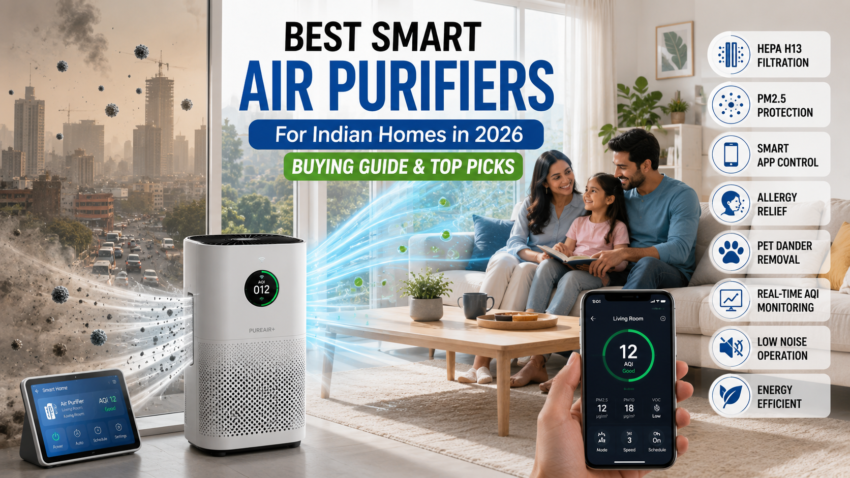
If you live in Delhi, Mumbai, Bengaluru, or any major Indian city, you already know what bad air days feel like. Eyes watering, a persistent cough, or that dusty haze that refuses to clear even indoors, these are not just inconveniences. They are health problems.
India consistently ranks among the countries with the worst air quality in the world. PM2.5 levels in cities like Delhi routinely cross 200–300 µg/m³ during winter, against the safe limit of 60 µg/m³ set by India’s CPCB. And this is outdoor air. What many people don’t realise is that indoor air can actually be two to five times more polluted than outside.
Common indoor pollutants in Indian homes include fine dust particles, PM2.5 from vehicle exhaust seeping in, cooking smoke, pet dander, pollen during seasonal changes, mould spores during the monsoon, and VOCs (volatile organic compounds) from paints, cleaning products, and furniture.
This is where air purifiers come in, and in 2026, the smart versions offer something older models couldn’t: real-time monitoring, app control, and auto-adjustment based on actual air quality in your room.
What Is a Smart Air Purifier?
A smart air purifier is a device that filters indoor air continuously and connects to your smartphone or smart home system for remote monitoring and control.
How it works:
Air is drawn into the device using a fan. It passes through multiple filter layers. The cleaned air is then pushed back into the room.
Typical filter stages:
- Pre-filter – Captures large particles like hair, dust, and pet fur
- HEPA filter (H13 grade) – Captures 99.97% of particles as small as 0.3 microns, including PM2.5, pollen, and bacteria
- Activated carbon filter – Absorbs odours, smoke, cooking fumes, and VOCs
Smart features typically include:
- Real-time AQI display on device and app
- Auto mode that adjusts fan speed based on air quality
- Scheduling (set timers for specific hours)
- Filter life tracking
- Voice assistant compatibility (Alexa, Google Home)
- Child lock
Why Indian Homes Need Air Purifiers in 2026
Urban Pollution Has Only Gotten Worse
Despite government initiatives, vehicular emissions, construction dust, and industrial activity continue to push PM2.5 levels to dangerous highs across Indian metros. Even smaller cities like Patna, Lucknow, and Indore are now among the most polluted globally.
Construction Dust Is Constant
With infrastructure development happening across the country, fine silica and cement dust regularly enters homes, even through sealed windows.
Seasonal Allergies Are Increasing
Changing weather patterns have extended the pollen season. More people now experience allergic rhinitis, sneezing, and wheezing for longer parts of the year.
Winter Air Quality Is Especially Bad
From October to February, temperature inversions trap pollutants near ground level. Delhi-NCR sees AQI readings well into the “Severe” category during these months. Even cities like Hyderabad and Kolkata see significant deterioration.
Indoor Pollutants Are Overlooked
Cooking on gas stoves generates nitrogen dioxide and fine particles. Incense sticks and agarbattis release particulates. Mosquito repellent coils, synthetic room fresheners, and off-gassing from new furniture all add to indoor pollution.
Benefits of Using a Smart Air Purifier
- Cleaner breathing air – Consistent filtration removes PM2.5, allergens, and bacteria.
- Reduced allergy and asthma symptoms – Particularly useful for those sensitive to dust mites and pollen.
- Better sleep – Cleaner air and quieter operation (on sleep mode) improves sleep quality.
- Odour control – Cooking smells, pet odour, and stale air are absorbed by the carbon filter.
- Healthier environment for children and seniors – Their immune systems are more vulnerable to airborne pollutants.
- Real-time awareness – Know exactly when your air quality is dropping and act on it.
Best Smart Air Purifiers for Indian Homes in 2026
Here are seven carefully selected models across different budgets and room sizes.
1. Philips AC2887/20
Room Size: Up to 409 sq ft
CADR: 333 m³/h
Filter Type: VitaShield IPS (3-layer HEPA + activated carbon)
Smart Features: AeraSense sensor, auto purification, compatible with Philips app
Noise Level: 33–65 dB
Pros:
- Reliable HEPA filtration, trusted brand
- AeraSense technology gives real-time air quality feedback
- Compact design fits most Indian rooms
Cons:
- App connectivity is basic compared to competitors
- Filter replacement cost is on the higher side (~₹2,500–3,000 per filter)
Best For: Mid-sized bedrooms and living rooms in polluted cities.
2. Xiaomi Smart Air Purifier 4 Pro
Room Size: Up to 600 sq ft
CADR: 500 m³/h
Filter Type: True HEPA + activated carbon composite
Smart Features: Mi Home app, Alexa and Google Home support, OLED display
Noise Level: 16.2–64.7 dB
Pros:
- One of the best CADR ratings in its price range (~₹12,000–14,000).
- Excellent app control and smart home integration.
- Very quiet on sleep mode.
Cons:
- Filter replacement can be tricky to source in smaller cities.
- Build quality feels slightly plastic-heavy.
Best For: Budget-to-mid-range buyers, smart home users, larger bedrooms.
3. Dyson Purifier Hot+Cool HP07
Room Size: Whole-room purification (up to ~800 sq ft with projection)
CADR: 290 m³/h (purification), also heats and cools
Filter Type: HEPA H13 + activated carbon (sealed system)
Smart Features: Dyson Link app, Alexa/Siri/Google, auto mode, real-time reporting
Noise Level: 36–62 dB
Pros:
- Three-in-one: purifier, heater, and fan
- Fully sealed HEPA system ensures no air bypasses the filter
- Outstanding app and data reporting
Cons:
- Very expensive (~₹50,000–65,000)
- CADR is relatively modest for the price
- Replacement filters cost ~₹4,500–5,000
Best For: Premium buyers wanting an all-season appliance; allergy sufferers who need reliable filtration
4. Honeywell Air Touch i9 (HAC35M2AQW)
Room Size: Up to 388 sq ft
CADR: 300 m³/h
Filter Type: HEPA + Pre-filter + Ionizer
Smart Features: Honeywell app, auto mode, AQI indicator
Noise Level: 25–55 dB
Pros:
- Widely available across India, easy service network
- Solid performance at a reasonable price (~₹10,000–13,000)
- AQI indicator is clearly visible
Cons:
- No voice assistant integration
- Ionizer can produce trace ozone (can be turned off)
Best For: Families, bedrooms, value-for-money buyers
5. Coway Airmega AP-1512HH (Mighty)
Room Size: Up to 360 sq ft
CADR: 246 m³/h
Filter Type: True HEPA + activated carbon
Smart Features: Air quality indicator LED, auto mode (no app version in base model)
Noise Level: 24.4–53.8 dB
Pros:
- Compact and efficient
- Very quiet on low settings
- Filter replacement reminder built in
Cons:
- No Wi-Fi or app connectivity in the base model
- CADR is lower than Xiaomi at a similar price
Best For: Small bedrooms, home offices, those who prefer simple controls over smart features
6. Sharp FP-J80M-W
Room Size: Up to 46 m² (approx. 495 sq ft)
CADR: ~320 m³/h
Filter Type: True HEPA H14 + Plasmacluster Ion Technology + carbon
Smart Features: Auto mode, Plasmacluster ion emission, app control (newer models)
Noise Level: 18–49 dB
Pros:
- Plasmacluster technology also reduces surface bacteria and mould
- Very quiet
- Strong performance during monsoon season (mould and humidity-related odours)
Cons:
- Less mainstream, harder to find in smaller towns
- Plasmacluster cartridge requires periodic replacement
Best For: Monsoon-heavy regions, homes with humidity issues, families with children
7. Blueair Blue Pure 411i Max
Room Size: Up to 46 m² (~495 sq ft)
CADR: 190 m³/h
Filter Type: HEPASilent + fabric pre-filter + carbon
Smart Features: Blueair app, auto mode, real-time PM2.5 display
Noise Level: 17–46 dB
Pros:
- HEPASilent technology combines mechanical and electrostatic filtration
- One of the quietest units available
- Fabric pre-filter is washable, reducing running costs
Cons:
- CADR is modest — best only for smaller rooms
- Higher price (~₹20,000–24,000) for the performance offered
Best For: Light sleepers, small bedrooms, noise-sensitive users
Comparison Table
| Model | Room Size | CADR | HEPA Filter | Smart App | Noise Level | Best For |
| Philips AC2887/20 | ~409 sq ft | 333 m³/h | Yes (IPS) | Yes | 33–65 dB | Bedrooms, city pollution |
| Xiaomi Smart 4 Pro | ~600 sq ft | 500 m³/h | Yes (True HEPA) | Yes | 16–65 dB | Budget buyers, smart homes |
| Dyson HP07 | ~800 sq ft | 290 m³/h | Yes (H13, sealed) | Yes | 36–62 dB | Premium, all-season use |
| Honeywell i9 | ~388 sq ft | 300 m³/h | Yes | Yes | 25–55 dB | Families, value buyers |
| Coway AP-1512HH | ~360 sq ft | 246 m³/h | Yes (True HEPA) | No | 24–54 dB | Small rooms, simple use |
| Sharp FP-J80M-W | ~495 sq ft | ~320 m³/h | Yes (H14) | Partial | 18–49 dB | Monsoon regions, mould control |
| Blueair 411i Max | ~495 sq ft | 190 m³/h | Yes (HEPASilent) | Yes | 17–46 dB | Light sleepers, small rooms |
How to Choose the Right Air Purifier
1. Room Size
Always match the purifier’s rated coverage to your room. A unit meant for 200 sq ft will struggle in a 400 sq ft living room. Add 20% buffer — if your room is 350 sq ft, buy a unit rated for at least 420 sq ft.
2. CADR Rating
CADR (Clean Air Delivery Rate) tells you how quickly a purifier cleans a given volume of air. Higher is better. For a standard Indian bedroom (~150–200 sq ft), look for at least 200 m³/h. For living rooms, aim for 300+ m³/h.
3. HEPA Certification
Look for H13 or H14 True HEPA. Avoid vague terms like “HEPA-type” or “HEPA-like” — these are not the same thing and filter far less efficiently.
4. Filter Replacement Cost
Factor this into your budget. A cheap unit with expensive filters can cost more in the long run. Most good HEPA filters need replacement every 6–12 months.
5. Smart Features
If you want app control, scheduling, or smart home integration, confirm the model has these. Some entry-level models have AQI displays but no app.
6. Energy Consumption
Most air purifiers use 30–80W, which is relatively low. But since they run continuously, check the wattage. We cover this in detail below.
7. Noise Level
Anything below 35 dB is suitable for a bedroom. Above 50 dB will be noticeable and disruptive at night.
Air Purifier vs Air Conditioner
This is one of the most common misconceptions. Many people assume their split AC with a dust filter is enough. It is not.
An AC’s job: To cool or heat air by circulating the same indoor air and adjusting its temperature. The filter in an AC only catches large dust particles to protect the internal coil — it is not designed for fine particulates.
An air purifier’s job: To remove PM2.5, allergens, bacteria, volatile compounds, and odours from the air you breathe.
Running an AC does not improve your air quality in any meaningful way for health purposes. In fact, dirty AC filters can become a source of mould and bacteria themselves.
You need both. An AC for thermal comfort, an air purifier for clean air.
Running an AC does not improve your air quality in any meaningful way for health purposes. If you are evaluating which type of AC is worth buying for your home, our guide on inverter AC vs non-inverter AC covers the cost and efficiency differences in detail.
Common Mistakes People Make When Buying Air Purifiers
Buying an undersized unit. A 150 sq ft rated purifier in a 300 sq ft room will run constantly but never clean the air properly.
Ignoring filter replacement costs. Some brands offer affordable devices but charge heavily for replacement filters. Always calculate the annual maintenance cost before buying.
Not checking CADR. Marketing terms like “360-degree purification” mean nothing without a CADR figure. Always compare numbers.
Choosing only by brand. A well-known brand does not guarantee the right product for your space. Check specifications.
Poor placement. Putting a purifier in a corner, behind furniture, or next to a wall restricts airflow. It should be placed in the open, ideally near the centre of the room or where air circulation is highest.
Running it only when the air feels bad. Air purifiers work best when run continuously or on auto mode. The goal is prevention, not reaction.
How Much Electricity Does an Air Purifier Consume?
Most air purifiers in India consume between 30W and 80W depending on fan speed.
Estimated monthly cost (running 12 hours/day):
| Power | Daily Use | Monthly Units | Monthly Cost (₹8/unit) |
| 30W | 12 hrs | 10.8 kWh | ~₹86 |
| 55W | 12 hrs | 19.8 kWh | ~₹158 |
| 80W | 12 hrs | 28.8 kWh | ~₹230 |
This is significantly lower than an AC (1,500–2,000W), a geyser (2,000W), or even a ceiling fan running all day. Running an air purifier around the clock costs roughly ₹100–250 per month in electricity — far less than what bad air costs in medical bills.
Are Smart Air Purifiers Worth the Money?
Yes, in most cases — with some context.
For urban Indian households dealing with PM2.5 pollution, regular dust, pet dander, or allergy symptoms, a good air purifier delivers real, measurable health benefits. Children and elderly family members benefit especially.
The smart features app control, real-time AQI monitoring, auto mode are genuinely useful. Auto mode alone means the purifier ramps up when pollution rises and stays quiet at night, saving energy and extending filter life.
If budget is genuinely tight, it is also worth reading our guide on buying refurbished electronics the same logic about long-term value vs upfront cost applies when shopping for home appliances.
When they may not be necessary:
- If you live in a rural or low-pollution area with genuinely clean air
- If your home has excellent ventilation and air quality is rarely an issue
- If budget is extremely tight — in that case, a basic non-smart HEPA purifier still does the core job
The higher the city’s pollution levels and the more vulnerable the occupants (children, seniors, people with asthma), the more value an air purifier delivers.
Best Air Purifier for Different Needs
For bedrooms: Xiaomi Smart 4 Pro or Coway AP-1512HH — quiet, efficient, right-sized
For large living rooms: Xiaomi Smart 4 Pro or Sharp FP-J80M-W — higher CADR handles larger spaces
For homes with pets: Philips AC2887/20 or Dyson HP07 — carbon filter handles pet odours well
For allergy sufferers: Dyson HP07 or Blueair 411i Max — sealed HEPA systems with the least chance of air bypass
For budget buyers: Xiaomi Smart 4 Pro or Honeywell i9 — strong performance at ₹10,000–14,000
For smart home users: Xiaomi Smart 4 Pro or Dyson HP07 — best app ecosystems and voice assistant support
Final Verdict
There is no single “best” air purifier for every Indian home. The right choice depends on your room size, pollution levels, budget, and specific needs.
- Under ₹15,000 with smart features: Xiaomi Smart Air Purifier 4 Pro is the strongest all-rounder
- Mid-range, reliable brand: Philips AC2887/20 or Honeywell i9 are dependable and widely serviced
- Premium, all-in-one: Dyson HP07 if budget allows and you want heating and cooling too
- Quietest option: Blueair 411i Max for sensitive sleepers
- Monsoon and mould concerns: Sharp FP-J80M-W with Plasmacluster technology
Whatever you choose, invest in a unit with a True HEPA filter, a CADR suited to your room size, and reasonable filter replacement costs. That combination will do more for your family’s health than any feature on a spec sheet.
FAQ: Smart Air Purifiers in India
Do air purifiers really work?
Yes. Independent studies and real-world testing consistently show that HEPA air purifiers reduce indoor PM2.5, allergens, and bacteria. They will not eliminate all pollutants, but they significantly reduce your exposure.
Which air purifier is best for Indian cities?
For high-pollution cities like Delhi, Lucknow, or Kanpur, look for a unit with a CADR above 300 m³/h and a True HEPA H13 filter. Xiaomi Smart 4 Pro and Philips AC2887/20 are solid choices.
Is a HEPA filter necessary?
Yes. HEPA filtration is the most effective method for capturing fine particles. H13 True HEPA is the standard to look for. Anything described as “HEPA-type” is not the same and should be avoided.
Can an air purifier remove dust completely?
No. It will significantly reduce airborne dust particles, but dust that has already settled on surfaces will not be removed. Combine regular cleaning with your purifier for best results.
How often should filters be replaced?
Most HEPA filters last 6–12 months depending on usage and pollution levels. In heavily polluted cities or homes with pets, expect to replace every 6 months. The purifier’s app or indicator light will usually notify you.
Are air purifiers safe for babies?
Yes — in fact, they are particularly beneficial for infants and young children whose lungs are still developing. Keep the purifier out of reach, avoid units with ionisers (which can produce trace ozone), and choose one with a quiet sleep mode.
Can I run an air purifier all day?
Yes, and it is recommended. Air purifiers are designed for continuous operation. Running it on auto mode is the most efficient approach — it adjusts fan speed to actual air quality and conserves energy when air is clean.
What size air purifier do I need?
Match the purifier’s coverage area to your room. For a standard Indian bedroom (150–200 sq ft), a unit rated for 200–300 sq ft is appropriate. For a living room (300–400 sq ft), look for 400–500 sq ft rated coverage. When in doubt, go slightly larger.
Is there any difference between an air purifier and an ioniser?
Yes. An air purifier physically filters air through a HEPA filter. An ioniser releases charged ions that cause particles to clump together and fall, but does not remove them — and can produce ozone. Most quality air purifiers include HEPA filtration as the primary mechanism.
Do I need an air purifier if I already have an AC?
Yes. An AC only recirculates and cools the same indoor air — its dust filter is minimal and not designed for health purposes. An air purifier actively removes fine pollutants from that air. The two serve different purposes and complement each other.

Harry S is a digital marketing expert with 19+ years of experience. He created Reviews-4u.com to share simple, research-backed product insights that help users make better buying decisions.