
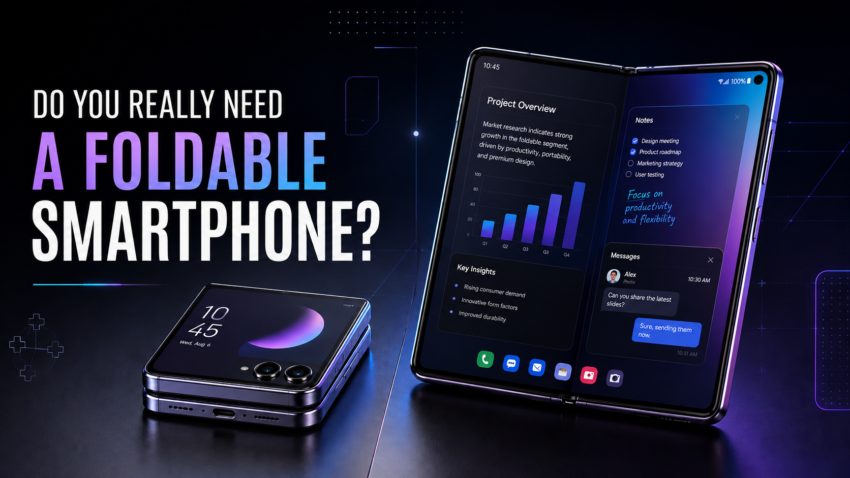
Foldables just had their most confident year yet. Samsung’s July 2026 Unpacked introduced three new folding phones in a single event, Motorola’s Razr Fold has been selling steadily in India since May, and Google’s Pixel 11 Pro Fold is arriving this month. The awkward hinges, obvious creases, and short battery life that defined the first few years of this category have mostly been engineered away.
So the real question isn’t “do foldables work now?” anymore. It’s simpler, and harder: do you really need a foldable smartphone, or are you buying one because the technology finally caught up to the marketing?
A foldable can be genuinely excellent hardware and still be the wrong purchase for you. This guide walks through what these phones actually do well, where they still ask you to compromise, and how to tell which side of that line you fall on.
What Makes a Foldable Smartphone Different?
Foldables come in two shapes, and they solve two different problems.
Flip-style foldables — the Samsung Galaxy Z Flip series and Motorola’s Razr line are the clearest examples — fold top to bottom into something that fits a jacket pocket easily. Open, you get a regular-sized phone screen. Closed, a cover display handles notifications, camera previews, and quick replies without opening the phone at all.
Book-style foldables — Samsung’s Galaxy Z Fold series and Google’s Pixel Fold line represent this format, opening sideways like a small book. The outer screen behaves like a normal phone. Unfold it, and you get a tablet-sized display that’s genuinely useful for documents, spreadsheets, video, and running two apps side by side.
Neither format is objectively better than the other. One trades screen size for portability; the other does the opposite. That distinction matters more than any spec sheet comparison between individual models.
The Real Benefits of a Foldable Phone
The honest case for a foldable comes down to a handful of practical wins, not the novelty of the hinge itself.
More screen without a second device. A book-style fold gives you tablet-sized space for reading, spreadsheets, and email without carrying a tablet alongside your phone. For a business professional catching up on documents during a commute, or a student annotating PDFs between classes, that’s a real, daily difference rather than a demo-room party trick.
Genuine multitasking. Running two apps side by side a browser next to a messaging app, or a spreadsheet next to email- works properly on a larger inner display in a way it simply doesn’t on a regular phone screen.
Compactness, if you go flip-style. A folded Z Flip or Razr takes up less pocket or bag space than any regular flagship, which matters if you travel light or dislike a phone-shaped bulge in a jacket pocket.
Flexible framing for photos and video. Flex modes let you prop the phone at an angle for hands-free video calls, group shots, or tripod-free selfies genuinely handy for frequent travellers and anyone who shoots a lot of casual video.
Where Foldable Phones Still Compromise
This is the part marketing tends to skip, so it’s worth being direct about it.
Price. Foldables still sit above conventional flagships. Motorola’s Razr Fold launched in India at ₹1,49,999, well past what most buyers would spend on a slab phone with comparable everyday performance, as our Samsung Galaxy S26 series review covers in more detail.
Durability. Samsung’s newest Z Fold and Z Flip models carry an IP48 rating — full protection against water immersion, but only partial protection against dust, since the rating covers particles larger than 1mm rather than fine sand or grit. That’s not a Samsung-specific gap either; every major book-style foldable currently on the market shares the same limitation, because a hinge that has to physically open and close hundreds of thousands of times can’t be sealed the way a regular phone’s body can.
Crease. Newer internal reinforcement layers have made the fold line less visible and less noticeable under a finger than on early foldables, but it hasn’t disappeared entirely.
Battery life. Powering a larger internal display inside a slim, foldable body involves real efficiency trade-offs. Foldables generally don’t match a similarly priced conventional flagship’s screen-on time.
Weight and thickness. Some models have gotten genuinely light; Samsung’s latest Fold is now close to typical flagship weight, but book-style foldables remain thicker when folded than a regular phone.
Cameras. Don’t assume the most expensive foldable automatically has the best camera system; that budget usually goes toward the hinge and display first. Our best camera phones in India guide makes this gap clear when comparing foldables against dedicated camera-first flagships.
Repairs. A cracked internal display or a damaged hinge is a more expensive, more specialised repair than a standard phone screen. Manufacturers rate hinges for a large number of fold cycles under lab conditions, but that’s a tested figure, not a guarantee of real-world lifespan.
Foldable Phone vs Normal Flagship: Which Makes More Sense?
| Factor | Foldable Smartphone | Conventional Flagship |
| Screen flexibility | Excellent | Good |
| Multitasking | Excellent | Good |
| Portability | Depends on design | Excellent |
| Durability | Improving | Generally simpler |
| Battery efficiency | Varies | Generally better |
| Camera value | Varies | Often stronger |
| Repair complexity | Higher | Usually lower |
| Price | Higher | Wider range |
| Productivity | Excellent | Good |
| Novelty | High | Low |
These are general tendencies, not fixed rules. Individual models close these gaps in different ways, so it’s worth checking the specific phone you’re considering rather than judging the whole category at once.
Who Should Actually Buy a Foldable Phone?
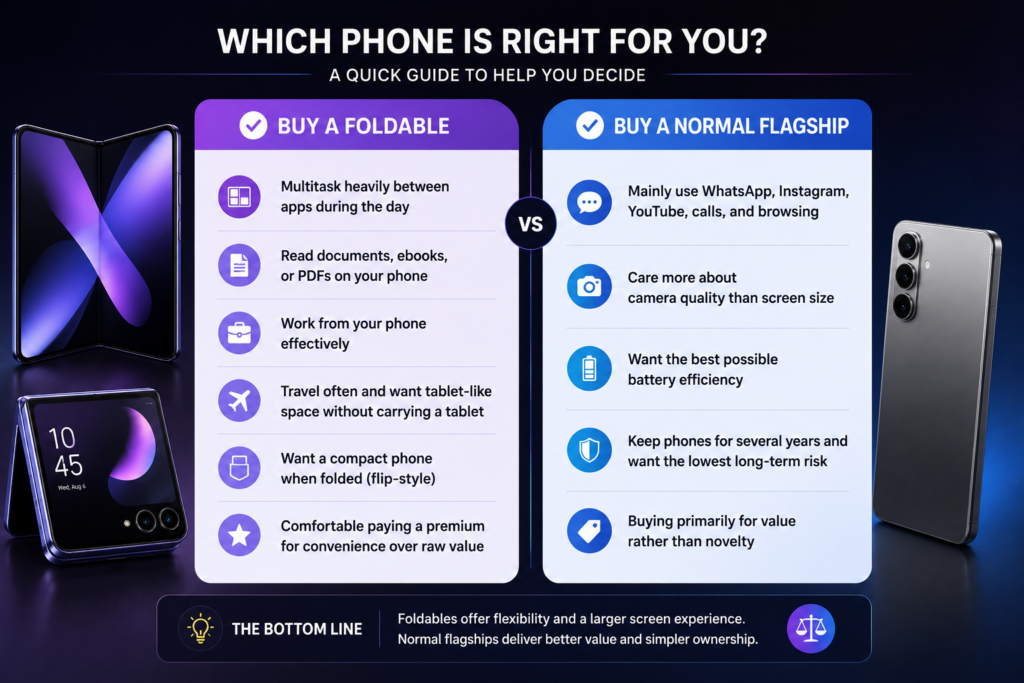
A foldable earns its price if you:
- Multitask heavily between apps during the day
- Read documents, ebooks, or PDFs on your phone regularly
- Effectively work from your phone rather than a laptop
- Travel often and want tablet-like space without carrying a tablet
- Want a genuinely compact phone when folded (flip-style)
- Are comfortable paying a premium for convenience over raw value
If two or more of these describe your actual daily habits, not just how you imagine using the phone, a foldable is worth serious consideration.
Who Should NOT Buy a Foldable Phone?
A conventional flagship makes more sense if you:
- Mainly use WhatsApp, Instagram, YouTube, calls, and browsing
- Care more about camera quality than screen size
- Want the best possible battery efficiency
- Keep phones for several years and want the lowest long-term risk
- Are buying primarily for value rather than novelty
Wanting a foldable and needing one are two different things, and it’s worth being honest with yourself about which one is actually driving the decision. If it’s mostly the latter, our guide to the best budget smartphones in 2026 is a more sensible place to start.
Are Foldable Phones Worth It in 2026?
Foldables have clearly moved past the first-generation gimmick stage. Samsung’s July 2026 lineup, Motorola’s Razr Fold doing steady business in India, and Google’s Pixel 11 Pro Fold arriving this month all point to a category competing seriously on durability, battery life, and software, not just novelty.
That maturity doesn’t automatically make a foldable the right choice for everyone, though. The core trade-offs price, hinge durability, camera focus, and repair cost – haven’t disappeared. They’ve simply gotten smaller and easier to live with, which is a genuinely different thing from being solved.
The Simple Test: Do You Need a Foldable?
Buy a foldable if: “I will regularly use the larger screen or the compact folded design, not just occasionally.”
Buy a normal flagship if: “I mainly want the best conventional smartphone experience for the money.”
If you have to think hard about which one applies to you, that’s usually your answer.
Conclusion
Most people don’t technically need a foldable smartphone. Screens fold, prices go up, and everyday use is still comfortably served by a well-specced conventional flagship. Our iPhone 18 vs Pixel 11 comparison is worth a look if that’s the phone you end up buying instead.
That doesn’t make foldables pointless. For someone who genuinely multitasks, reads documents constantly, or wants a phone that disappears into a pocket, the larger screen or the compact form factor can change how the phone actually gets used day to day, not just how it looks in hand.
Before you spend the extra money, take stock of what you actually do on your phone in a normal week, not what you imagine doing with a bigger screen. That answer will tell you more than any spec sheet.

Harry S is a digital marketing expert with 19+ years of experience. He created Reviews-4u.com to share simple, research-backed product insights that help users make better buying decisions.