
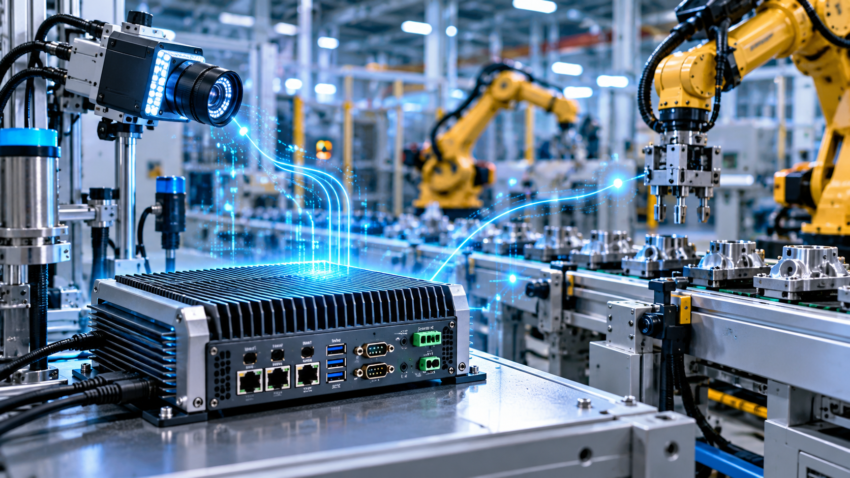
AI is moving beyond laptops, smartphones and cloud data centres. In modern factories, AI can increasingly analyse information where it is generated on production lines, near industrial cameras, sensors, machines and robots.
This is where industrial AI computers and edge AI come into play. Instead of sending every piece of data to a remote cloud server, some AI workloads can be processed locally, allowing systems to respond faster and continue operating even when connectivity is limited.
But what exactly is an industrial AI computer, and why does a smart factory need one?
What Is an Industrial AI Computer?
An industrial AI computer is a computing system designed to run AI workloads in industrial environments.
Unlike a conventional desktop or laptop, it is designed around the requirements of factories, warehouses, production facilities and other demanding environments. It can collect data from cameras, sensors and machines, process that information locally and use AI models to identify patterns, anomalies or events.
Industrial AI systems can combine computing power, AI acceleration, industrial connectivity and local processing in a system designed for long-term operation.
The important point is that an industrial AI computer is not simply a more powerful PC. It is designed for a different operating environment and purpose.
How Is an Industrial AI Computer Different From a Regular PC?
A consumer PC is generally designed for activities such as web browsing, gaming, office applications, content creation and general computing. An industrial AI computer may spend its working life analysing camera feeds, processing sensor information or supporting automated equipment.
| Feature | Industrial AI Computer | Regular Consumer PC |
| Primary use | Industrial automation and AI workloads | General computing |
| Environment | Factories and other demanding locations | Homes and offices |
| AI workloads | Local inference and real-time processing | AI, productivity and consumer applications |
| Reliability | Designed for continuous industrial operation | Designed for normal consumer use |
| Cooling | May use specialised or fanless designs | Conventional active cooling is common |
| Connectivity | Industrial interfaces and networking | Consumer-focused connectivity |
| Operating duration | Often intended for long deployments | Usually shorter product cycles |
| Applications | Vision, robotics, maintenance and automation | Work, entertainment and personal use |
This does not mean an industrial computer is always more powerful than a consumer PC. Its advantage is that the hardware, software, and physical design are intended for industrial requirements.
Why Does AI Need to Move to the Edge?
The term edge AI refers to running AI models close to where data is generated rather than relying entirely on a remote cloud server.
Consider an automated production line with cameras inspecting products:
Camera → Edge AI computer → AI analysis → Decision/action
The computer can analyse the camera feed locally and determine whether a product appears defective.
If every image had to travel to a remote cloud service before a decision could be made, network latency and connectivity could become important factors. Edge processing reduces the distance between the data source and the AI workload.
This can provide several advantages:
- Lower latency
- Reduced dependence on internet connectivity
- Lower data-transfer requirements
- Local processing of sensitive information
- Faster responses for real-time applications
Edge AI does not mean the cloud becomes unnecessary. A factory can process time-sensitive information locally while sending selected data to the cloud for larger-scale analysis, reporting or model management.
This same shift toward local AI processing is also happening in consumer computers. If you want to understand how dedicated AI hardware is changing modern laptops, see our guide to AI Laptop vs Normal Laptop.
What Can Industrial AI Computers Actually Do?
The value of industrial AI computing becomes clearer when looking at practical applications.
Machine Vision
Industrial cameras can capture images of products, components or production processes. AI models can analyse those images to identify defects, recognise objects or detect unusual conditions.
Because the analysis can happen near the production line, decisions can be made without waiting for a remote service.
Predictive Maintenance
Machines generate information through vibration, temperature, pressure, sound and other sensors.
AI can analyse this information to identify unusual patterns that may indicate developing equipment problems. Instead of relying entirely on fixed maintenance schedules, manufacturers can use these insights to investigate potential problems earlier.
Robotics
Robots increasingly need to understand their surroundings.
An edge AI computer can process information from cameras and sensors and provide the robot with information needed for tasks such as object recognition, navigation or inspection.
Low-latency processing is particularly useful when a system needs to respond quickly to changing conditions.
Automated Quality Inspection
AI-powered vision systems can inspect products continuously on a production line.
They can identify certain defects or variations and flag products that require further inspection. This can help manufacturers monitor quality at a scale that would be difficult to achieve through manual inspection alone.
Smart Warehouses
Edge AI can also support warehouse operations, including inventory monitoring, machine vision, sorting, autonomous equipment and logistics.
The common factor is that the computer is processing information close to the physical operation rather than treating the entire workload as a remote cloud application.
Worker Safety
Cameras and sensors can also be used to identify certain safety-related conditions, such as restricted-zone access or proximity between workers and equipment.
These systems can provide alerts or information to operators, although AI-based safety systems should not automatically be treated as a replacement for established safety procedures and human oversight.
What Hardware Does an Industrial AI Computer Need?
The hardware depends heavily on the workload.
An industrial AI computer may include a CPU for general computing and system control, a GPU for highly parallel workloads, and an NPU or other AI accelerator for supported AI inference tasks.
Modern edge processors increasingly integrate different compute types on the same platform. The exact combination depends on the workload and the type of AI processing required.
Other important components include:
- RAM for running applications and AI models
- Storage for operating systems, applications and local data
- Networking for connecting machines and systems
- Industrial I/O for interacting with equipment and sensors
The right combination depends on whether the system is performing computer vision, sensor analysis, robotics, predictive maintenance or another workload.
For readers interested in how AI hardware is evolving in consumer computers, our Best AI Laptops in India 2026 guide provides a useful comparison of current AI PCs and laptops.
Why Are Industrial AI Computers Built Differently?
Factories can be challenging places for computing hardware.
Equipment may need to operate continuously while dealing with heat, dust, vibration, limited space, and other environmental conditions. Some systems may also need to remain in service for many years.
This is why industrial computing systems can use specialised enclosures, industrial I/O, extended-temperature support and fanless designs.
Fanless systems can reduce the number of moving parts and may be useful where dust, maintenance or noise is a concern. However, removing a fan does not remove the need for thermal management. The system still has to dissipate the heat generated by its processor and other components.
Industrial AI hardware therefore has to balance performance, power consumption, reliability, size and thermal requirements, rather than simply maximising processing power.
Industrial AI vs Cloud AI: Which Is Better?
There is no universal winner.
| Factor | Edge / Industrial AI | Cloud AI |
| Processing location | Local device or facility | Remote data centre |
| Latency | Generally low | Depends on network connection |
| Internet dependency | Lower | Higher |
| Data handling | Can remain local | Often transferred to cloud |
| Best suited for | Real-time local decisions | Large-scale processing and analysis |
| Scalability | Limited by local hardware | Highly scalable |
For a factory, the most practical solution may be a combination of both.
An industrial computer can handle immediate inference and control-related workloads locally, while cloud infrastructure can be used for historical analysis, centralised reporting, model development or information gathered from multiple facilities.
Is Industrial AI the Future of Smart Factories?
Industrial AI is part of a broader change in how computing is being deployed.
The progression is not simply:
Cloud AI → AI PCs → Edge AI → Industrial AI
Instead, these categories increasingly overlap.
AI PCs bring local AI capabilities to consumers. Edge AI brings processing closer to devices and data sources. Industrial AI applies similar principles to physical operations where response time, reliability and integration with machines matter.
Manufacturers are increasingly applying edge AI to areas such as quality inspection, predictive maintenance, production optimisation, robotics and safety monitoring.
The technology does not mean every factory will immediately replace its existing systems. Industrial deployments have to work with existing machines, networks, software and operational technology. Reliability, integration, security, cost and long-term support can be just as important as AI performance.
Conclusion
An industrial AI computer is essentially a specialised computing system that brings AI processing closer to machines, sensors, cameras and other physical operations.
Its importance comes from more than raw computing power. By processing information locally, these systems can support faster responses, reduce dependence on constant cloud connectivity and enable AI applications such as machine vision, predictive maintenance, robotics, and automated inspection.
The future of smart manufacturing is unlikely to be completely cloud-based or completely local. Instead, factories will increasingly combine industrial computers, edge AI and cloud infrastructure, using each where it makes the most sense.
Industrial AI computers are not simply more powerful PCs. They are purpose-built systems designed to put computing intelligence closer to where real-world decisions need to happen.

Harry S is a digital marketing expert with 19+ years of experience. He created Reviews-4u.com to share simple, research-backed product insights that help users make better buying decisions.