
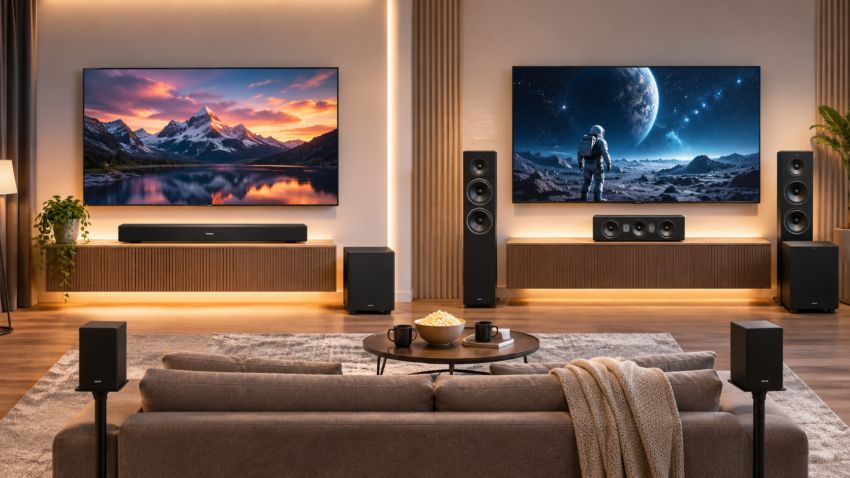
Slim TVs leave little room for proper speaker drivers. Many viewers notice it in muffled dialogue, thin bass during a cricket final and action scenes that sound flat next to the picture.
If you have already settled the screen question, our guide to understanding the differences between OLED and Mini-LED displays covers that decision. Audio is the next upgrade worth planning, because a good picture delivers only half of a good movie night.
That brings most buyers to the same question: soundbar vs home theatre. A soundbar is a single speaker unit, usually paired with a subwoofer, that sits under the TV. A home theatre system uses separate speakers placed around the room, normally driven by an AV receiver. Neither is automatically better. The right choice depends on your budget, room size, viewing habits and how much setup you are willing to do.
The short version:
- Choose a soundbar if you want a clear step up from TV speakers with minimal setup.
- Choose a home theatre system if you have space around your seating and want physical surround sound you can upgrade piece by piece.
What Is a Soundbar?
A soundbar houses several speaker drivers in one long cabinet that sits below or in front of the TV. Most connect through a single HDMI or optical cable, and many add Bluetooth or Wi-Fi for music.
Common configurations:
- 2.0: left and right channels only, a basic gain in clarity and volume.
- 2.1: adds a subwoofer for fuller bass.
- 3.1: adds a dedicated centre channel for dialogue, plus a subwoofer.
- Dolby Atmos models (such as 3.1.2 or 5.1.2): add height channels. The third number counts them.
Dolby describes two ways soundbars create that height effect. Up-firing drivers bounce sound off the ceiling, while height virtualisation uses processing instead and does not depend on ceiling reflections. Virtualised models are more flexible in awkward rooms, but they cannot fully match dedicated up-firing drivers.
Many soundbars ship with a wireless subwoofer, and some include wireless rear speakers. Virtual surround uses processing to make sound seem to arrive from beyond the bar. It can widen the soundstage, but the sound still starts at the front of the room. The real appeal is practicality: it is compact and quick to install.
What Is a Home Theatre System?
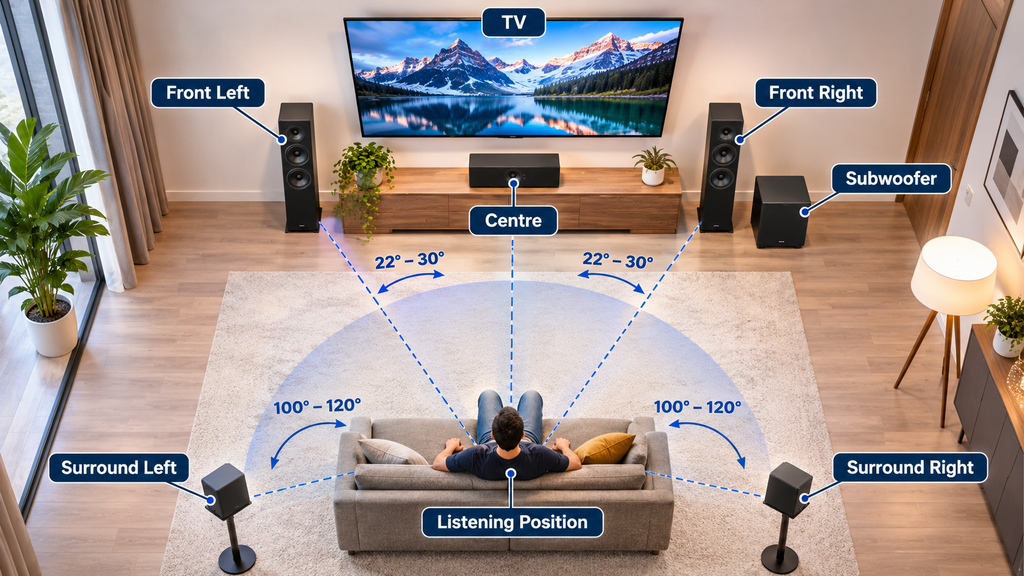
A home theatre system splits the work across several components. An AV receiver decodes the audio and powers the speakers. A centre speaker handles most dialogue, left and right speakers carry the front soundstage, surround speakers sit beside or behind you, and a subwoofer handles low frequencies.
A 5.1 layout means five speakers plus a subwoofer. A 7.1 layout adds two more surround speakers behind the seating position. Dolby Atmos versions add height speakers and are written like 5.1.2.
The main strength is physical surround sound: effects really do come from behind and beside you. The second is upgrade flexibility. You can replace the receiver, swap a speaker or add a second subwoofer later without starting over.
Modern wireless systems cut some cable runs, but wireless speakers still need power, either from a socket or a battery. There is also a middle ground. Sony India lists the HT-S20R as a 5.1-channel home cinema soundbar system: a three-channel bar, two wired rear speakers and a wired subwoofer, with 400 W total output and Dolby Digital. The line between the two categories has blurred.
Soundbar vs Home Theatre: Key Differences
| Feature | Soundbar | Home Theatre System |
| Sound quality | Clear step up from TV speakers; varies widely by model | Generally stronger, with more drivers and power; varies by setup |
| Bass performance | Built-in or wireless subwoofer, kept compact | Larger separate subwoofer, with more scope to upgrade |
| Surround sound | Mostly virtual, unless rear speakers are included | Physical speakers around the room |
| Dolby Atmos support | Selected models, via up-firing or virtualised height | Needs an Atmos-capable receiver and height speakers |
| Installation complexity | One unit, one or two cables | Receiver, several speakers, speaker cable runs |
| Space requirements | Compact; sits under the TV | Floor or stand space around the seating, plus the receiver |
| Connectivity | HDMI ARC or eARC, optical, Bluetooth, often Wi-Fi | Receiver with multiple HDMI inputs; eARC on many newer models |
| Upgrade flexibility | Limited | Component by component |
| Maintenance | Minimal | More parts and cables to manage |
| Overall cost | Lower entry price | Usually higher once every part is counted |
Sound Quality: Which One Delivers a Better Experience?
Dialogue. Speech clarity matters most for news, sports commentary, and OTT shows. A home theatre has a dedicated centre speaker. A soundbar with a centre channel (3.1 or above) narrows the gap compared with a basic 2.0 bar.
Bass. Both can include a subwoofer, but a separate home theatre subwoofer has more scope for size and placement.
Action movies and surround. This is where a properly configured home theatre generally pulls ahead. Speakers placed beside and behind you create physical surround sound, while a soundbar relies on virtual processing unless rear speakers come in the box. A premium soundbar, particularly one with rear speakers, can still deliver impressive results with far less equipment.
Music. A soundbar suits casual playlists over Bluetooth or Wi-Fi. If you listen critically, a receiver with a good pair of front speakers gives you more room to improve.
Gaming. Directional cues such as footsteps behind you are easier to place with real rear speakers.
Watt ratings and channel counts do not tell you how a system sounds. Room shape, speaker placement and the specific model matter just as much, so listen in a store if you can.
Which Audio System Is Better for Different Living Room Sizes?
- Small apartments and compact living rooms: A soundbar usually fits better. A full speaker layout can overwhelm a small room, and in flats with shared walls a large subwoofer may draw complaints.
- Medium-sized family living rooms: Either works. A 3.1 or Atmos soundbar with a wireless subwoofer suits many families. A 5.1 setup pays off if the seating area has space for speakers beside and behind the sofa.
- Large living rooms and dedicated entertainment spaces: A home theatre system is easier to scale, because you can add speakers and power as needed. A single soundbar, especially one without rear speakers, can be stretched by a large room.
Layout matters as much as size: a sofa against a wall makes rear speakers awkward.
Soundbar vs Home Theatre: Which Is More Budget-Friendly?
A soundbar generally has a lower initial cost and requires fewer additional components. A home theatre system involves several separate purchases, including an AV receiver, speakers, subwoofer, speaker cables, stands or brackets and sometimes professional installation.
Prices change often and vary widely across basic soundbars, Atmos models and receiver-based systems, so check the current price of the exact model before you decide.
Extras to budget for:
- Soundbar: a wall mount and an HDMI cable, if not included.
- Home theatre: speaker wire, stands, a longer HDMI run, a power point for each powered unit, and installation if you hire it.
Soundbar vs Home Theatre for Movies, Gaming and Music
Movies and OTT. Streaming services deliver Dolby Atmos on selected titles, and a compatible soundbar or Atmos home theatre can use it. Support depends on the title, your plan, and your device.
Sports and TV programmes. Commentary clarity is the priority. A centre channel helps on either system, and the voice or dialogue modes on many soundbars are worth trying.
Gaming consoles. Connect the console to the TV and the TV to the sound system over eARC, or connect the console to the receiver if it has HDMI inputs. HDMI.org notes that eARC matters for game sound too. If you notice lip-sync delay, look for an audio-delay setting on the TV or sound system.
Music. Casual listening suits a soundbar. Serious listening benefits from a receiver and a good pair of front speakers.
Connectivity and Compatibility With Smart TVs
Check the ports before you check the price.
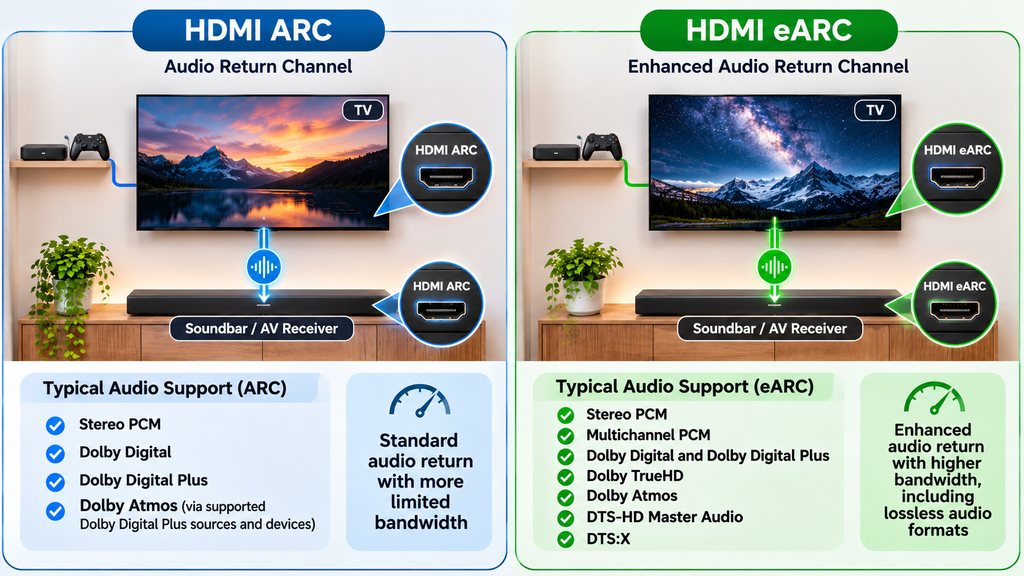
- HDMI ARC: sends audio from the TV to the sound system over one cable. Many TVs and soundbars support it.
- HDMI eARC: a higher-bandwidth version that can pass uncompressed audio, according to HDMI.org. Both devices need it.
- Optical: simple and widely available, but it cannot carry Dolby Atmos.
- Bluetooth and Wi-Fi: mainly for streaming music. Use HDMI for TV audio where you can.
Dolby Atmos needs support at every step: the content, the TV’s output, the connection and the sound system. Streaming services carry Atmos inside a compressed Dolby Digital Plus stream, which regular ARC can handle. Lossless Dolby TrueHD Atmos from some external sources, such as Blu-ray players, needs eARC on both the TV and the sound system.
Not every TV passes every audio format over ARC, so check the TV’s specifications, enable the audio output in settings, and use the HDMI port the TV labels for ARC or eARC. A TV with eARC paired with a soundbar that supports only ARC will still produce sound, but you are limited to ARC’s bandwidth.
Advantages and Disadvantages of Soundbars and Home Theatre Systems
Soundbars
Pros
- Compact and quick to set up
- Far fewer cables
- Suits small rooms and wall-mounted TVs
- Dolby Atmos available on selected models
Cons
- Surround is mostly virtual unless rear speakers are included
- Limited upgrade options
- Speakers sit close together, which narrows the soundstage
- Atmos height effect depends on the model and the room
Home Theatre Systems
Pros
- Physical surround sound
- Upgrade one component at a time
- Easier to scale for large rooms
- A receiver can manage several HDMI sources
Cons
- More setup and more cables
- Higher total cost
- Needs floor or stand space
- More parts to manage and troubleshoot
Soundbar vs Home Theatre: Which One Should You Buy?
A soundbar is worth it if:
- You want the biggest improvement for the least effort.
- Your living room is small to medium, or you rent and may move.
- You mostly stream shows and watch sports.
A home theatre is worth it if:
- You have space around the seating area and can route speaker cables.
- You watch movies at night, play consoles or care about music.
- You want to upgrade one component at a time.
Stay with TV speakers if you rarely watch anything beyond news and your budget is better spent elsewhere.
Frequently Asked Questions
1. Is a soundbar better than TV speakers?
In most cases, yes. A soundbar has more room for drivers and usually includes a subwoofer, which helps dialogue, volume and bass. A very basic 2.0 bar may be a smaller step up, so check reviews for the exact model.
2. Is a 5.1 home theatre better than a Dolby Atmos soundbar?
It depends. A 5.1 system offers real rear speakers, while an Atmos soundbar adds height effects from one unit. A 5.1 setup suits viewers who want rear surround. An Atmos soundbar suits those with limited space who want height cues. Quality varies by model, so compare specific products.
3. Can a soundbar provide true surround sound?
Only partly. Virtual surround uses processing, so sound still starts at the front. A soundbar with real rear speakers gets closer, but speakers placed around the room are what deliver physical surround sound.
4. Is a soundbar sufficient for a large living room?
It can be, if the model has strong output, a good subwoofer and ideally rear speakers. Large or open-plan rooms are where a home theatre system is easier to scale.
5. Do I need HDMI eARC for Dolby Atmos?
Not always. Streaming services deliver Atmos in a compressed format that regular HDMI ARC can carry. eARC is needed for lossless formats such as Dolby TrueHD Atmos from some external sources. Optical connections cannot carry Atmos.
6. Which is better for watching movies at home?
A properly set up home theatre generally offers more convincing surround. A good soundbar, especially one with a centre channel and a subwoofer, is a practical choice for smaller rooms and simpler setups.
7. Can I upgrade a soundbar or home theatre system later?
A home theatre is easier to upgrade, since you can replace the receiver, speakers or subwoofer separately. Soundbars have limited upgrade paths. Some accept add-on speakers or a subwoofer from the same brand, so check compatibility before buying.
Conclusion
The soundbar vs home theatre question has no universal winner. A soundbar is the practical upgrade: quick to set up, kind to small rooms and a clear step up from built-in speakers. A home theatre system asks for more money, space and effort, and repays it with physical surround sound and room to upgrade.
If you rent or live in a compact flat, start with a 3.1 or Atmos soundbar. If you have a dedicated space and enjoy setting things up, a home theatre system is the stronger long-term pick. Either way, check your TV’s HDMI ports and supported audio formats first.

Harry S is a digital marketing expert with 19+ years of experience. He created Reviews-4u.com to share simple, research-backed product insights that help users make better buying decisions.