
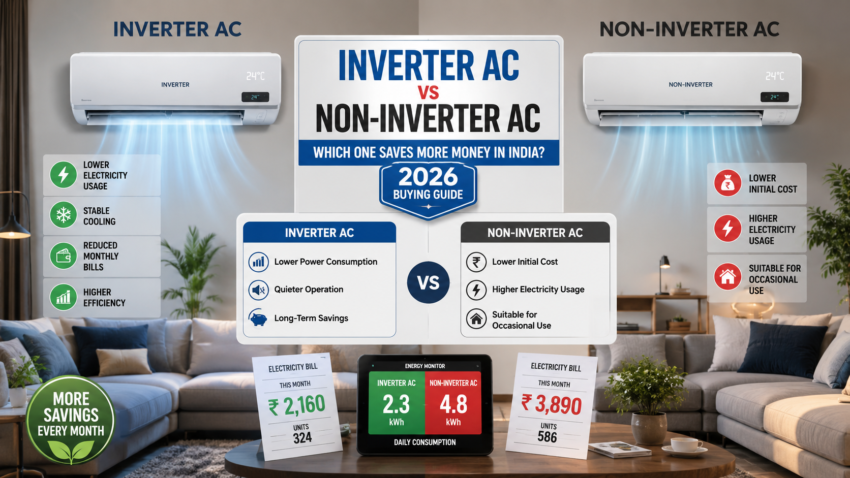
If your electricity bill shoots up every summer, you are not alone. Across India, millions of households run their ACs for 6 to 10 hours a day during peak summer months. When you are paying ₹4–₹8 per unit of electricity, even a small difference in power consumption adds up to thousands of rupees every year.
That is exactly why the choice between an inverter AC and a non-inverter AC matters more than most people realise.
Many buyers walk into a store, see that inverter ACs cost ₹5,000–₹10,000 more than their fixed-speed counterparts, and wonder, is it actually worth it? Or is it just a marketing label to charge more?
This guide breaks it all down in simple terms — from how each type works to how much you actually save on your electricity bill.
What Is an Inverter AC?
An inverter AC uses a variable-speed compressor. In simple terms, the compressor does not switch fully on or off like a regular AC. Instead, it adjusts its speed based on how much cooling the room needs at any given moment.
Think of it like driving a car. A non-inverter AC is like pressing the accelerator fully and then releasing it repeatedly. An inverter AC is like gently pressing and easing off to maintain a steady speed — far more efficient and smooth.
If you are already looking at specific models, our review of the best 1 Ton 5-star inverter split ACs in India covers top eco-friendly options worth considering.
Key benefits of the inverter AC compressor:
- Once the room reaches your set temperature, the compressor slows down instead of stopping completely
- It maintains the temperature without large fluctuations
- Less energy is wasted in repeated start-stop cycles
- The motor runs at lower stress levels, which adds to its lifespan
Most 3-star, 4-star, and 5-star inverter ACs available in India from brands like Daikin, Voltas, LG, Blue Star, and Panasonic use this technology. The BEE (Bureau of Energy Efficiency) star ratings you see on AC units are based on the ISEER (Indian Seasonal Energy Efficiency Ratio), which directly rewards inverter ACs for their efficiency across varying load conditions.
What Is a Non-Inverter AC
A non-inverter AC (also called a fixed-speed or conventional AC) uses a fixed-speed compressor. This compressor has only two states — fully ON or fully OFF.
Here is how it works in practice:
- You turn the AC on and set it to 24°C
- The compressor runs at full power until the room hits 24°C
- It shuts off completely
- The room gradually heats up again
- The compressor kicks back in at full power
This cycle repeats every few minutes. Every time the compressor restarts, it draws a surge of power — much like how a refrigerator hum goes loud when it kicks back on.
For short or occasional use, this is perfectly fine. But for homes running ACs for 8–10 hours daily in Indian summers, the repeated on-off cycles result in noticeably higher power bills.
Non-inverter ACs are also generally cheaper to buy upfront, which is why they remain popular in guest rooms, small shops, and budget-conscious households.
Inverter AC vs Non-Inverter AC — Key Differences
Here is a side-by-side comparison to make the differences easy to understand:
| Feature | Inverter AC | Non-Inverter AC |
| Compressor Type | Variable speed | Fixed speed |
| Power Consumption | Lower (adjusts as needed) | Higher (runs at full power) |
| Cooling Speed | Fast initial cooling, steady after | Rapid bursts, fluctuates |
| Temperature Consistency | Very stable | Slight fluctuations |
| Noise Level | Quieter during steady operation | Louder due to on-off cycling |
| Initial Price | ₹5,000–₹10,000 higher | More affordable |
| Electricity Bill | Lower (especially with heavy use) | Higher for daily users |
| Lifespan | Longer (less mechanical stress) | Shorter with frequent use |
| Maintenance Cost | Slightly higher (complex PCB) | Simpler, cheaper repairs |
| BEE Star Rating | 3-star to 5-star (ISEER based) | Up to 2–3-star typically |
| Best For | Daily use, long hours | Occasional or limited use |
| Ideal Rooms | Bedroom, living room, offices | Guest rooms, infrequent use |
Which AC Saves More Electricity in India?
The short answer: inverter ACs consume significantly less electricity, especially when used for more than 5–6 hours a day.
Here is why. In Indian summers, the outdoor temperature regularly crosses 40°C in cities like Delhi, Nagpur, Lucknow, and Ahmedabad. Once you set your AC to 24°C, the compressor works hardest during the first 20–30 minutes to pull the room temperature down. After that, maintaining the temperature requires far less effort.
A non-inverter AC does not know this. It still runs at 100% capacity every time it restarts — even when just 10–15% of cooling effort is actually needed.
An inverter AC, on the other hand, detects that the room is almost at the target temperature and drops its compressor speed to 20–30%. This is where the real savings happen.
Real-world usage pattern for Indian homes:
- Morning use: 1–2 hours before leaving for work
- Afternoon nap: 1–2 hours
- Night use: 6–8 hours
That adds up to 8–12 hours of daily use in a typical summer month from April to June. Over three months, the efficiency gap between an inverter and non-inverter AC becomes very significant.
Studies and consumer reports consistently show that inverter ACs consume 30–50% less electricity compared to non-inverter models of the same capacity under similar usage conditions.
Electricity Bill Comparison Example
Let us look at a practical comparison for a 1.5 Ton AC used 8 hours daily for 30 days:
| Parameter | 1.5T Inverter AC (5-Star) | 1.5T Non-Inverter AC (3-Star) |
| Power Rating | ~1.2–1.4 kW (average load) | ~1.8–2.0 kW (fixed load) |
| Daily Consumption (8 hrs) | ~10–11 units | ~15–16 units |
| Monthly Consumption (30 days) | ~300–330 units | ~450–480 units |
| Monthly Bill (@ ₹7/unit) | ~₹2,100–₹2,310 | ~₹3,150–₹3,360 |
| Monthly Savings | — | Inverter saves ~₹900–₹1,100/month |
| Annual Savings (5 months use) | — | ~₹4,500–₹5,500 per year |
Note: Electricity rates vary by state in India. The above uses an average of ₹7 per unit. Your actual bill may differ based on your slab rate and usage pattern.
At this rate, a buyer who spends ₹8,000 more on an inverter AC recovers that cost in less than two cooling seasons. From year three onwards, it is pure savings.
Is Inverter AC Worth the Higher Price?
For most Indian households — yes, absolutely.
Here is the simple math. A premium inverter AC costs roughly ₹5,000–₹10,000 more than a comparable non-inverter model. If you save ₹4,500–₹5,500 per year on electricity, you recover the extra investment in 1.5 to 2 years.
After that, you continue saving every summer for the next 8–12 years that the AC is in service.
Inverter AC is especially worth it if:
- You run the AC for 6 or more hours daily
- You live in a hot region with 4–6 months of summer (Rajasthan, UP, Maharashtra, Gujarat, Telangana, etc.)
- You work from home and use the AC throughout the day
- You have time-of-use electricity tariffs where peak hour rates are high
- You want quieter operation, especially for sleeping
One thing to keep in mind: inverter ACs have more sophisticated electronics (inverter PCB, variable frequency drive). Repairs for these components can cost ₹2,000–₹5,000 more than standard non-inverter repairs. But most brands offer 5-year warranty on the compressor and 1-year warranty on the parts, which covers the critical period.
When Should You Buy a Non-Inverter AC?
Non-inverter ACs are not a bad choice in every situation. There are specific scenarios where they still make practical sense:
1. Very low usage (under 3–4 hours daily) If the AC only runs briefly in the evening or at night for a few hours, the efficiency gap narrows considerably. The savings from an inverter model may not justify the price difference.
2. Guest rooms or occasional-use spaces A room that gets used only during weekends or family visits does not need the efficiency of an inverter AC. A basic non-inverter AC with a good star rating works fine here.
3. Tight budget with limited savings options If you are working with a strict budget and cannot stretch to a 5-star inverter model, a 3-star non-inverter AC is better than a poorly maintained or undersized inverter AC. The star rating matters more than the technology in isolation.
4. Areas with unstable power supply In regions with frequent voltage fluctuations or power cuts, non-inverter ACs with a robust stabilizer setup can sometimes be more reliable. The complex electronics in inverter ACs can be vulnerable to power surges without adequate protection.
5. Commercial setups with short, intense cooling needs Shops, waiting rooms, or offices that need fast cooling for short periods and then shut down may not benefit much from inverter technology.
If budget is a real constraint, it is also worth reading our guide on when buying refurbished gadgets makes sense the same smart-buying logic applies to appliances too.
Best AC Choice for Indian Homes in 2026
India’s AC market has shifted sharply towards inverter technology in the past few years. Most major brands now offer inverter ACs as their base model, pushing non-inverter options to the budget segment. Here is what makes sense for different home setups:
Urban apartments (1–2 BHK): A 1.5 Ton 5-star inverter AC is the right choice for a standard 120–150 sq. ft. bedroom. For a living room of 180–220 sq. ft., a 2 Ton inverter model is more suitable.
Small bedrooms (under 100 sq. ft.): A 1 Ton inverter AC is sufficient and draws even lower power. This is especially useful in compact city apartments in Mumbai, Pune, Bengaluru, and Hyderabad.
Large living rooms or open-plan spaces: A 2 Ton inverter AC, or two 1.5 Ton units placed strategically, handles larger areas better. Oversized ACs cool too quickly and cycle often, reducing their efficiency advantage.
Work-from-home users: This group benefits the most from inverter ACs. Running an AC for 9–10 hours daily means the efficiency advantage compounds quickly. A 5-star inverter AC with a Wi-Fi control feature also lets you pre-cool the room and schedule it remotely — saving even more.
Areas with long summers (6+ months): States like Rajasthan, Gujarat, Telangana, and parts of Maharashtra see extreme heat from March through September. For these regions, the inverter AC payback period shortens to just one season.
Common Myths About Inverter ACs
Myth 1: Inverter ACs cool slower
This is not true. Inverter ACs cool at full capacity during the initial phase, just like any other AC. The variable speed kicks in only after the room reaches close to the set temperature. In fact, because the compressor never fully shuts down, temperature recovery after opening a door is faster in an inverter AC.
Myth 2: Inverter ACs always need expensive repairs
The inverter PCB is a costlier component to replace, but it is also built to last and is rarely the cause of typical AC failures. Most common AC issues — dirty filters, refrigerant leaks, fan problems — are equally inexpensive to fix in both types. With proper annual maintenance, inverter ACs are very reliable.
Myth 3: Inverter AC only works for small rooms
Inverter compressors are available in 1 Ton, 1.5 Ton, and 2 Ton capacities. The technology is about efficiency, not room size. A 2 Ton inverter AC handles large rooms just as a 2 Ton non-inverter would — but more efficiently.
Myth 4: The savings are too small to notice
As the electricity bill comparison above shows, a household can save ₹4,500–₹5,500 per year on a single 1.5 Ton AC. If you have two ACs in the home, those savings double. Over 10 years, that is ₹1 lakh or more back in your pocket.
Things to Check Before Buying Any AC
Whether you go inverter or non-inverter, these factors matter for any AC purchase in India:
- BEE Star Rating: Higher is better. A 5-star AC can use up to 28% less energy than a 3-star model of the same type. Do not ignore the ISEER value — it is more reliable than just the star count.
- Copper Condenser Coil: Always prefer copper over aluminium. Copper is more durable, transfers heat better, and is easier to repair in case of leaks.
- Room Size Compatibility: Use the right tonnage. A 1 Ton AC is for rooms up to 120 sq. ft., 1.5 Ton for 120–180 sq. ft., and 2 Ton for 180–240 sq. ft. An undersized AC runs non-stop and burns more electricity.
- Brand Service Network: In India, after-sales service is critical. Brands like Daikin, Voltas, LG, and Blue Star have strong service networks across Tier 1 and Tier 2 cities. Check service availability in your area before buying.
- Stabilizer Requirement: Most modern inverter ACs come with built-in voltage protection up to 290V or higher. Check the specs. If not included, a good quality voltage stabilizer adds ₹1,500–₹3,000 to your cost.
- Noise Level (dB Rating): For bedrooms, look for models rated below 35 dB. Inverter ACs are generally quieter during steady operation.
- Smart Features: Wi-Fi-enabled ACs let you control temperature remotely and schedule cooling. This reduces wasted cooling time and lowers bills further. Features like sleep mode, auto-clean, and dehumidification add practical value.
Making the wrong call on specs is a common trap with any big-ticket purchase. Our piece on common mistakes people make when buying laptops covers a similar checklist mindset that applies here too.
Final Verdict
For daily use, long hours, or hot climates — inverter AC wins clearly.
If you are planning to run your AC for more than 5–6 hours a day during Indian summers, an inverter AC pays for itself within 2 years and keeps saving money for a decade after that. The quieter operation, stable cooling, and longer lifespan make it the smarter long-term choice.
For occasional use, guest rooms, or tight budgets — a non-inverter AC still has its place.
If the AC will be used for just 2–3 hours a day or in a room that sees infrequent use, the savings from an inverter model will not be large enough to justify the higher upfront cost. In that case, a good quality 3-star non-inverter AC with a copper condenser and reputable brand service is a perfectly sensible choice.
The bottom line: do not just look at the price tag — look at how many hours per day and how many months per year you will actually use the AC. That calculation will tell you exactly which type is worth your money.
Frequently Asked Questions (FAQs)
Q1. Does inverter AC really save electricity? Yes, significantly. Inverter ACs can save 30–50% on electricity compared to non-inverter models when used for 6 or more hours daily. The savings come from the variable-speed compressor that reduces power draw once the room is cooled.
Q2. Which AC is better for daily use in India? An inverter AC is better for daily use. For households running ACs 6–10 hours a day across summer months, the electricity savings far outweigh the higher purchase price within 1–2 years.
Q3. Is inverter AC good for Indian summers? Inverter ACs are very well suited for Indian summers, especially in states with extreme heat like Rajasthan, Gujarat, UP, and Telangana. They handle long continuous usage better and maintain stable temperatures even during hot afternoons.
Q4. Can inverter AC run on a home inverter (battery backup)? Yes, modern inverter ACs — especially 1 Ton and 1.5 Ton models — can run on a high-capacity home inverter system. You will need a large battery bank (typically 150Ah or more) and a compatible inverter (1500VA or higher). Check the AC’s minimum running wattage before connecting it to a battery system.
Q5. Which AC has lower maintenance costs? Non-inverter ACs have simpler electronics and generally lower repair costs per visit. However, inverter ACs require fewer repairs overall because the compressor runs under less mechanical stress. Over a 10-year period, total maintenance costs are roughly comparable.
Q6. What is the right star rating to buy for an AC in India? For inverter ACs, a 5-star model offers the best energy savings and is ideal if you plan long-term use. A 3-star inverter AC is a good middle ground if budget is a concern. Avoid buying a 1-star or 2-star AC for regular household use — the electricity costs will exceed any savings on the purchase price.
Q7. Does the inverter AC work during voltage fluctuations? Most inverter ACs today have built-in voltage protection that handles fluctuations between 160V and 290V. Check the product specifications before buying. In areas with extreme voltage issues, a separate stabilizer is still recommended for added protection.
Q8. How long does it take for an inverter AC to recover its extra cost? Based on typical Indian usage patterns (8 hours/day, 5 months/year, ₹7/unit electricity rate), the extra ₹8,000–₹10,000 paid for an inverter AC is recovered in approximately 1.5 to 2 years through electricity savings. After that, the savings continue for the remaining life of the AC.

Harry S is a digital marketing expert with 19+ years of experience. He created Reviews-4u.com to share simple, research-backed product insights that help users make better buying decisions.