
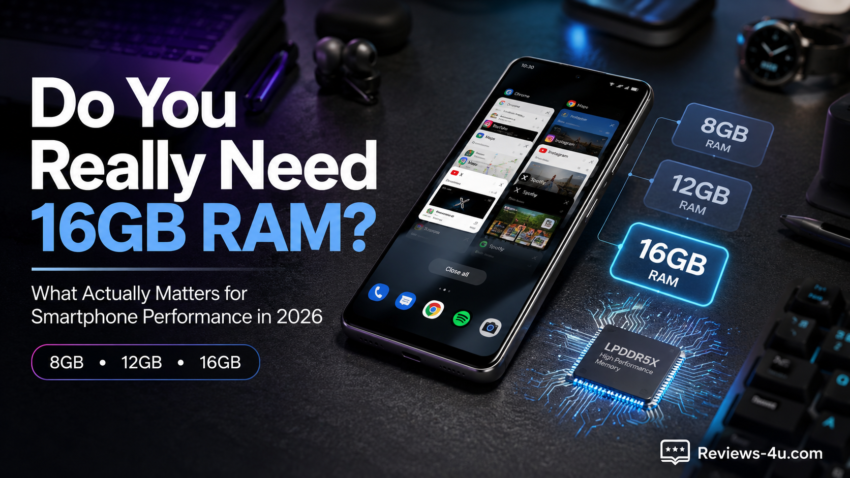
Walk into any mobile store in 2026, and you’ll hear the same pitch. 16GB RAM Smartphone. Sometimes, 18GB if you’re looking at a flagship. The salesperson says it like it settles the argument on its own: more RAM means a faster, better phone.
It’s an easy assumption to make. RAM has always been the number brands lead with, right after the processor name. But does a phone with 16GB RAM actually feel different in daily use compared to one with 12GB, or even 8GB?
This guide breaks it down honestly. We’ll look at what RAM actually does, when extra RAM genuinely helps, and when it’s just a bigger number on a spec sheet. By the end, you’ll know exactly what to check before you pay extra for it.
What Does RAM Actually Do in a Smartphone?
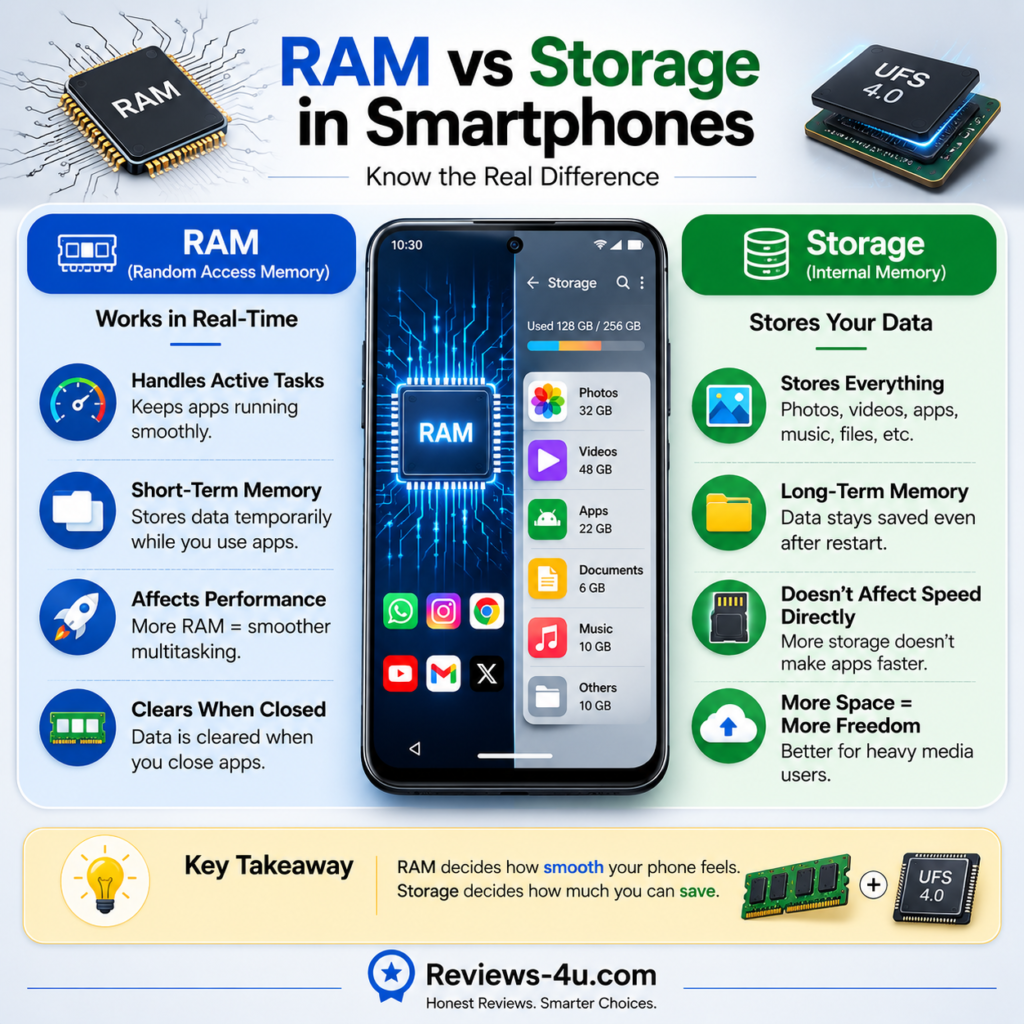
RAM and storage often get confused, but they do very different jobs. Storage is where your photos, apps, and files live permanently. RAM is where your phone keeps things it’s actively working on right now.
Think of storage as a cupboard and RAM as your kitchen counter. The cupboard holds everything you own. The counter only holds what you’re using at this exact moment while cooking. A bigger counter lets you prep more dishes without constantly putting things away and pulling new ones out.
When you switch between WhatsApp, your camera, and a browser tab, your phone is trying to keep all of them ready in that counter space. Run out of room, and the phone starts closing apps in the background to make space, which is why a paused video sometimes restarts from the beginning when you switch back.
Android and iOS handle this differently. iOS manages memory aggressively and efficiently, which is one reason iPhones have historically shipped with less RAM than Android flagships and still performed smoothly. Android is more RAM-hungry by design, especially with heavier custom skins layered on top.
It’s also worth remembering that RAM is only one piece of the performance puzzle. A phone with 16GB RAM and a weak processor will still feel sluggish. Speed comes from how RAM, the chipset, and software work together, not from RAM alone.
Why Are Smartphone Brands Offering 16GB RAM?
Flagship competition is fierce, and RAM is an easy number to advertise. It’s simple, it’s big, and buyers instinctively understand “more is better,” even when the real-world difference is small.
There are legitimate reasons, too. On-device AI features, such as local image generation, live translation, and offline voice assistants, use more memory than older apps did. Heavy gaming and multitasking across several demanding apps also benefit from extra headroom.
But a lot of it comes down to marketing positioning. When two phones are priced similarly, the one advertising 16GB RAM often looks more attractive on paper, even if both phones feel identical in daily use for most people.
8GB vs 12GB vs 16GB RAM: Real-World Comparison
| Use Case | 8GB RAM | 12GB RAM | 16GB RAM |
| Everyday usage | Smooth | Smooth | Smooth |
| Social media (Instagram, WhatsApp) | No noticeable lag | No noticeable lag | No noticeable lag |
| Web browsing (10+ tabs) | Occasional tab reloads | Rarely reloads tabs | Tabs stay open longer |
| Camera usage | Fine | Fine | Fine |
| Gaming (casual to mid-range titles) | Fine | Smooth | Smooth with more apps open in the background |
| Heavy gaming with recording/streaming | Can struggle | Handles it well | Extra comfort margin |
| Video editing on phone | Slower rendering | Comfortable | Best for longer 4K timelines |
| AI features (on-device) | Basic AI features only | Handles most AI tools well | Best for multiple AI tools running together |
| Longevity (years of smooth use) | 2-3 years | 3-4 years | 4-5 years |
| Price impact | Lowest | Moderate | Highest |
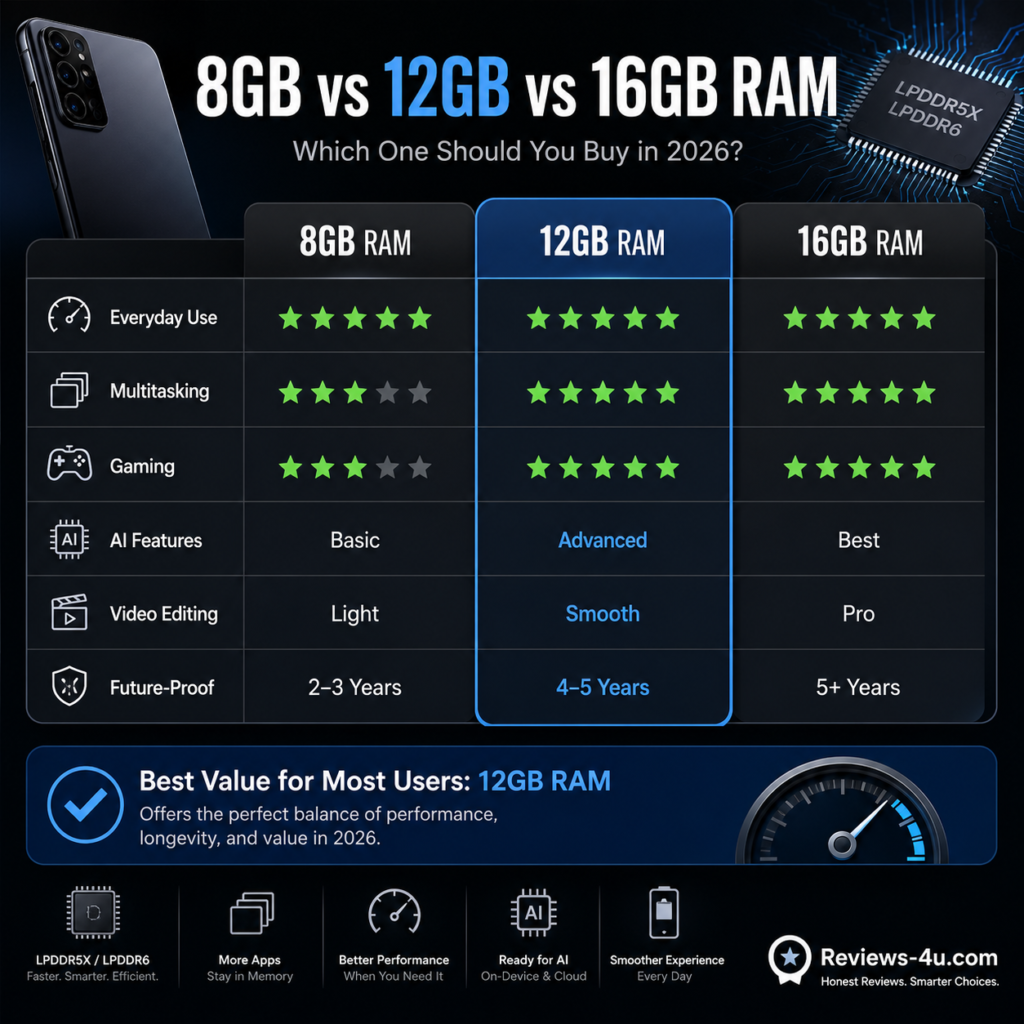
The pattern here is consistent: for most everyday tasks, the three tiers feel nearly identical. The gap widens only under specific, demanding conditions.
Is 16GB RAM Necessary for Everyday Users?
For most people, daily phone use looks like this: WhatsApp, Instagram, Facebook, YouTube, Netflix, Google Maps, email, banking apps, and online shopping.
None of these apps are particularly RAM-hungry on its own. A 12GB phone handles all of them without hesitation, and honestly, so does a well-optimised 8GB phone.
The difference between 12GB and 16GB in this kind of usage is barely noticeable. You might keep one or two extra apps paused in the background before they reload, but that’s about it. If your phone use fits this pattern, paying extra purely for 16GB RAM is unlikely to change your day-to-day experience.
When Does 16GB RAM Actually Make Sense?
There are genuine cases where 16GB earns its price difference.
Mobile gamers who play graphically demanding titles while running Discord or a recording app in the background benefit from the extra buffer. Content creators editing 4K video or working with multiple editing apps open at once will notice smoother performance.
Developers running testing environments, emulators, or multiple browser instances for debugging need the headroom. Users who run several demanding apps simultaneously, like a video call, a note-taking app, and a browser with dozens of tabs, will also feel the difference.
If you plan to keep your phone for four or five years, buying a little extra RAM now can help it stay usable for longer as apps get heavier over time. This is a reasonable, practical reason to choose 16GB even if you don’t need it immediately.
Samsung’s Galaxy S26 lineup is a good real-world example of this. Depending on which model you pick, the RAM configuration changes considerably, and that difference genuinely plays out in daily use. We’ve covered exactly how in our Samsung Galaxy S26 Series Review, if you’re weighing up variants before buying.
Does More RAM Improve Gaming Performance?
Not on its own. Frame rates depend far more on the processor (SoC) and GPU than on RAM capacity. A phone with 16GB RAM and a weak chipset will still struggle with demanding games.
Display refresh rate and thermal management matter just as much. A phone that overheats during a long gaming session will throttle its performance regardless of how much RAM it has.
Game optimisation also plays a big role. Some titles are simply better tuned for certain chipsets. RAM’s real job in gaming is keeping the game and background apps ready without interruption, not pushing higher FPS by itself.
Virtual RAM vs Physical RAM
Many phones today advertise “Virtual RAM” or “RAM expansion,” sometimes an extra 4GB to 8GB on top of the physical amount. This is essentially unused storage space being borrowed to act as temporary memory.
The problem is that storage, even fast UFS storage, is significantly slower than physical RAM. Virtual RAM can help keep a few extra apps paused in the background, but it won’t speed up active tasks like gaming or video editing.
Manufacturers market this feature heavily because it sounds impressive on a spec sheet. In practice, treat virtual RAM as a small, secondary benefit rather than a real substitute for physical RAM.
How AI Features Are Changing Smartphone Memory Requirements
On-device AI has genuinely increased memory demands. Features like AI photo editing, live translation, offline voice recognition, and local AI assistants need memory available to run without lag, especially when they work without an internet connection.
These features don’t require 16GB to function, but having more RAM does mean multiple AI tools can run alongside your regular apps more comfortably. If you use these features constantly, the extra RAM has some practical value. If you rarely touch them, it matters much less.
If you want a clearer picture of which AI features are genuinely worth having versus which ones are mostly marketing polish, our guide on AI Smartphones in 2026: Features That Actually Matter Before You Buy breaks it down feature by feature. It’s worth a read before deciding how much AI-readiness you actually need.
Other Smartphone Specifications That Matter More Than RAM
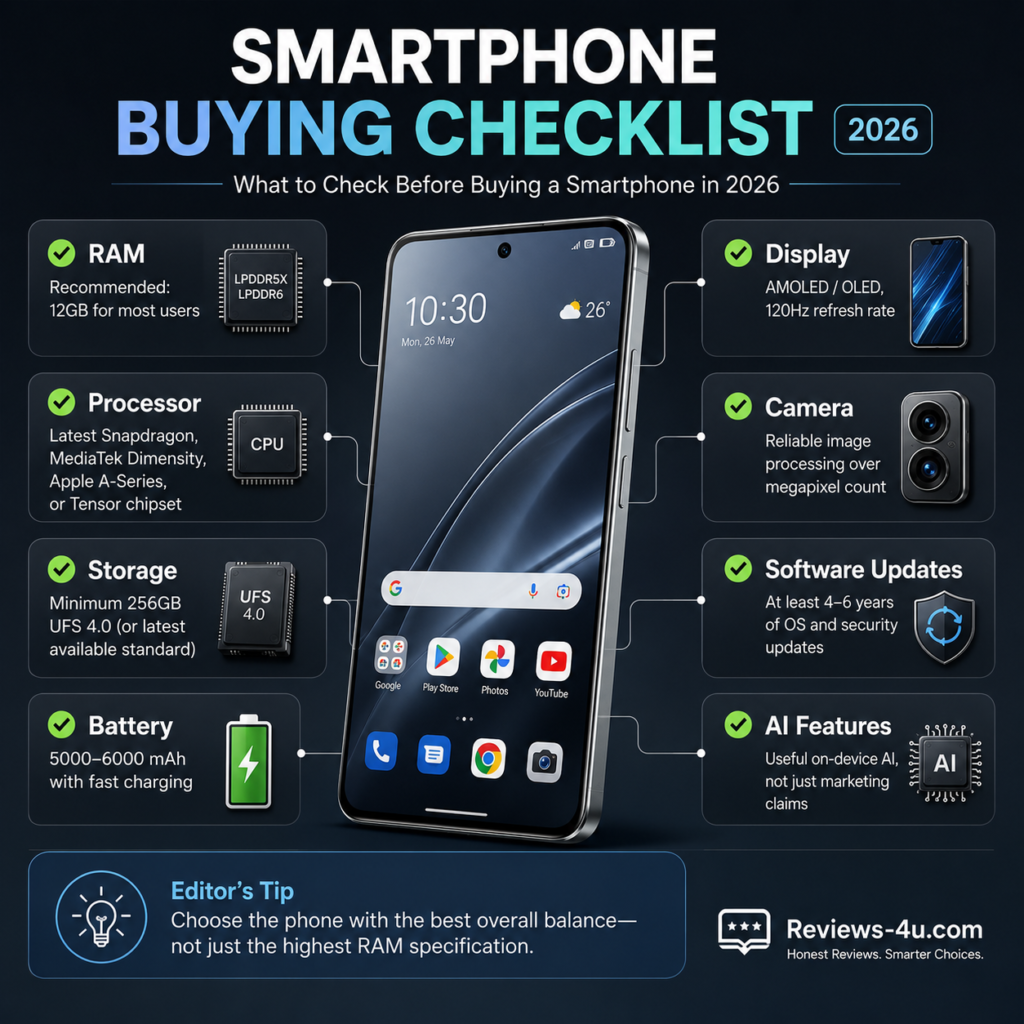
Before RAM, buyers should weigh several other specs that shape the real experience:
- Processor (SoC): determines actual speed and efficiency
- Storage speed (UFS 3.1 or 4.0): affects app loading and file transfers
- Battery life: matters more day-to-day than most spec sheet numbers
- Display quality: affects everything you see on the phone
- Camera system: still the most-used feature for most buyers
- Software update policy: determines how long the phone stays secure and current
- Build quality and cooling: affects durability and sustained performance
A phone with balanced specs across these areas will almost always feel better to use than one that leads with RAM alone and compromises elsewhere.
How Much RAM Should You Buy in 2026?
| Usage Type | Recommended RAM |
| Basic users (calls, messaging, browsing) | 6-8GB |
| Students | 8-12GB |
| Office professionals | 8-12GB |
| Content creators | 12-16GB |
| Gamers | 12-16GB |
| Power users / long-term buyers | 16GB |
For most students and professionals, 12GB strikes the best balance of price and future headroom. Content creators and gamers benefit from stepping up to 16GB RAM Smartphone, while basic users can comfortably save money by staying at 8GB.
If you fall into the basic-user category, you really don’t need to stretch your budget chasing extra RAM. Our pick of the best budget smartphones in 2026 covers several options that handle everyday use comfortably without flagship pricing.
Buying Tips Before Choosing a Smartphone
Don’t choose a phone based on RAM alone. Compare the processor generation and benchmark scores first, since this affects speed far more directly.
Check the software update policy; a phone with three or four years of security updates will serve you better long-term than one with extra RAM but limited support. Consider your actual storage needs, too, since running low on storage causes its own slowdowns.
Read long-term usage reviews rather than launch-day impressions, and be honest with yourself about your actual usage pattern before paying for specs you won’t use
This same principle, buying based on how you actually use a device rather than chasing the biggest number on the spec sheet, applies just as much when you’re shopping for a laptop. If that’s on your list too, our guide on how much RAM you really need in a laptop in 2026 walks through the same decision-making process for that side of your budget.
Final Verdict
8GB RAM is still genuinely sufficient for many everyday users, particularly those focused on messaging, browsing, and social media. 12GB offers the best all-around balance for most buyers in 2026, covering everyday use with comfortable multitasking headroom.
16GB RAM smartphones benefit specific users, gamers, content creators, developers, and long-term buyers, rather than being a universal requirement. The smartest approach is to look at the complete phone, processor, display, camera, battery, and software support, rather than fixating on one number.
FAQ Section
Is 16GB RAM overkill for a smartphone? For most everyday users, yes. Unless you game heavily, edit video, or run multiple demanding apps at once, 12GB already covers daily use comfortably.
Is 8GB RAM still enough in 2026? Yes, for basic users focused on calls, messaging, browsing, and social media, 8GB remains sufficient, especially on well-optimised software.
Does more RAM make Android faster? Not directly. RAM helps with multitasking and keeping apps ready in the background, but overall speed depends more on the processor and software optimisation.
Does 16GB RAM improve gaming? Not by itself. Frame rates depend mainly on the processor and GPU. RAM helps keep the game and background apps running smoothly rather than increasing FPS.
What is Virtual RAM? Virtual RAM borrows unused storage space to act as extra temporary memory. It’s slower than physical RAM and mainly helps keep a few extra apps paused in the background.
Which matters more: RAM or processor? The processor has a bigger overall impact on speed and performance. RAM supports multitasking, but a strong processor matters more for day-to-day smoothness.

Harry S is a digital marketing expert with 19+ years of experience. He created Reviews-4u.com to share simple, research-backed product insights that help users make better buying decisions.