
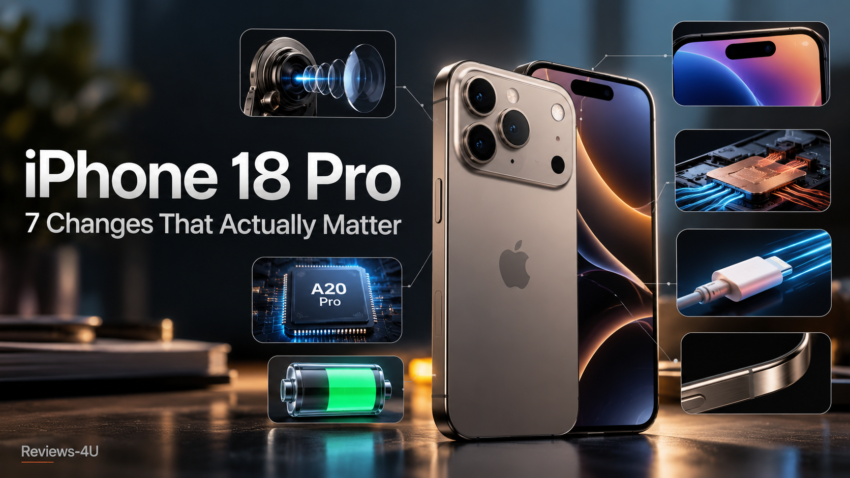
The iPhone 18 Pro reached stores on September 18 with a long list of new hardware, and a long list is a poor guide to whether a phone will feel different in your hand. A chip you never push, or a camera feature that only helps in certain scenes, can look impressive on paper and vanish in daily use.
This article sorts the iPhone 18 Pro changes by practical weight rather than listing everything Apple announced. Some changes matter technically but will pass most people by. Some are modest refinements with a real payoff. A few should show up in ordinary days: how the camera copes with a dim restaurant, how long the battery lasts, and whether the phone stays quick through a long game session.
Each section separates three things: what Apple claims, what independent testers have measured since launch, and our own reading of what it means for you. Where nobody outside Apple has tested a claim, we say so.
1. Variable Aperture Makes the Main Camera More Flexible
Aperture is the opening that lets light reach the sensor. A wide opening (a low f-number) gathers more light, which helps in dim scenes, but keeps only a thin slice of the picture sharp. A narrow opening lets in less light but keeps more of the scene in focus, front to back. Until now, iPhones used a fixed aperture and leaned on software to compensate.
Apple says the new 48MP main camera uses six blades to move between four settings, from ƒ/1.48 to ƒ/4, and adjusts automatically. Pro controls in the Camera app let you choose a setting yourself.
Independent findings so far are specific rather than sweeping. In 9to5Mac’s comparisons with the iPhone 17 Pro, the clearest gain came at night: the wider opening let the camera use a lower ISO (less amplified noise) at the same shutter speed. The other visible effect came with close subjects, where stopping down to ƒ/4 kept both subject and background sharp, which can help group photos. On ordinary daylight landscapes, the reviewer saw little difference from the aperture itself.
Our read: this is more meaningful than a megapixel bump because it changes how much light and depth of field the lens can work with. It will not improve every photo. If you shoot mostly outdoors in good light, expect small differences. iFixit’s teardown also suggests a stuck aperture would likely mean replacing the whole camera assembly. For wider context, see our guide to the best camera phones in India 2026.
2. The Battery Improvement May Matter More Than the Faster Chip
Apple rates the 18 Pro at up to 36 hours of video playback and the Pro Max at up to 45, plus a new “typical use” figure of up to 24 and 30 hours. Those numbers are for eSIM-only models; Apple says physical-SIM versions get about two hours less video playback. Apple’s headline battery figures apply to eSIM-only models, so buyers should check the exact configuration available in their market.
Capacity barely moved on the smaller phone. LTT Labs measured 4,288 mAh on the eSIM-only 18 Pro against 4,252 mAh on the 17 Pro, a 0.8% increase, while the Pro Max rose from 5,088 to 5,567 mAh (9.4%). Most of the gain therefore comes from efficiency: the 2nm chip and related silicon doing the same work on less energy.
Independent results are mixed in a useful way. LTT’s streaming video test matched Apple’s claims. One review roundup, however, reports that Tom’s Guide’s web-browsing test put the Pro Max only about half an hour ahead of its predecessor, and that TechRadar questioned whether Apple’s “largest increase” claim holds beyond video.
Our read: battery life touches every day of ownership, while a faster chip mostly touches peak moments. Expect a real but uneven gain, stronger for video than for browsing.
3. A20 Pro: What Does the New Chip Actually Change?
A20 Pro is built on a 2-nanometer process. A smaller process node packs transistors more densely, which generally lets a chip do the same work on less power, or more work on the same power. Apple lists a 6-core CPU, a 7-core GPU it calls up to 40% faster than A19 Pro, 50% more memory bandwidth, and double the AI processing power.
Testers largely support the GPU claim. 9to5Mac measured CPU scores 22–27% above A19 Pro and GPU scores 40–45% higher, while LTT Labs recorded a 55% GPU gain in 3DMark Steel Nomad Light.
Will an average user notice? Probably not while messaging, browsing or scrolling, which the previous chip already handled easily. The people more likely to feel it:
- Gamers: more graphics headroom in demanding titles.
- Video editors and photographers: more processing capacity for heavy files, though we found no independent editing tests yet.
- AI-heavy users: more on-device capacity, but Siri AI launched in beta, English first, and Apple says it needs an Apple Intelligence-enabled device, not specifically this one.
4. The New Vapor Chamber Could Be More Important Than Peak Performance
Chips slow themselves when they overheat, a behaviour called thermal throttling. A phone can score well in a short benchmark, then lose speed ten minutes into a game, a long 4K recording or an AI task. A vapor chamber is a sealed metal plate holding a small amount of liquid that evaporates over hot spots and condenses in cooler areas, spreading heat across a wider surface.
Documented changes: Apple says A20 Pro’s packaging moves memory beside the chip, letting it attach directly to a chamber with three times the surface area of the 17 Pro’s. iFixit’s teardown, as reported by 9to5Mac and others, shows the redesign. Apple claims up to 40% higher sustained performance.
Independent testing: in LTT Labs’ 20-minute 3DMark stress test, the 18 Pro finished above the 17 Pro’s peak. Both fell to roughly 66–69% of their own peak, so the advantage comes from a higher starting point rather than smaller losses.
Our analysis: a phone doesn’t only need to be fast; it needs to remain fast when the workload continues. Long games and video capture are where this should show. Hot-weather use is a logical beneficiary, but we haven’t seen independent testing of it.
5. The Smaller Dynamic Island Is a Small Change With a Practical Benefit
Apple moved the Face ID infrared camera beneath the display, which allowed a smaller Dynamic Island. Apple’s announcement gives no percentage; independent analysis shows the Dynamic Island is physically smaller, and Apple says it can now show up to three Live Activities at once. iFixit found Apple hides the relocated sensor by removing every other row of pixels above it.
The payoff is mostly in software. Apple says the island can now show three Live Activities at once, covering things like navigation, timers, calls and media. In 9to5Mac’s testing, the most noticeable benefit came with two activities running: the second could show more information without a long press. Face ID worked as before, though the sensor can be visible in bright sunlight.
Our read: this is a usability refinement, not a performance upgrade. You will see it daily in the status bar, but it won’t change what the phone can do.
6. Faster Charging Changes How You Use the Phone
Apple says the 18 Pro reaches about 50% in around 15 minutes on wired charging, or 30 minutes wirelessly. The 17 Pro claim was 50% in 20 minutes. LTT Labs measured 15 minutes for half the energy on the 18 Pro and 16 on the Pro Max, and saw the 18 Pro draw over 40W, against a brief 30W peak on the 17 Pro.
One caveat: Apple’s figures assume a 60W-capable cable and a compatible adapter, which its footnotes list as available separately.
Our read: the value is in short top-ups. A quarter-hour plugged in before leaving home changes the day more than overnight speed does, and it can matter more than a small capacity increase, particularly on the smaller Pro, where capacity barely moved. We found no independent full-charge times, so we don’t quote any.
7. The iPhone 18 Pro Is More Refined Than Redesigned
Much stays familiar. LTT Labs calls the outside a small iteration on the 17 Pro. 9to5Mac lists the same 8.75 mm thickness, with weight up from 206 g to 211 g on the Pro and from 233 g to 249 g on the Pro Max. The back glass now matches the aluminium colour, USB-C remains, and LTT found Apple’s display brightness claims unchanged and mostly corroborated. Face ID stays, though its sensor moved.
The bigger differences sit inside: chip, cooling, aperture, battery. Not every generation needs a new design to be worth considering. But if what bothers you about your current phone is its weight or its look, little here addresses that. The 18 Pro is a refinement of the existing Pro formula, not a new one.
What the iPhone 18 Pro Specifications Don’t Tell You
| New Feature | What Apple/Specs Say | What It Means in Everyday Use |
| Variable aperture | Four settings, ƒ/1.48 to ƒ/4 | Helps at night and with close subjects; little change in bright landscapes |
| A20 Pro | 2nm; GPU up to 40% faster | GPU gains confirmed by testers; everyday apps already ran smoothly |
| New cooling system | Chamber with 3x the area; up to 40% higher sustained performance | Higher output after 20 minutes of stress; matters in long sessions |
| Battery improvements | Up to 36 hours video (eSIM-only) | Real but uneven; strongest in video |
| Faster charging | About 50% in 15 minutes | Tested at 15 minutes; needs compatible gear |
| Smaller Dynamic Island | Three Live Activities at once | Small daily usability gain; no speed change |
Should You Upgrade to the iPhone 18 Pro?
The US starting price is $1,199, $100 above last year, so the question is what you would gain over what you own.
If you own an iPhone 17 Pro
9to5Mac says there is little reason to upgrade. The differences are night photography, a claimed battery gain near 10% in streaming video, five minutes off the 50% charge claim, and higher sustained GPU output. They matter if your 17 Pro throttles in long sessions or you shoot in low light. For a wider view, see our iPhone 17 Pro Max vs Galaxy S26 Ultra comparison.
If you own an iPhone 16 Pro or older
9to5Mac calls this a good time to move. Battery rating, cooling (the 15 Pro and 16 Pro throttled under load, per the same review), camera behaviour in low light and charging speed are the likelier gains. Our piece on upgrading every year covers the timing question.
If you use an older iPhone
Siri AI needs an Apple Intelligence-capable device, which many older models are not. Battery wear, camera and charging gaps are usually larger too.
If you’re switching from Android
Ecosystem, app purchases and messaging habits matter more than specifications. On specifications, LTT measured the GPU 33% ahead of the Galaxy S26 Ultra’s chip, and the S26 Ultra fell to about 53% of peak in the stress test.
Final Verdict: What Actually Matters?
Five changes carry the most weight. The variable-aperture camera helps most in low light and close-up scenes. Battery and efficiency gains are real, if uneven. A20 Pro adds graphics and AI headroom that most people won’t stress. The larger cooling system may be the more useful half of that pairing, since it keeps performance from fading. Faster charging suits short top-ups.
The most important question isn’t how many new specifications the iPhone 18 Pro has, but whether those changes address something you actually need from your current phone.
FAQ
Is the iPhone 18 Pro a major upgrade over the iPhone 17 Pro?
Not by design: the outside is nearly unchanged, and 9to5Mac sees little reason for 17 Pro owners to upgrade. The gains are internal: night photography, cooling, battery and charging. They matter if a specific limitation of your current phone bothers you.
What is new about the iPhone 18 Pro camera?
The 48MP main camera has a variable aperture with four settings, ƒ/1.48 to ƒ/4, plus manual Pro controls and a new image pipeline. Testers found the clearest gains in low light and with close subjects. Bright landscapes show little aperture-driven change.
What does the A20 Pro chip improve?
Apple builds it on a 2nm process. Testers measured GPU gains of roughly 40–55% over A19 Pro and CPU gains of 22–27%. Everyday apps already ran smoothly, so gamers and heavy on-device AI users are the likelier beneficiaries.
Does the iPhone 18 Pro have better battery life?
Yes, with limits. LTT Labs’ video test matched Apple’s claim of roughly 10% more. Web-browsing tests reported by reviewers show narrower gains on the Pro Max. Apple’s headline hours apply to eSIM-only models; physical-SIM versions rate about two hours lower.

Harry S is a digital marketing expert with 19+ years of experience. He created Reviews-4u.com to share simple, research-backed product insights that help users make better buying decisions.