
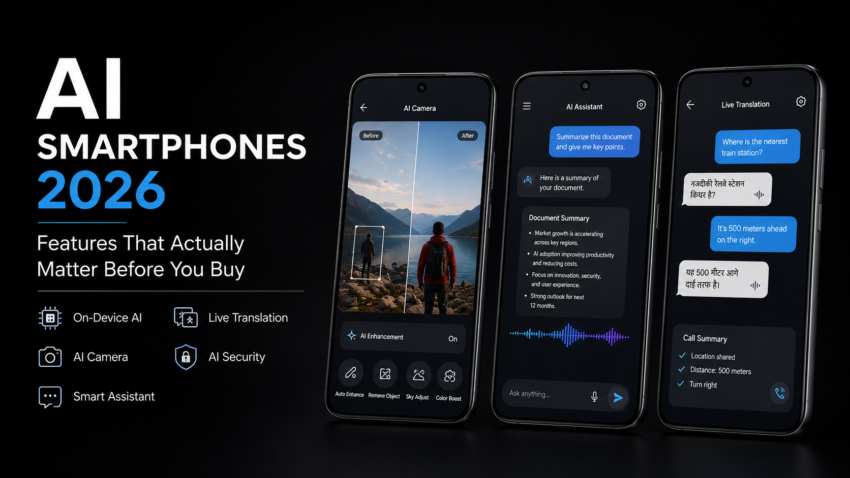
📦 Key Takeaways
- AI smartphones in 2026 use dedicated Neural Processing Units (NPUs) to run artificial intelligence tasks directly on the device faster, more privately, and without requiring an internet connection.
- The most genuinely useful AI features in 2026 are: computational photography, live translation, call summaries, AI writing assistance, adaptive battery management, and on-device security.
- Features like AI wallpaper generators, emoji creators, and AI avatars are real but rarely influence whether a phone is worth buying.
- On-device AI is faster and more private; cloud AI handles heavier tasks but requires connectivity.
- In India, capable AI smartphones now start from around ₹20,000–₹25,000. You do not need to spend ₹1,00,000+ to get genuinely useful AI features.
- If your current phone is more than three years old, upgrading to an AI-capable mid-range device in 2026 is likely worth it. If it is two years old or newer, assess your specific needs first.
📘 What You’ll Learn in This Guide
- What an AI smartphone actually is beyond the marketing label
- Why 2026 marks a meaningful shift in on-device AI capability
- Which AI features save you real time and effort
- Which ones are padded onto spec sheets to fill bullet points
- How on-device and cloud AI compare on privacy, speed, and reliability
- Which brands are doing AI well right now
- What hardware to check before buying
- Whether upgrading makes sense for your situation
Imagine: You’re at a cousin’s wedding somewhere in Rajasthan. Your phone’s camera picks up on the dust, the golden-hour light, and twenty people moving at once. You tap the shutter a few times, and within seconds the phone has already selected the sharpest frame, removed the random stranger who wandered into the background, and balanced the sky without blowing out the faces in the foreground. No editing app. No laptop. Just a tap.
At the same table, someone else is on a call with a supplier in Germany. Their phone is translating the conversation in real time, the German arrives as Hindi in their ear, and their spoken Hindi goes back as German. The call ends, and a summary appears: three action points, neatly formatted.
None of this requires a ₹1,30,000 flagship. By 2026, these scenarios are playing out on phones costing ₹25,000.
But “AI-powered” is now printed on the box of almost every smartphone, from a ₹10,000 entry-level handset to the most expensive ultra-premium device you can find. Not all of those claims mean the same thing.
This guide cuts through the noise. It explains which AI features genuinely improve everyday life, which ones exist primarily to sound impressive in advertisements, and what to actually check before spending your money.
What Is an AI Smartphone?
An AI smartphone is a device with dedicated hardware, specifically a Neural Processing Unit, or NPU, built into its main chip to accelerate artificial intelligence tasks. The NPU handles the kind of mathematics that powers machine learning: recognising objects in images, transcribing speech, predicting what word you will type next, and analysing patterns in your charging behaviour.
This is different from a standard processor running an AI app. The CPU in your phone can technically run AI models, but it uses significantly more power and is slower at it. The NPU is purpose-built for this work, the way a graphics processor is built specifically for rendering images.
There are two broad ways AI runs on a phone:
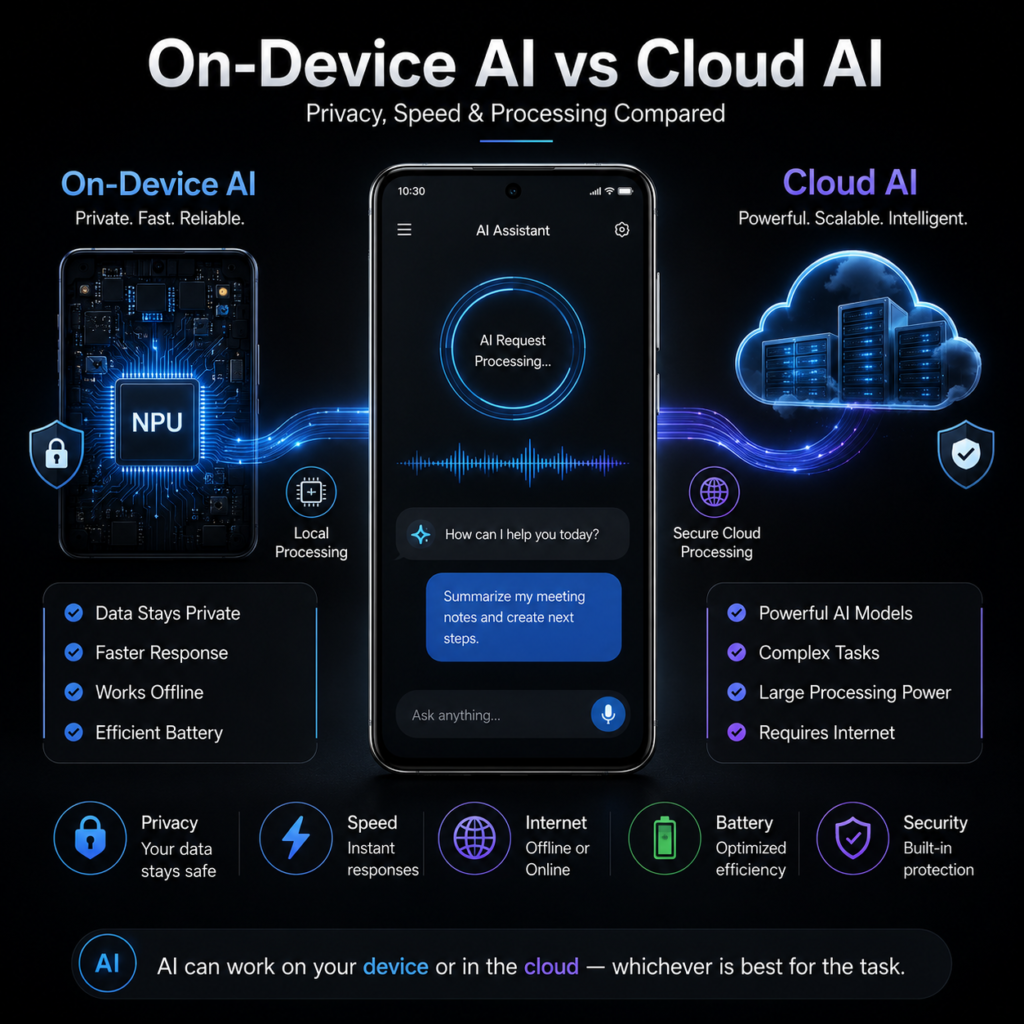
On-device AI processes tasks locally, using the NPU and the phone’s own memory. Your data does not leave the device. This is faster for common tasks, works without an internet connection, and keeps your information private.
Cloud AI sends your request to a server, processes it there using much larger models, and returns the result. This can handle more complex tasks, generating an image from scratch, for example, or answering open-ended research questions, but it requires connectivity, introduces latency, and means your data travels off the device.
Most AI smartphones in 2026 use a combination of both: everyday tasks like grammar correction, photo enhancement, and spam call detection happen on the device, while heavier requests are routed to the cloud when a connection is available.
Every major chipmaker now integrates an NPU as standard. Qualcomm calls its version the Hexagon NPU, and it is present in the Snapdragon 8 Elite series that powers Android flagships. Apple uses its Neural Engine across the entire iPhone range. Google’s Tensor G5 chip, designed primarily around AI workloads, powers the Pixel 10 series. MediaTek’s Dimensity 9400+ brings comparable on-device AI capability to many mid-range and flagship alternatives.
Why AI Smartphones Are Different in 2026
The honest answer to “what changed?” comes down to sheer processing power and software maturity.
In 2023, the NPU in a flagship phone could handle roughly 10–20 TOPS (tera-operations per second). By 2026, <cite index=”3-1″>flagship NPUs are reaching 45–50+ TOPS, with the Qualcomm Snapdragon 8 Elite Gen 5 delivering over 50 TOPS via its Hexagon NPU, the Apple A19 Pro reaching approximately 45 TOPS, and the MediaTek Dimensity 9400+ closing the gap at around 48 TOPS.</cite> That is enough to run compact but capable language models entirely on the phone.
The practical results are visible in three areas:
Privacy improvement. <cite index=”3-1″>When the AI lives on your phone, there is nothing to upload. For sensitive tasks, drafting a private message, summarising a confidential document, scanning a suspicious call, on-device processing means that data never leaves your hands.</cite>
Speed and reliability. On-device tasks respond in milliseconds rather than waiting for a round trip to a server. Features like live translation, real-time photo enhancement, and call noise cancellation feel instantaneous because the processing happens locally.
Offline capability. <cite index=”2-1″>An on-device AI phone can translate speech, rewrite messages, describe images, flag scam-like calls, and summarise recordings without sending every task to a server.</cite> This matters in India, where connectivity can be patchy, especially during travel.
<cite index=”3-1″>According to Counterpoint Research, over 54% of all smartphones shipped globally in Q1 2026 are now classified as capable of running generative AI features, up from just 11% in 2023.</cite> In practical terms, this means useful AI features are no longer exclusive to ₹80,000+ handsets.
AI Features That Actually Matter
AI Photography
This is where AI has the clearest, most measurable impact on everyday use.
Modern AI cameras do not just apply filters. They analyse a scene before you tap the shutter, identifying faces, reading the lighting environment, detecting motion, and selecting computational settings accordingly. On flagships like the Samsung Galaxy S26 Ultra or the Google Pixel 10 Pro, this happens in real time as you compose the shot.
The features that make a practical difference:
Night photography: AI photography significantly improves low-light shots by stacking and aligning multiple short exposures, then using machine learning to denoise the combined image. The result is a photo that looks brighter and cleaner than what the sensor hardware alone would produce.
Object and person removal: Tools like Samsung’s Object Eraser and Google’s Magic Eraser can remove an unwanted element from a photo and fill the gap with a plausible background. This used to require desktop software. It now takes two taps.
Best frame selection: When you hold the shutter button, the camera captures a burst. AI selects the frame where faces are sharpest and eyes are open. This is genuinely useful for group photos.
AI zoom enhancement: Periscope telephoto lenses provide optical zoom, but AI processing sharpens and recovers detail at higher zoom levels — useful for photographs at concerts, sporting events, or distant architecture.
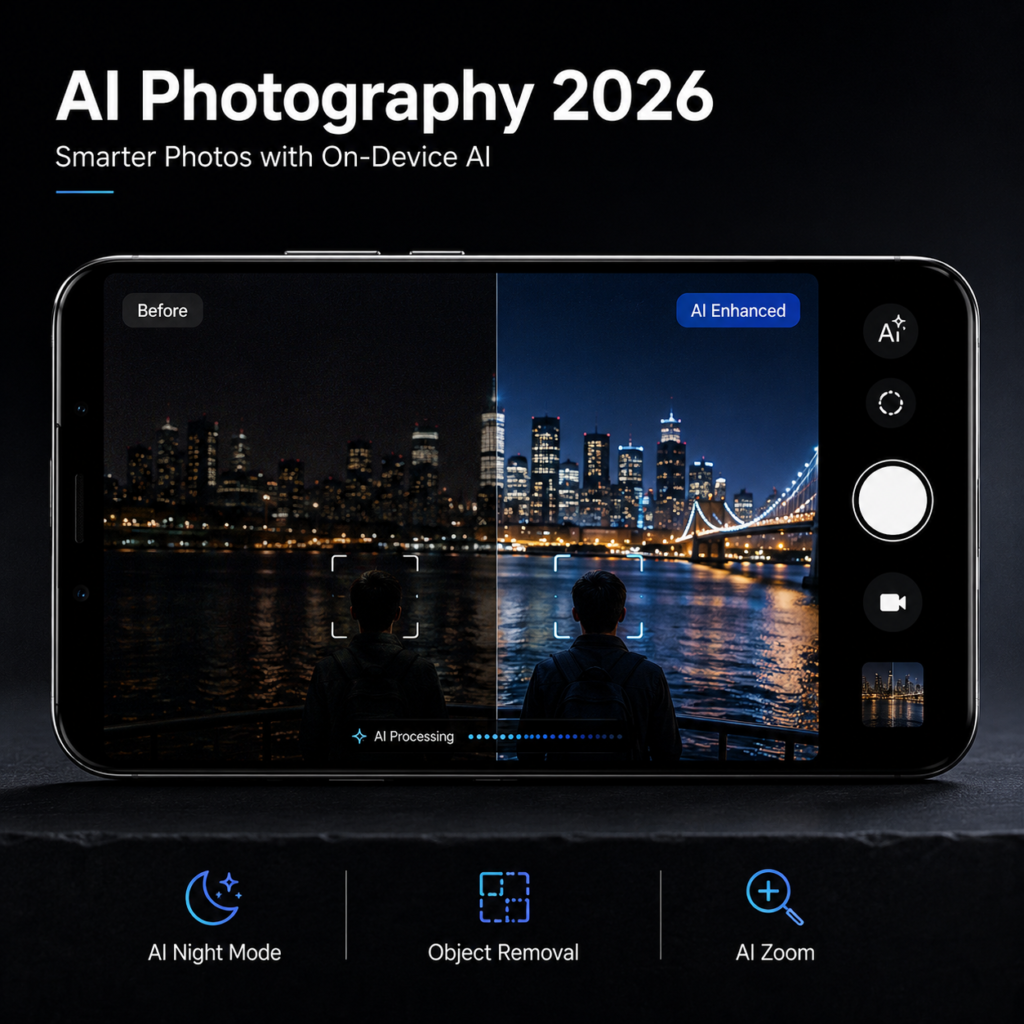
Portrait improvements: Modern AI can re-light a portrait after it is taken, separate the subject from the background more accurately, and apply bokeh that correctly handles fine details like hair.
AI Video Editing
Video has become the primary medium for content creators, whether they are running a YouTube channel, posting Instagram Reels, or making short clips for family groups.
On-device AI now handles tasks that previously required a desktop editing suite:
Auto captions: The phone transcribes spoken audio and overlays subtitles in real time, using models that understand context rather than just individual words. This is especially useful for Indian creators who mix Hindi, English, and regional languages in the same video.
Background noise reduction: AI separates voice from ambient sound traffic, wind, and a noisy café and attenuates the background without affecting the speaker’s voice.
AI slow motion: Phones like the Xiaomi 15 Ultra can artificially generate slow-motion frames between real captured ones, producing smoother slow-motion from footage that was not recorded at a high frame rate.
Video background replacement: Similar to photo background editing, this allows the background of a video clip to be changed or blurred while keeping the subject intact.
Live Translation
This is one of the most immediately practical AI features available in 2026 — and it has particular relevance in India.
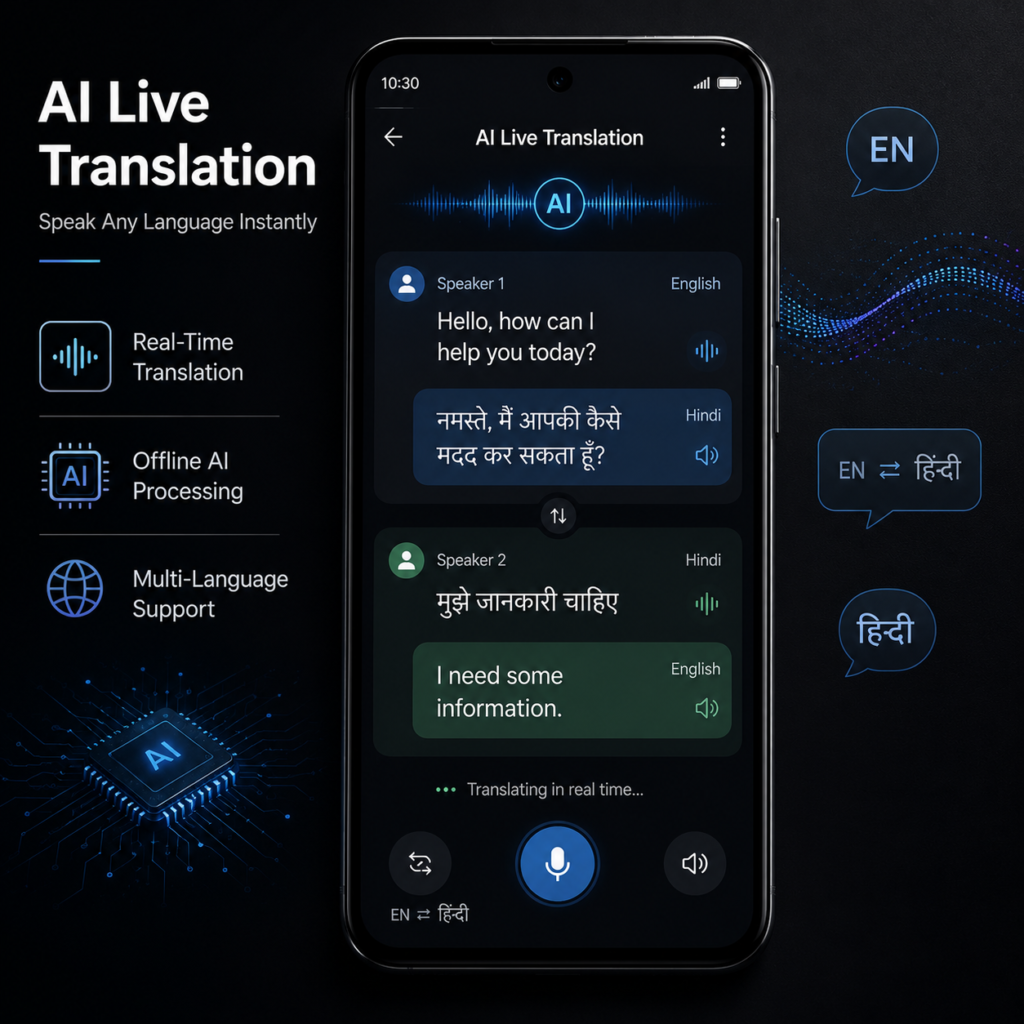
Samsung’s Live Translate can translate a phone call in real time, so someone speaking Hindi and someone speaking German can have a natural conversation with the phone acting as an interpreter. Google Pixel’s Call Translate does the same. Both work for a range of Indian languages, including Hindi, Tamil, Telugu, Bengali, and others.
Practical scenarios: speaking to a customer overseas, travelling internationally, dealing with a service provider who only speaks a regional language you do not know, or assisting an elderly family member who struggles with English-only customer service systems.
<cite index=”2-1″>Samsung’s Galaxy AI supports translation in over 41 languages for certain features as of early 2026, though availability varies by model and region.</cite> It is worth checking which Indian languages are supported for the specific model you are considering, as support can differ between the international and India variants.
AI Voice Assistant
The voice assistants on smartphones have improved substantially, though it is worth being specific about what has actually changed versus what was already possible.
The meaningful improvements in 2026:
Context awareness across multiple turns. You can ask “Summarise the email from Rahul” and then follow up with “Reply and say I’ll be there by 3 PM” — without restating who Rahul is or what the email was about.
Cross-app actions. <cite index=”6-1″>Samsung’s Cross-App Actions feature enables workflows that span multiple applications without manual intervention, for example, receiving an email about a meeting, and the AI automatically checks your calendar availability and drafts a response.</cite>
Offline processing. Basic commands like setting alarms, playing music, reading messages aloud, and calling contacts work without internet access.
The caveat: these assistants are still bound by what the manufacturer has built. They handle structured tasks well but can struggle with ambiguity or tasks that fall outside their training.
AI Writing Assistant
This feature is now integrated at the operating system level on Android and iOS — meaning it is available across apps rather than inside one specific application.
What it does well: correcting grammar without changing your intended meaning, rewriting a draft at a different tone (more formal, more concise), summarising long articles or documents, generating a first draft of a message when you describe what you want to say.
Samsung’s Note Assist can format and summarise meeting notes. Google’s Gboard uses on-device AI for context-aware suggestions. Apple’s writing tools across iOS handle proofreading and rewrites without any data leaving the device.
For students writing assignments, professionals drafting emails, and anyone who types in multiple languages, this is a feature with daily utility. It does not write for you — but it does reduce the friction in writing.
AI Call Features
Beyond translation, AI has improved the core phone call experience in ways that are easy to underestimate.
Call summaries: After a call ends, the phone can produce a short summary of what was discussed and any commitments made. This is useful in professional contexts where you would otherwise need to take notes while talking.
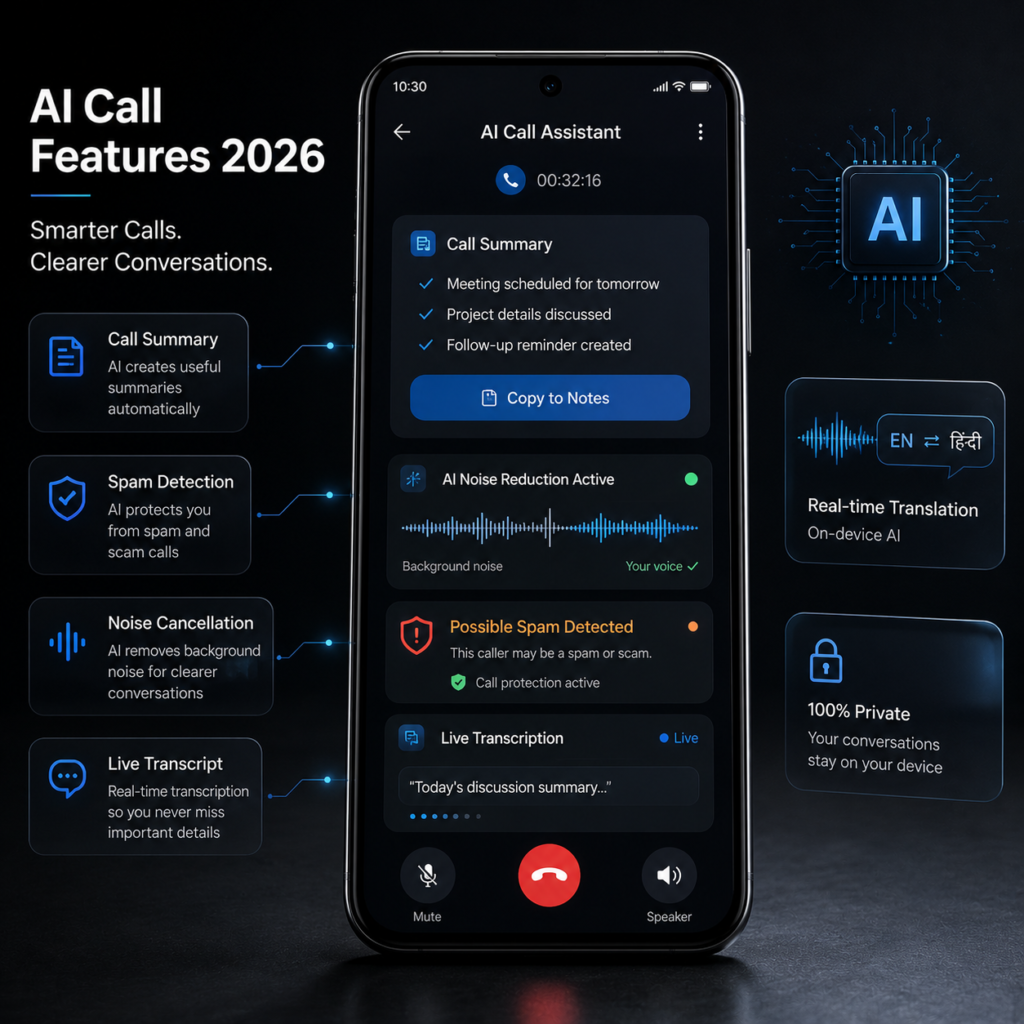
Spam and scam detection: <cite index=”4-1″>Real-time AI translation enables instant conversion of speech, text, and visual content between languages, while scam detection analyses conversation patterns to flag suspicious callers.</cite> Google’s call screening on Pixel devices has been doing this since Android 12, but 2026 models handle it faster and with fewer false positives.
Background noise cancellation during calls: The microphone AI identifies your voice and suppresses ambient sound, making calls cleaner in noisy environments — relevant if you are frequently calling from auto-rickshaws, open offices, or markets.
Live transcription: The call is transcribed in real time and saved, which is useful if you need to reference what was said without relying on memory.
AI Battery Optimisation
<cite index=”8-1″>AI battery optimisation learns how you use your phone — which apps you open at what time, how you charge overnight, and how much screen-on time you typically need — and adapts power delivery accordingly. Combined with silicon-carbon battery cells now appearing in flagships like the OnePlus 15T and Xiaomi 15 Ultra, all-day battery life has improved meaningfully.</cite>
Specifically, adaptive charging learns your overnight charging pattern and slows the charge rate during the period when the phone would otherwise sit at 100% for hours, which is hard on battery chemistry over time. Adaptive brightness uses the front camera to learn your actual viewing conditions rather than relying solely on an ambient light sensor.
These features work silently in the background and require no user input. Over months of use, they contribute to both daily runtime and long-term battery health.
AI Security
Facial recognition has become significantly more reliable on 2026 devices, with infrared sensors and 3D depth mapping making it resistant to spoofing with photographs. <cite index=”3-1″>Apple’s approach routes sensitive on-device tasks through local models, and even when cloud processing is required, it uses a Private Cloud Compute architecture where the data remains encrypted and inaccessible even to Apple.</cite>
On-device fraud detection can analyse incoming messages and payment requests for patterns consistent with UPI scams, a particularly relevant feature for the Indian market, where digital payment fraud remains a significant problem.
Biometric verification for payment apps, banking, and authentication has also improved: the AI models that power face unlock are more accurate in varying light conditions and at non-ideal angles.
AI Features That Are Mostly Marketing
Not every AI feature on a smartphone spec sheet deserves weight in a buying decision.
| Feature | What It Actually Does | Worth Prioritising? |
| AI wallpaper generator | Creates abstract or scene-based lock screen images | No |
| AI emoji/sticker creation | Generates personalised emoji from your photo | No |
| AI avatar creation | Creates animated avatar versions of your face | No |
| Real-time AR filters | Applies effects to your face during video calls | Situational |
| AI ringtone composer | Generates custom ringtones from a text prompt | No |
| Generative image editing | Remove/add objects in photos using AI fill | Yes — if well-implemented |
The distinction is between AI that reduces friction in tasks you already do (photography, communication, note-taking) and AI that introduces entirely new tasks you probably will not do regularly. Wallpaper generation and emoji creation are fun to try once, and are rarely used after the first week.
When comparing phones, prioritise the functional AI features, such as photography processing, translation, writing assistance, and battery management, over the novelty ones.
On-Device AI vs Cloud AI
| Feature | On-Device AI | Cloud AI |
| Privacy | High — data stays on device | Lower — data sent to servers |
| Speed | Fast — millisecond response | Slower — depends on connection |
| Internet required | No | Yes |
| Task complexity | Handles moderate tasks | Handles complex/large tasks |
| Battery impact | Lower, NPU is efficient | Higher overall, plus data use |
| Security | No interception risk | Server-side security dependent |
| Feature availability | Limited to device capability | Access to larger models |
| Reliability in India | Consistent | Variable — connectivity-dependent |
The practical takeaway: for everyday tasks in India, composing messages, editing photos, translating a call, and summarising notes on-device AI is fast enough and private enough to be the better default. Cloud AI becomes valuable for tasks that require large models: generating complex images, writing long-form content, or conducting research queries.
Which Brands Are Leading AI Smartphones?
Rather than ranking brands, here is where each one stands on AI implementation in 2026:
Samsung offers the most comprehensive AI feature set through Galaxy AI. Live Translate, Note Assist, Circle to Search, Transcript Assist, and Cross-App Actions cover productivity, photography, and communication. The Galaxy S26 series (reviewed separately on Reviews-4U.com — see internal link below) runs on the Snapdragon 8 Elite Gen 5 with advanced on-device AI processing. Samsung’s AI is available across more price segments than most competitors, appearing in the Galaxy M and Galaxy A series as well.
Google Pixel takes a different approach: fewer features, but with tighter integration and a stronger emphasis on privacy. The Pixel 10 series uses the Tensor G5 chip, designed specifically around AI workloads. Features like Magic Editor, Best Take, Call Screen, and Gemini-powered assistance feel coherent rather than feature-stuffed. The Pixel 10 Pro starts at approximately ₹80,000 in India.
Apple provides the deepest hardware-software integration. <cite index=”3-1″>Apple Intelligence leans hardest into privacy — most features run entirely on-device, and when a task is too complex, it routes to Private Cloud Compute, a custom server architecture where even Apple cannot read your data.</cite> iPhone 17 series starts at approximately ₹85,000 in India for the base model. Regional language support for Indian languages remains narrower than Android competitors.
Xiaomi focuses AI capability heavily on photography — the Leica-tuned imaging pipeline on the Xiaomi 15 Ultra (approximately ₹90,000–₹95,000 in India) uses AI at every stage of the capture and processing chain. Xiaomi’s HyperOS also includes AI note-taking, translation, and document summarisation.
OnePlus offers strong on-device AI features (Detail Boost for photos, AI call noise cancellation, AI system performance tuning) in devices that typically undercut Samsung and Apple on price. The OnePlus 13s delivers flagship-tier AI performance at approximately ₹65,000–₹70,000 in India.
Vivo has invested significantly in AI camera technology, and the X200 series (approximately ₹55,000–₹90,000) delivers capable computational photography alongside AI productivity tools and call features. Vivo’s AI features are available down to the T-series range, starting around ₹22,000.
Oppo and Honor offer AI features through their ColorOS and MagicOS platforms, respectively, with strengths in photography processing and device management. Oppo’s Find X9 Ultra is available in India from approximately ₹1,10,000. Honor’s mid-range devices are solid options if you can find them in the Indian market.
AI Hardware That Buyers Should Look For
| Specification | What to Check | Recommended Minimum |
| Chipset / NPU | Verify NPU is present and its TOPS rating | Snapdragon 7s Gen 4 / Dimensity 8300 or above for genuine AI |
| RAM | More RAM allows larger AI models to run | 8GB minimum; 12GB for flagship-tier AI features |
| Storage | AI models occupy on-device storage | 128GB minimum; 256GB preferred |
| Battery | AI tasks increase workload | 4,500mAh minimum |
| Display | Higher refresh rate benefits AI-generated UI | 90Hz minimum; 120Hz preferred |
| Software support | AI features need OS updates to improve | 3+ years of updates guaranteed |
| Android version | Some AI features require Android 15 or 16 | Android 15 minimum |
The software support point deserves emphasis. A phone that launched with strong AI features but will only receive two years of updates is a less future-proof purchase than one with four to six years of guaranteed support, which Samsung and Google now offer on flagship devices.
Who Really Needs an AI Smartphone?
Students: Writing assistance, document summarisation, and smart note-taking tools all reduce the friction in academic work. Useful AI features are available in mid-range phones starting around ₹20,000–₹25,000, so this is not an exclusively expensive upgrade.
Professionals: AI call summaries, cross-app workflow automation, live translation, and email drafting tools address genuine daily pain points. Professionals who communicate across language barriers or take many calls benefit most.
Travellers: Live translation, offline AI assistance, and AI-powered navigation contextualisation are particularly useful when moving through areas with limited connectivity or unfamiliar languages.
Photographers and content creators: AI photography and video editing features deliver the clearest, most measurable quality improvement. If photography is a primary use case, investing in a phone with a stronger AI imaging system is well justified.
Casual users: Basic AI features, such as spam detection, adaptive battery, and smart brightness, are present even in budget handsets and work in the background without any conscious interaction. Even casual users benefit, even if they never engage with the more visible AI tools.
Common Myths About AI Smartphones
“AI drains the battery faster.” <cite index=”7-1″>AI phones use dedicated neural engines inside the main chipset to run tasks like image enhancement, transcription, and on-device assistance. The NPU is far more efficient at these tasks than the CPU, meaning AI features running on the NPU can actually use less power than the same task running on a general-purpose processor.</cite>
“AI only works with the internet.” On-device AI handles most everyday tasks, translation, grammar correction, photo enhancement, voice commands, and spam detection without any internet connection. Cloud AI extends capability but is not required for the core features.
“AI replaces apps.” AI is integrated into apps rather than replacing them. Your camera app uses AI. Your messaging app uses AI suggestions. Your settings panel uses AI to manage battery life. AI works within the existing structure of how you use a phone, not instead of it.
“AI makes every photo better.” AI camera processing improves most photos, but not unconditionally. Poor composition is still poor composition. Very dark scenes can still produce visible noise on lower-end sensors. AI makes good conditions better and helps in difficult conditions, but it does not override the underlying camera hardware entirely.
“AI is only for flagship phones.” <cite index=”14-1″>In India, AI features including real-time translation, photo editing, and smart assistants are now available in smartphones under ₹30,000.</cite> Budget AI may be less sophisticated, but basic on-device AI features, such as noise cancellation, object removal, and smart battery management, are now standard across mid-range devices.
Should You Upgrade to an AI Smartphone in 2026?
The answer depends on your current device and what you actually need from a phone.
If your phone is more than three years old: The difference in AI hardware between a 2022 or 2023 mid-range phone and a 2026 equivalent is significant. NPU capability has roughly doubled, on-device model size has increased substantially, and software features have matured. An upgrade makes sense on both AI grounds and general performance grounds.
If your phone is one to two years old: The AI features available to you depend on the software updates your manufacturer has delivered. Check whether your phone has received the AI features that matter to you through software updates before spending money on new hardware.
If you are upgrading specifically for AI: Identify the two or three AI features that would genuinely change your daily routine, translation, photography, call summaries, and verify they are available and well-implemented on the phone you are considering. Do not buy based on a long feature list if most of those features do not apply to your use.
Budget guidance in India:
- ₹20,000–₹30,000: Solid AI cameras, basic translation, adaptive battery, AI writing suggestions. Sufficient for students and casual users.
- ₹30,000–₹60,000: More capable NPUs, better live translation, improved AI photography, faster on-device processing. Good for professionals and regular content creators.
- ₹60,000 and above: Full-featured AI suites with cross-app automation, advanced photography, longer software support, and the fastest on-device AI available.
Conclusion
The AI in smartphones has moved from a collection of novelty demos to a set of features that genuinely affect how useful a device is in everyday life. The ones that matter most, computational photography, live translation, on-device writing assistance, AI call features, and adaptive battery management, are now available across a wide range of price points in India.
What should not drive your buying decision: AI avatars, generative wallpapers, and AI emojis. What should: the quality of the NPU, the depth of software support, the track record of the manufacturer in delivering AI features through updates, and whether the specific AI capabilities on offer match tasks you actually perform.
An AI smartphone is worth buying in 2026. An AI smartphone bought for the right reasons and with realistic expectations will serve you well for the next three to four years.
📖 Explore More on Reviews-4U.com
If this guide helped clarify what to look for in an AI smartphone, these related articles go deeper into specific devices and categories:
- Samsung Galaxy S26 Series Review: Performance, Camera, Battery Life, AI Features & Should You Buy It in 2026? — A hands-on look at Samsung’s Galaxy AI features in practice, including photography, cross-app actions, and live translation after three months of real-world use.
- Best AI Laptops in India (2026): Are Copilot+ PCs Worth Buying? — Thinking about AI beyond your phone? This guide covers which AI laptop features are genuinely useful and how the Indian market is shaping up for Copilot+ devices.
- iPhone 18 vs Pixel 11: Latest Leaks, Rumoured Specs & Which Flagship Is Worth Waiting For in 2026 — If you are eyeing the next generation of Apple and Google flagships, this comparison covers what the leaks suggest about their AI capabilities.
- Why Are You Still Overpaying for a Phone? These 7 Budget Smartphones in 2026 Are All You Need — Not every buyer needs to spend ₹80,000+ to get a capable device in 2026. This roundup covers the best budget smartphones that include meaningful AI features.
Frequently Asked Questions
What is an AI smartphone?
An AI smartphone is a device with a dedicated Neural Processing Unit (NPU) inside its main chip, designed to accelerate artificial intelligence tasks. Unlike using the general CPU for AI processing, the NPU handles machine learning workloads more efficiently, enabling features like real-time translation, AI photo enhancement, smart assistants, and battery optimisation to work quickly and without heavy power consumption.
Are AI smartphones worth buying in 2026?
Yes, for most buyers. AI features have moved beyond novelty into everyday utility, particularly in photography, communication (translation and call summaries), productivity (writing assistance, note summarisation), and battery management. The value depends on which features match your actual needs. If you are buying a new phone anyway, there is little reason to choose one without a capable NPU in 2026.
Do AI features work without the internet?
Many do. On-device AI features — including grammar correction, basic translation, photo editing, spam call detection, voice commands, and battery optimisation — work offline because they run on the phone’s NPU rather than a remote server. More complex tasks, like generating detailed images or answering broad research questions, typically require cloud processing and an internet connection.
Which phone has the best AI features in India in 2026?
Samsung Galaxy S26 Ultra and Google Pixel 10 Pro are strong choices if budget is not a primary concern. For mid-range buyers, the OnePlus 13s and Vivo X200 series offer capable AI features at more accessible price points (₹55,000–₹70,000). Under ₹30,000, the Samsung Galaxy M56 5G and Vivo T4 Pro both offer meaningful AI camera and productivity features.
Does AI consume more battery?
Not significantly for on-device AI tasks. The NPU is built specifically for AI workloads and is far more power-efficient than running the same tasks on a general CPU. Cloud AI can increase data usage. Overall, AI battery optimisation features often extend runtime compared to a phone without them, because the system learns your habits and reduces unnecessary background activity.
Is on-device AI safer than cloud AI?
On-device AI offers stronger privacy by default because your data does not leave the phone. Cloud AI sends data to a server, which introduces a transfer risk and means the company’s server-side security practices matter. For tasks involving sensitive personal data, private messages, health-related queries, and financial documents, on-device AI is the more private option.
Can AI improve old photos stored on my phone?
Yes. Several phones include tools that can remaster or upscale older photos from your gallery. Samsung’s Remaster feature and Google’s Photo Unblur tool apply AI processing to existing images, not just ones taken on the current device. Results vary depending on the quality of the original image and how degraded it is.
Do budget phones in India include AI features?
Yes. <cite index=”14-1″>By 2026, AI features, including real-time translation, photo editing, and smart assistants, will be available in smartphones under ₹30,000 in India.</cite> Budget AI is less capable than flagship AI, smaller models, fewer languages supported, less sophisticated photography processing, but core features like spam detection, adaptive battery, and basic camera enhancement are available even in the ₹15,000–₹20,000 range.
What processor is best for AI smartphones?
In 2026, the Snapdragon 8 Elite Gen 5 delivers the highest on-device AI throughput among Android chips. The Apple A19 Pro in iPhone 17 Pro offers comparable performance with tighter software integration. Google’s Tensor G5 prioritises specific AI use cases (photography, transcription) over raw NPU performance scores. For mid-range buyers, the Snapdragon 7s Gen 4 and Dimensity 8300 both offer meaningful on-device AI capability.
Should I upgrade my phone specifically for AI features?
If your current phone is more than three years old, upgrading makes sense on general performance grounds as well as AI capability. If it is one to two years old, check whether your current phone has received AI feature updates through software — many of the improvements are delivered via software rather than requiring new hardware. If your primary motivation is AI, identify the two or three specific features that would change your daily routine and verify they are well-implemented on any phone you are considering, rather than buying based on a long feature checklist alone.
🔗 Authoritative External References
- Qualcomm Snapdragon 8 Elite Platform Overview — Technical specifications on the Hexagon NPU powering the majority of 2026 Android flagships.
- Apple Machine Learning Research — Apple’s published research on on-device AI models and Private Cloud Compute architecture.
- Google AI for Android Developers — Google’s developer documentation on Gemini Nano integration and on-device AI capabilities in Android.
- MediaTek Dimensity Platform AI Features — MediaTek’s NPU architecture documentation for Dimensity chips used in mid-range and flagship Android devices.
- GSMA Intelligence: AI in Mobile — Industry-level analysis of how AI is changing mobile network and device capabilities globally.
- Counterpoint Research: GenAI Smartphone Tracker — Quarterly market data on AI smartphone adoption and shipment volumes.
- Samsung Galaxy AI Features Overview — Official Samsung documentation on Galaxy AI capabilities, language support, and availability by region.

Harry S is a digital marketing expert with 19+ years of experience. He created Reviews-4u.com to share simple, research-backed product insights that help users make better buying decisions.