
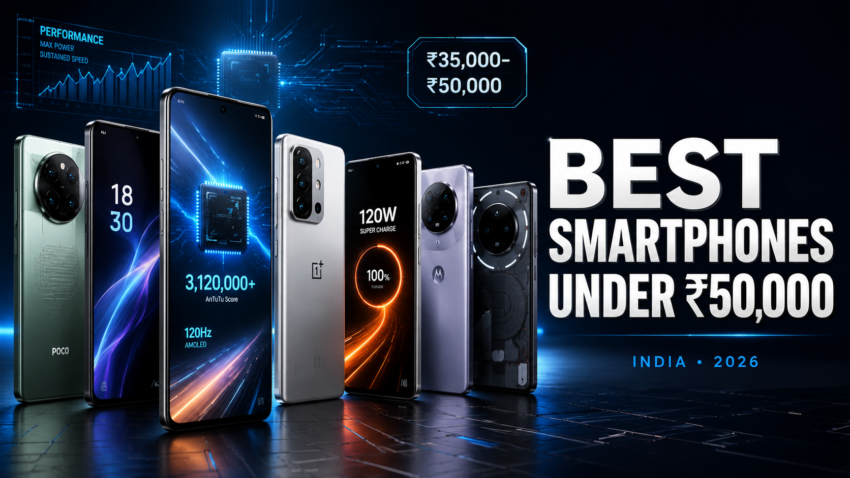
The ₹35,000 – ₹50,000 segment has quietly become one of the most competitive brackets in the Indian smartphone market. Chipsets that powered flagships two years ago now show up here, batteries have grown past 7,000mAh on several models, and 120W charging is no longer reserved for premium phones. If you’re wondering whether it’s even worth upgrading your smartphone every year, a genuine generational jump like this is a reasonable trigger.
This guide is built around one idea: performance comes first, not camera glamour shots or marketing bullet points. Every phone below earns its place through how it handles gaming, multitasking, and sustained workloads, with camera, display, and battery treated as secondary factors.
Quick Comparison Table
| Smartphone | Approx. Price | Processor | RAM/Storage | Display | Main Camera | Battery | Charging | Best For |
| POCO X8 Pro Max | ₹46,999 | Dimensity 9500s | 12GB/256GB | 6.83″ AMOLED, 120Hz | 50MP | 8,500mAh | 100W | Best overall performance |
| OnePlus Nord 6 | ₹46,999 | Snapdragon 8s Gen 4 | 8GB/256GB | 6.78″ AMOLED, 165Hz | 50MP | 9,000mAh | 80W | Best gaming |
| realme GT 7 | ₹41,999 | Dimensity 9400e | 8GB/256GB | 6.78″ LTPO AMOLED, 120Hz | 50MP | 7,000mAh | 120W | Best value performance |
| Xiaomi Redmi Turbo 5 | ₹41,999 | Dimensity 8500 Ultra | 8GB/256GB | 6.59″ AMOLED, 120Hz | 50MP | 7,540mAh | 100W | Best balanced performer |
| Motorola Edge 70 Pro+ 5G | ₹46,999 | Dimensity 8500 Extreme | 12GB/256GB | 6.8″ Extreme AMOLED, 144Hz | 50MP triple | 6,500mAh | 90W | Best camera + performance |
| vivo V70 Elite | ₹45,999 | Snapdragon 8s Gen 3 | 8GB/256GB | 6.59″ AMOLED, 120Hz | 50MP triple | 6,500mAh | 90W | Best battery + performance |
| Nothing Phone 4a Pro | ₹43,880 | Snapdragon 7 Gen 4 | 8GB/128GB | 6.83″ AMOLED, 144Hz | 50MP triple | 5,400mAh | 50W | Best value |
Prices are approximate India street prices as of 22 August 2026, sourced from 91mobiles, and can shift with bank offers and festive discounts.
Best Smartphones Under ₹50,000
1. POCO X8 Pro Max — Best Overall Performance
Price: ₹46,999 (12GB/256GB) | Processor: MediaTek Dimensity 9500s
The X8 Pro Max is the clearest “flagship killer” here. Its Dimensity 9500s pushes AnTuTu scores past 3 million, normally seen only in true flagships, staying composed under sustained load thanks to a large vapour chamber. Gaming is where it separates itself: heavy titles hold high frame rates for extended sessions without the stutters that plague weaker chipsets.
The 6.83-inch QHD+ AMOLED display is bright at 120Hz, and the 8,500mAh battery is class-leading. The main compromise is the camera, which skips a telephoto lens, and the phone runs warm during long gaming sessions.
Pros: Flagship-tier AnTuTu scores, huge battery, 100W charging, IP68/IP69K rating. Cons: No telephoto camera, runs warm under sustained gaming. Best for: Buyers who want the fastest chip in this price band and don’t mind sacrificing zoom photography. Skip if: You shoot a lot of zoomed photos or prioritise cooler running over peak benchmarks
2. OnePlus Nord 6 — Best Gaming Performance
Price: ₹46,999 (8GB/256GB) | Processor: Snapdragon 8s Gen 4
The Nord 6 is built around one goal: smooth, sustained gaming. The Snapdragon 8s Gen 4 with a 165Hz AMOLED display holds a stable 60fps in demanding titles like Genshin Impact for over an hour without thermal spikes. OxygenOS stays fluid throughout, and the 9,000mAh battery is the largest here, lasting into a second day with regular gaming.
Camera performance is respectable rather than exceptional, and the ultrawide lens is the clear weak point. The polycarbonate frame keeps weight down but feels less premium in hand.
Pros: Sustained gaming performance, two-day battery life, 80W charging. Cons: Weak ultrawide camera, polycarbonate build feels less premium, no wireless charging. Best for: Mobile gamers who want long sessions without thermal throttling. Skip if: Camera versatility matters more to you than gaming stamina
3. realme GT 7 — Best Value for Flagship-Grade Power
Price: ₹41,999 (8GB/256GB) | Processor: MediaTek Dimensity 9400e
At under ₹42,000, the GT 7 packs a flagship-tier Dimensity 9400e chipset, the same silicon family used in pricier phones. GT Boost mode, paired with vapour chamber cooling, keeps performance stable at 120fps across most competitive titles. The 7,000mAh battery and 120W charging let it charge from empty in about 15 minutes.
The main trade-off is the ultrawide camera, which lags behind the primary sensor, and it ships with a fair amount of pre-installed bloatware.
Pros: Flagship chipset at a mid-range price, exceptional 120W charging, excellent display brightness. Cons: Average ultrawide camera, noticeable pre-installed apps. Best for: Buyers who want the highest performance-per-rupee. Skip if: You want a cleaner software experience out of the box
4. Xiaomi Redmi Turbo 5 — Best Balanced Performer
Price: ₹41,999 (8GB/256GB) | Processor: MediaTek Dimensity 8500 Ultra
The Redmi Turbo 5 doesn’t lead any single category but does almost everything well. The Dimensity 8500 Ultra handles gaming and multitasking confidently, and its 7,540mAh battery, the largest ever on a Redmi phone in India, stretches past a full day. The 100W charging tops it up in roughly 35 minutes.
Its 6.59-inch AMOLED display is sharp and bright at up to 3,500 nits. Camera hardware is the weakest link: no telephoto lens, and the ultrawide trails the primary sensor. It also runs warmer than rivals under extended gaming.
Pros: Massive battery with fast charging, bright AMOLED display, durable IP69K build. Cons: No telephoto lens, average ultrawide, warms under heavy use. Best for: Buyers who want one dependable, well-rounded phone without chasing a single spec. Skip if: Camera versatility is a higher priority than battery and display
5. Motorola Edge 70 Pro+ 5G — Best Camera + Performance Combination
Price: ₹46,999 (12GB/256GB) | Processor: MediaTek Dimensity 8500 Extreme
This is the most camera-capable phone here without giving up performance. Its triple 50MP setup includes a genuine periscope telephoto with 3.5x optical zoom, rare at this price, and low-light shots handle exposure better than rivals. The Dimensity 8500 Extreme, with 12GB RAM, handles daily use and gaming comfortably, if not at flagship pace.
At 7.19mm thick, it’s also the slimmest phone here, with strong IP68/IP69 durability. Battery life is merely adequate, and Motorola’s update commitment trails Samsung and Google.
Pros: Periscope telephoto camera, slim durable design, capable all-round performance. Cons: Battery life is average for the segment, fewer guaranteed OS updates. Best for: Buyers who want strong zoom photography without sacrificing performance. Skip if: All-day battery matters more to you than camera versatility
6. vivo V70 Elite — Best Battery + Performance Combination
Price: ₹45,999 (8GB/256GB) | Processor: Snapdragon 8s Gen 3
The V70 Elite pairs dependable Snapdragon 8s Gen 3 performance with strong endurance, rated for over 18 hours of active use. Its triple 50MP camera, including a 3x telephoto, performs reliably across daylight and portraits, and the flat-edge glass-metal design feels premium in hand.
It isn’t the fastest chip here, and the 8MP ultrawide camera trails the other two lenses. It also carries a fair amount of pre-installed software.
Pros: Excellent all-day battery, dependable telephoto camera. Cons: Not the fastest chipset here, weak ultrawide camera. Best for: Buyers who want strong everyday performance without babysitting battery life. Skip if: You want the highest possible gaming benchmarks
7. Nothing Phone 4a Pro — Best Value Pick
Price: ₹43,880 (8GB/128GB) | Processor: Snapdragon 7 Gen 4
The 4a Pro is the most design-led phone here, with Nothing’s distinctive Glyph Matrix and clean, close-to-stock software. The Snapdragon 7 Gen 4 handles everyday tasks, casual gaming, and Android Auto smoothly, though it sits a tier below the Dimensity and Snapdragon 8-series chips elsewhere here. Its bright 6.83-inch, 144Hz AMOLED display is a genuine highlight at this price.
Camera output is good rather than outstanding, and the 5,400mAh battery, while solid, is the smallest capacity here. It’s also the only phone with just 128GB base storage.
Pros: Distinctive design, clean software, bright display, dependable performance. Cons: Smallest battery here, camera slightly inconsistent, base storage capped at 128GB. Best for: Buyers who want standout design and clean software over outright benchmark leadership. Skip if: Sustained gaming performance is your top priority
Performance Ranking
Based on the chipsets, sustained benchmarks, and gaming behaviour discussed above:
- Best overall performance: POCO X8 Pro Max
- Best gaming performance: OnePlus Nord 6
- Best balanced performer: Xiaomi Redmi Turbo 5
- Best camera + performance combination: Motorola Edge 70 Pro+ 5G
- Best battery + performance combination: vivo V70 Elite
- Best value under ₹50,000: realme GT 7
External Expert Reviews
GSMArena on the POCO X8 Pro Max: a well-rounded “flagship killer” with class-leading battery and strong sustained performance, though the missing telephoto lens is a genuine gap. (Read)
Beebom on the OnePlus Nord 6: stable frame rates in Genshin Impact with well-controlled thermals, held back mainly by a weaker ultrawide camera. (Read)
GSMArena on the realme GT 7: flagship-adjacent Dimensity 9400e performance and stable high-refresh gaming via GT Boost, with an average ultrawide camera as the main drawback. (Read)
Digit.in on the Redmi Turbo 5: strong all-round performance, quality AMOLED display, and excellent battery life, though cameras aren’t class-leading and it warms under heavy use. (Read)
91mobiles on the Motorola Edge 70 Pro+ 5G: one of the most balanced phones under ₹50,000, citing its vibrant display and periscope camera, with battery efficiency and updates as weaker points. (Read)
GSMArena on the vivo V70 Elite: a premium AMOLED display and 50MP primary-telephoto pairing as strong points of a well-rounded V-series debut. (Read)
TechRadar on the Nothing Phone 4a Pro: distinctive design, bright screen, and solid performance for a mid-range chip, though the camera is slightly inconsistent and the battery fell short of estimates. (Read)
How to Choose a Smartphone Under ₹50,000 in 2026
Processor and GPU: The single biggest factor in how a phone feels two years from now. The Dimensity 9400e/9500s and Snapdragon 8s-series chips here outperform last year’s mid-range silicon.
Sustained performance and thermals: A high benchmark score means little if the phone throttles after ten minutes of gaming. Vapour chamber cooling, present on the POCO, realme, and OnePlus picks, matters more than peak numbers alone.
RAM and storage: More RAM does not automatically mean better performance; the processor and software optimisation matter more. Our look at whether 16GB RAM is actually necessary in 2026 found 12GB already covers nearly all real-world use, and every phone here meets that bar. If you record a lot of 4K video, our storage guide is worth checking, since 128GB base models like the Nothing Phone 4a Pro fill up faster than expected.
Display: Look for at least 120Hz AMOLED with high peak brightness; every phone here clears that bar.
Battery and charging: Capacity above 6,500mAh with 80W+ charging is now standard here and genuinely changes daily usability.
Camera system: A higher megapixel count tells you little; sensor size and stabilisation matter more. If cameras matter more than performance, our Best Camera Phones in India guide covers that angle.
Software support: Check how many years of OS and security updates a brand commits to. If on-device AI factors into your decision, our guide to which AI smartphone features actually matter in 2026 is worth a cross-check.
Build quality: Several phones here use Gorilla Glass Victus rather than newer Victus 2 or Gorilla Armor. Our piece on whether Victus still holds up in 2026 is worth reading if durability matters to you.
Connectivity and after-sales support: Confirm 5G band compatibility with your carrier and local service centre availability.
Best Choice by User Type
- Gamers: OnePlus Nord 6, for sustained frame rates and the largest battery here
- Heavy multitaskers: POCO X8 Pro Max, for raw chipset headroom
- Camera-focused users: Motorola Edge 70 Pro+ 5G, for its periscope telephoto lens
- Students and professionals: Xiaomi Redmi Turbo 5, for all-day battery and dependable everyday performance
- Long-term users: vivo V70 Elite, for its balance of performance, battery, and build
- Best overall performance: POCO X8 Pro Max
Final Verdict
If performance is your top priority, the POCO X8 Pro Max is the best overall smartphone here, backed by the strongest benchmarks and battery in this bracket. For flagship-grade silicon at the lowest price, the realme GT 7 is the best performance-focused pick and arguably the best value overall. Gamers should look at the OnePlus Nord 6, which sustains frame rates longer than anything else here. If camera versatility alongside solid performance matters most, the Motorola Edge 70 Pro+ 5G is the clearest choice. And if design and software polish matter as much as raw speed, the Nothing Phone 4a Pro rounds this list out as a well-priced alternative.
No single phone wins every category: match the pick to daily use, not the biggest spec sheet number.
Prices in this article are approximate and sourced from retailer listings as of 22 August 2026; always verify current pricing before purchase, since discounts and bank offers change frequently.

Harry S is a digital marketing expert with 19+ years of experience. He created Reviews-4u.com to share simple, research-backed product insights that help users make better buying decisions.