
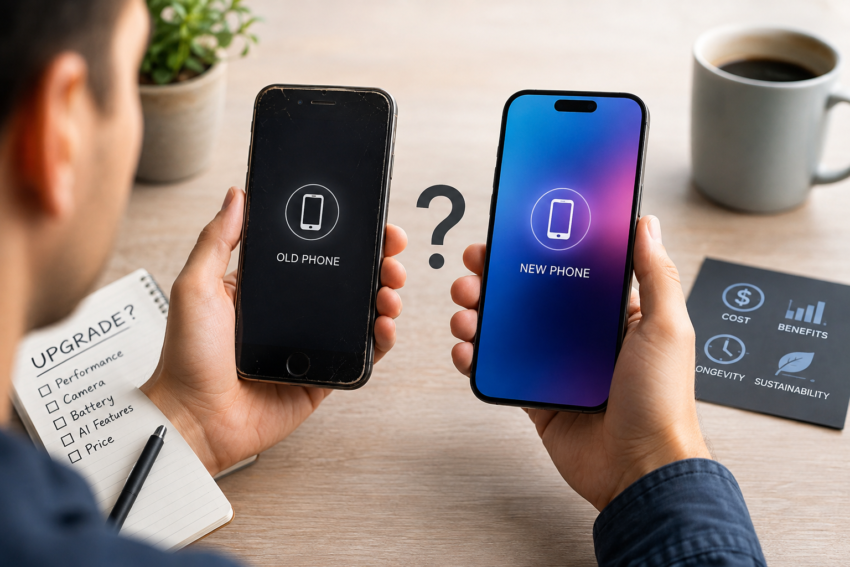
A new phone launches every year with a faster chip, a sharper camera, more RAM, and a fresh list of AI features. Within days, last year’s flagship starts to feel a little behind, even though nothing about it has changed. That’s the marketing doing its job, turning a capable phone into something that feels dated overnight.
Before upgrading your smartphone, ask a more honest question: has your current phone actually gotten worse, or has a newer model simply arrived? This isn’t an argument for keeping a phone for five years regardless; it’s about knowing when a new smartphone delivers a real improvement, and when it’s just a bigger number on a spec sheet.
Quick answer: For most people, upgrading every year isn’t worth it; gains in performance, cameras, and AI are usually too incremental to justify the cost annually. It makes more sense to do it sooner if your battery has degraded significantly, a hardware limitation is genuinely holding you back, or your work depends on a specific new capability.
Why Annual Smartphone Upgrades Are So Tempting
Flagship launches follow a predictable yearly rhythm, and manufacturers are good at making last year’s phone look tired by comparison. Trade-in offers soften the sticker shock, glossy camera samples suggest a leap in quality, and processor names change often enough that most buyers can’t tell which jump is meaningful. AI features get top billing at nearly every launch, whether or not they change daily use. Social pressure plays a role too; a two-year-old phone can start to feel embarrassing to pull out, regardless of how well it still works.
The important distinction: a phone being replaced by a newer model on a shelf doesn’t mean the phone in your pocket has become obsolete.
What Actually Changes After One Year?
Performance. Processors get faster and more efficient each year, but this rarely shows up in messaging, browsing, or scrolling. It’s noticeable in heavy gaming, 4K editing, multitasking, or intensive on-device AI.
Camera. A higher megapixel count alone tells you little. Sensor size, processing, low-light handling, and stabilisation shape quality more; our guide to the best camera phones in India covers this further. A one-generation jump is often subtle; two or three usually isn’t.
Battery. Age matters more than generation here. A phone that’s lost real capacity over a year can be a stronger reason to upgrade than one “a generation behind.” Check whether a battery replacement, a fraction of a new phone’s cost, solves it first.
Display. Brightness, refresh rate, and outdoor visibility improve, but the jump is usually more noticeable across two or three years than one. Durability matters too. Our look at whether Gorilla Glass Victus still holds up in 2026 is worth a read if screen protection factors in.
Software. Long-term support is now one of the most important factors in how long a phone stays usable. Samsung and Google guarantee seven years of OS and security updates on recent flagships; Apple’s iPhones typically get five to six.
Does More RAM Mean Upgrading Your Smartphone?
More RAM on a spec sheet doesn’t automatically mean a phone will feel faster. RAM mainly determines how many apps stay ready in the background before one gets closed; actual speed depends far more on the processor, storage speed, and how well the OS manages memory. Our deeper look at whether 16GB RAM is actually necessary in 2026 found that most users don’t notice a meaningful difference above 12GB; the gap opens only for heavy gaming, video editing, or running several demanding apps together. If a salesperson leans on the RAM number alone, look at the rest of the spec sheet instead.
The AI Smartphone Upgrade Question

Are AI features a genuine reason to upgrade in 2026? Every launch now leads with AI, photo editing, live translation, writing assistance, voice assistants, smarter search. Some of this is genuinely useful; some is a feature list padded for a press release.
Before letting an AI feature justify an upgrade, ask: Is it exclusive to new hardware, or will it reach your phone via a software update? Would you actually use it regularly? Does it noticeably improve something you already do daily? Is the benefit large enough to justify the price difference?
Our breakdown of which AI smartphone features actually matter is a useful reference: computational photography, live translation, call summaries, and adaptive battery management deliver real value, while AI wallpaper generators and emoji creators mostly don’t. Much of the newer AI capability also arrives on existing phones via software updates, so check your update history first.
AI isn’t automatically a reason to upgrade; it’s a reason worth checking case by case, like any other spec.
When Upgrading Every Year Actually Makes Sense
- You rely on your phone heavily for work. Professionals using it daily for calls, documents, and photography can benefit from gains in speed, camera quality, or battery life.
- You’re a mobile gamer. Performance improvements matter more here than for casual users.
- Photography matters to you. If you shoot regularly, camera-generation jumps show up clearly in results.
- Battery health has dropped noticeably. A phone that no longer lasts a full day is a legitimate reason to replace it — though a battery swap is worth checking first.
- You have a genuine hardware limitation. Poor network reception, storage that’s constantly full (our storage guide covers how much people need), a broken component, or overheating.
- Trade-in economics make it unusually cheap. What matters is the effective cost after trade-in, not the sticker price.
When You Probably Should NOT Upgrade
If your phone is around a year old, battery life is solid, performance handles what you throw at it, the camera meets your needs, and updates are still arriving, there’s rarely a compelling reason to replace it. The same goes if the newer model’s AI features don’t interest you, or the improvements are mostly incremental; a slightly better sensor, a marginally faster chip, numbers that look good on paper but won’t change how the phone feels day to day.
The 1-Year vs 2-Year vs 3-Year Upgrade Cycle
No single cycle suits everyone, but the trade-offs are worth knowing:
| Cycle | Pros | Cons |
|---|---|---|
| Every year | Newest hardware, strongest trade-in value, latest cameras and AI | Highest total cost, frequent setup, gains often too small to notice |
| Every 2 years | More visible improvement, moderate total cost | Misses some newest features between cycles |
| Every 3+ years | Biggest jump in performance, camera, and display per rupee | More trade-in depreciation, possible battery replacement needed |
Two years is a reasonable middle ground, balancing visible improvement against cost. Three years or longer stretches value further but raises the odds you’ll need a battery replacement along the way.
The Real Cost of Upgrading Every Year
The number that actually matters isn’t the new phone’s price; it’s the effective upgrade cost: what you pay minus what you get back for your current phone.
Effective upgrade cost = New phone price − Trade-in/resale value of current phone

As a hypothetical example: a ₹60,000 new phone against a ₹30,000 trade-in makes the effective cost ₹30,000, not ₹60,000 that’s the figure to weigh against how much better the new phone actually is.
The catch shows up over several years: a smaller annual amount can still add up to more than upgrading every two or three years, since trade-in values fall fastest in a phone’s first year, and you absorb that depreciation every time.
A Simple Smartphone Upgrade Checklist
- Is my phone fast enough for what I actually do?
- Is the battery holding up?
- Does the camera meet my needs?
- Am I still receiving software updates?
- Is there a feature I genuinely need, not just want?
- Does the new phone solve a real problem I have?
- What’s the effective cost after trade-in?
- Would a battery replacement fix my actual complaint?
- Will I notice the improvement daily, or only on a spec sheet?
- Would keeping my phone one more year serve me just as well?
If most answers favour your current phone, keep it. If several point to real limitations, an upgrade is worth considering.
Signs Your Phone Is Actually Ready for Replacement
Age alone isn’t the signal to watch for — condition and usefulness matter more. Genuine signs include noticeable battery drain, frequent crashes, storage that’s constantly full, cracked or failing hardware (our look at how well Gorilla Glass Victus holds up is worth reading if screen damage is the issue), a camera that no longer meets your needs, unreliable connectivity, missed security updates, apps that no longer support your OS version, or repairs costing disproportionately more than the phone’s remaining value.
What About Flagship vs Mid-Range Phones?
Upgrade cycles can differ by category. Flagship owners tend to already have strong processors, capable cameras, and long software-support windows, so a single-year upgrade often delivers a smaller practical gain. Mid-range buyers can sometimes see more noticeable improvements year to year, particularly if their current phone had real limitations — though affordability and actual need should still drive the decision. Our pick of the best budget smartphones in 2026 is a useful starting point for mid-range options.
The Environmental Side of Annual Upgrades
Every discarded phone adds to electronic waste and consumes the resources that went into manufacturing it. Extending a phone’s usable life by even a year a battery replacement, a repair, or simply skipping an unnecessary upgrade— reduces that footprint. Reselling or recycling a phone you no longer want beats letting it sit in a drawer. It’s not the deciding factor for most buyers, but it’s a reasonable tiebreaker when everything else points to “either choice is fine.”
So, How Often Should You Upgrade Your Smartphone?
There’s no universal answer, but for most users, a 2–3 year cycle offers the best balance between cost and meaningful improvement. Heavy gamers, professional photographers, and anyone whose current phone has a real limitation will get genuine value from upgrading sooner. Others can comfortably stretch ownership well beyond three years, particularly with a battery replacement along the way.
The deciding factor isn’t how new the latest launch is; it’s whether the new phone solves a problem you actually have, or adds enough real value to justify what it costs.
Final Verdict
You don’t need to upgrade your smartphone simply because a newer model has launched. Upgrade when your current phone stops meeting your needs, or when a new device offers improvements substantial enough to justify what it costs. That’s not an argument against enjoying new technology; it’s an argument for deciding on purpose instead of on autopilot.
Explore More on Reviews-4U.com
- Do You Really Need a Foldable Smartphone?
- Why Are You Still Overpaying for a Phone? 7 Budget Smartphones in 2026
- Best Camera Phones in India (2026): Full Buying Guide
- AI Smartphones in 2026: Features That Actually Matter Before You Buy
FAQ Section
Is it worth upgrading your smartphone every year? For most users, no gains are too incremental to justify the annual cost, unless work or a real limitation demands it.
How often should you replace your smartphone? Every two to three years offers the best balance of cost and improvement for most people.
Is a two-year-old smartphone still worth keeping? Usually, if the battery is healthy, performance meets your needs, and updates are still arriving.
Does a new processor justify upgrading? Only if you regularly run tasks that stress your current chip: heavy gaming, video editing, multitasking.
Do AI features make newer smartphones worth buying? Only if you’d use them regularly and they meaningfully improve a task you already do.
Is it cheaper to replace a phone battery or buy a new phone? A battery replacement is almost always cheaper and fixes the biggest complaint without the rest of the cost.

Harry S is a digital marketing expert with 19+ years of experience. He created Reviews-4u.com to share simple, research-backed product insights that help users make better buying decisions.