
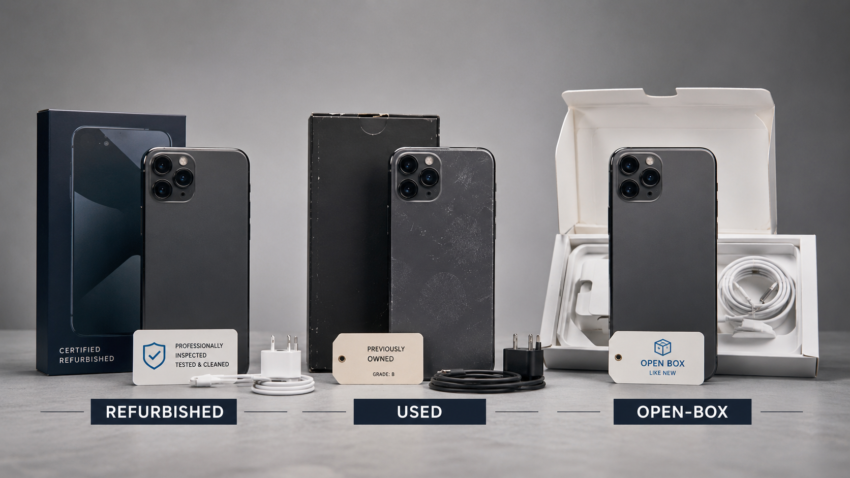
A new smartphone can cost ₹50,000 or more. A laptop with similar specs might run past ₹70,000. So when the same model shows up as “refurbished” for 30% less, “open-box” for a smaller discount, or simply “used” from a stranger online, it’s tempting to just grab whichever one is cheapest.
That’s usually the wrong way to decide. Refurbished, used, and open-box aren’t interchangeable words for “not new”, they describe genuinely different processes, risks, and value. Confusing them is how buyers end up overpaying for something with no real quality checks, or underpaying for something they didn’t fully understand.
So which one should you actually buy? The honest answer: it depends less on the label and more on who’s selling it. Here’s how to tell them apart before you spend a rupee.
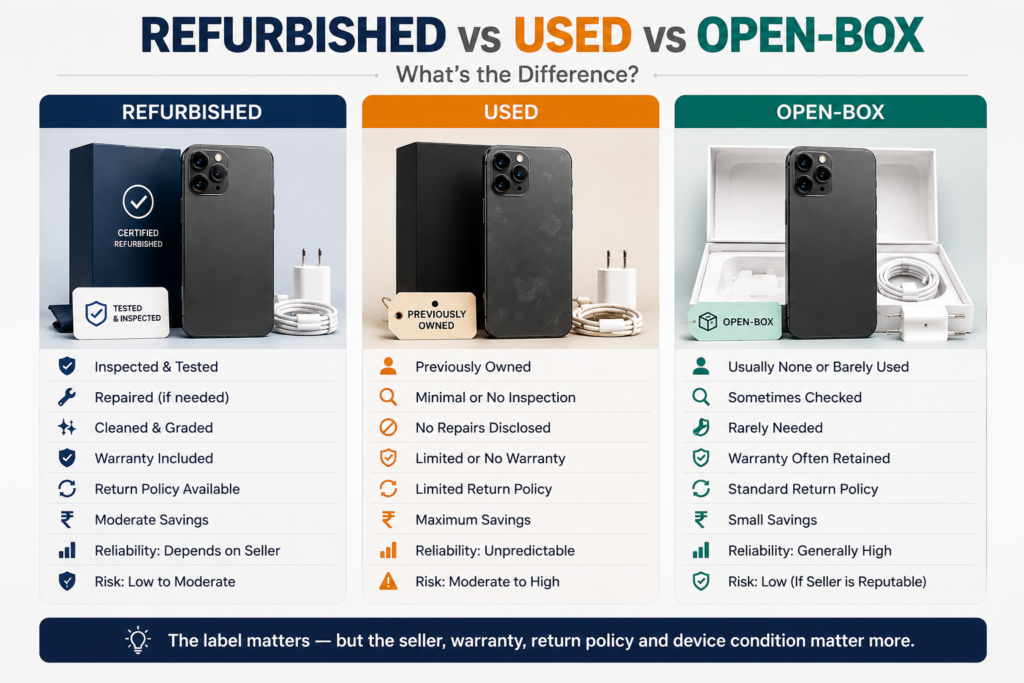
Refurbished vs Used vs Open-Box at a Glance
| Factor | Refurbished | Used | Open-Box |
| Previous owner | Yes, then returned/traded in | Yes, sold directly or via reseller | Usually none, or barely used |
| Inspection | Formal testing by seller/manufacturer | Rarely formal; seller’s word | Sometimes checked, sometimes not |
| Repairs | Defective parts often replaced | Usually none disclosed | Rarely needed |
| Cosmetic condition | Cleaned, graded, sometimes like-new | Varies widely | Near-new, occasionally opened packaging |
| Warranty | Often 3–12 months from refurbisher | Rare, seller-dependent | Frequently retains original warranty |
| Return policy | Usually offered by reputable sellers | Often none or very short | Typically standard retailer policy |
| Reliability | Depends heavily on refurbisher standard | Unpredictable | Generally high, but verify |
| Typical price | Moderate discount vs new | Largest discount, most variable | Smallest discount vs new |
| Risk level | Low to moderate, seller-dependent | Moderate to high | Low, if seller is reputable |
What Does Refurbished Actually Mean?
“Refurbished” doesn’t just mean second-hand — it implies a process: inspection, testing, cleaning, data wiping, and repair or replacement of faulty parts before resale.
That process isn’t standardised, though, and this is what buyers often miss. Manufacturer-refurbished products (Apple, Samsung, Dell, and similar) usually get the most rigorous testing, often with a fresh warranty. Certified refurbished listings from major retailers follow a documented checklist, though depth varies by platform. Seller-refurbished items range from genuinely well-restored to barely inspected, depending entirely on who did the work.
This is why the refurbisher’s identity matters as much as the label. A refurbished phone from a brand’s own store isn’t the same purchase as an identical listing from an unknown third-party seller. Not every refurbished product is restored to factory-new condition; assume “good working order,” not “indistinguishable from new,” unless the listing proves otherwise.
What Does Used Mean?
A used product is resold after ownership, without necessarily going through formal refurbishment. It might have been well cared for, or it might not; there’s no standard process guaranteeing either outcome.
Condition varies enormously between listings for the exact same model. Two used phones can differ in battery health, screen wear, included accessories, and whether they’ve been previously repaired, sometimes with non-original parts. Warranty is usually absent or expired, and return windows, if offered at all, tend to be short.
This unpredictability is the core trade-off with used electronics: savings can be significant, but so can the range of outcomes. Buying from a well-reviewed individual or a reputable resale platform is a very different risk than an anonymous classifieds listing with no history.
What Does Open-Box Mean?
Open-box describes a product whose packaging has been opened, but that isn’t automatically the same as “unused.” Common scenarios include a customer return, a display or demo unit handled in-store, packaging opened for inspection or by a previous buyer who changed their mind, or a box opened during shipping and repackaged.
The important nuance: a returned product could have been used for several days before coming back to the seller. “Open-box” tells you about the packaging, not necessarily the usage history. Reputable retailers grade open-box condition (e.g., “like new,” “good,” “fair”); always check that grading and the seller’s specific description rather than assuming the best case.
Refurbished vs Used vs Open Box: Which Is Safer?
There’s no universal winner. A certified refurbished device from a reputable seller, backed by warranty and a return policy, is often the lowest-risk option on paper. But a well-documented open-box laptop from a major retailer with a strong return window can be just as safe, since it likely hasn’t been used much at all.
Used electronics carry the widest range of outcomes: the best used deals (well-maintained, honestly described, fairly priced) can beat a mediocre refurbished listing, and the worst can be far riskier than either alternative.
The pattern that holds across all three: seller standards matter as much as the label. A trustworthy seller selling “used” stock responsibly will often serve you better than a low-effort refurbisher cutting corners.
Which Option Gives You the Best Value?
Value isn’t just price; it’s price weighed against condition, warranty, lifespan, and risk. The cheapest listing isn’t automatically the best deal once you factor in what happens if something goes wrong.
Example 1: A two-year-old used flagship, no warranty, sold “as-is.” Cheapest upfront, but if a component fails in month two, you cover the full repair cost yourself.
Example 2: A certified refurbished flagship with a 6-month warranty and documented testing. Costs more than Example 1, but the warranty absorbs early-failure risk, often making it the better real-world value.
Example 3: An open-box laptop from a reputable retailer with a 10-day return window and most of its original warranty intact. Smallest discount of the three, but close to new-purchase confidence.
Which makes sense depends on your risk tolerance and how long you’ll keep the device. A short-term, low-stakes purchase can justify the used route; something you’ll depend on daily for work usually justifies paying more for warranty coverage.
Refurbished vs Used vs Open Box for Smartphones
Before buying a pre-owned or refurbished smartphone, physically check: battery health (arguably the most important factor; ask for a percentage where the OS reports one), screen condition and touch responsiveness, all cameras, the charging port, speakers and microphones, and that the IMEI is clean and matches the box.
Also confirm network compatibility, and don’t assume water resistance still holds on an older or opened device; seals degrade. Check how many years of software updates the model has left. Factor in screen durability too: our look at whether Gorilla Glass Victus still holds up in 2026 is worth reading if the glass generation matters to you.
Storage tier matters more on a pre-owned phone than a new one, since you can’t upgrade it later; our guide to choosing between 128GB, 256GB, and 512GB can help you avoid a variant that’s already too small.
Battery condition deserves extra weight because, unlike a laptop, most phone batteries aren’t user-replaceable without a service visit, and degraded battery life is the most common complaint with older smartphones.
Refurbished vs Used vs Open-Box for Laptops
For laptops, inspect: battery cycle count or health percentage (available in most system settings), keyboard and trackpad responsiveness, the display for dead pixels or discoloration, all ports, and whether the fan runs unusually loud, a common sign of dust buildup or a struggling cooling system.
Ask what type of storage drive it uses; our breakdown of SSD vs HDD vs NVMe explains why this spec affects “slow” vs “fast” more than almost anything else, and why refurbished units sometimes still ship with older drive types. Confirm RAM is sufficient and upgradeable; our guide to how much RAM a laptop needs covers this in detail. Check hinges for looseness, ask about prior repairs, and confirm the charger is original or a genuine replacement.
Here’s where pre-owned laptops can outperform buying new on a tight budget: an older premium laptop, well maintained, can offer a better typing experience, display, and build quality than a new budget model at the same price. Our MacBook Air vs Pro vs Neo comparison is a useful reference for premium options that hold their value well on the refurbished market.
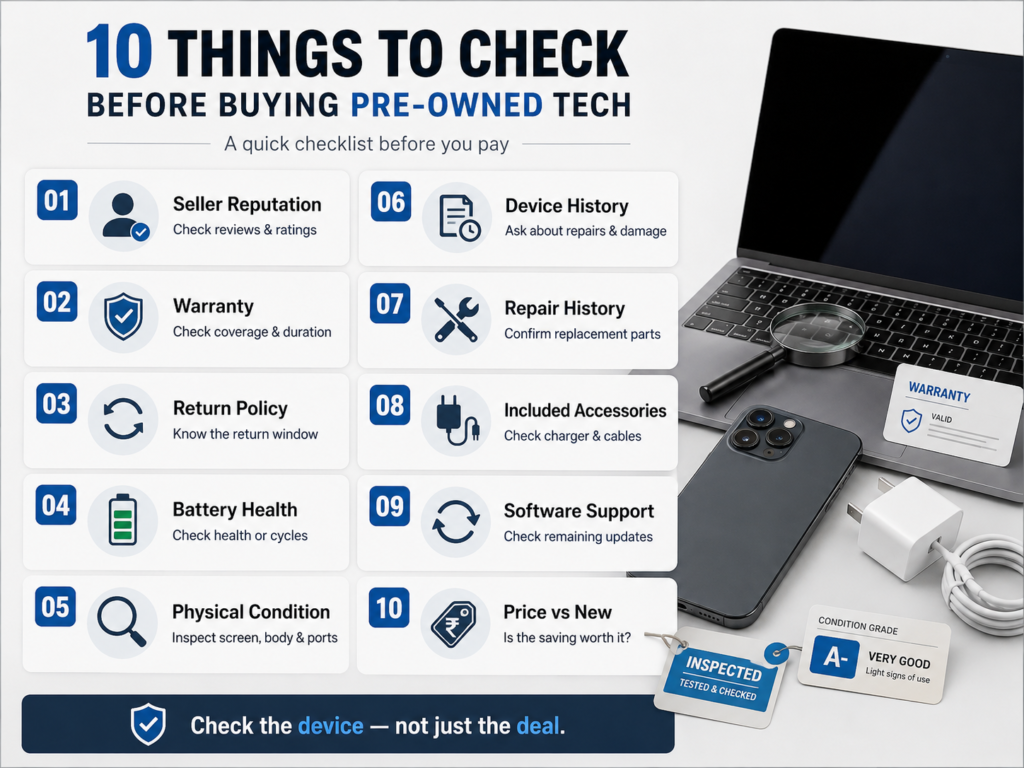
10 Things to Check Before Buying Any Pre-Owned Device
- Seller reputation — reviews, ratings, and how long they’ve been selling.
- Warranty — how long, and does it cover parts and labour.
- Return policy — window length and any conditions attached.
- Battery condition — health percentage or cycle count, not just “good.”
- Physical condition — screen, body, ports, and hinges (for laptops).
- Device history — prior repairs, water damage, or ownership changes.
- Repairs disclosed — ask specifically; don’t assume none happened.
- Accessories included — original charger, box, cables.
- Software and security updates — how many years the model has left.
- Final price vs new — is the discount large enough to justify the risk?
For a deeper checklist specifically for laptops, our guide to common laptop buying mistakes covers several of these points in more depth.
Red Flags You Should Not Ignore
Be cautious if you encounter: no return policy at all, no warranty of any kind, a seller who avoids or deflects questions about the device’s history, a price that’s unusually low compared to similar listings, missing or unverifiable serial/IMEI information, visibly poor-quality replacement parts, significant battery degradation the seller downplays, a device reported locked to a network or account, requests for unusual or untraceable payment methods, and “as-is” condition with no explanation of what that actually covers.
None of these automatically mean a scam, but each one raises the risk enough to ask more questions before paying.
Is Refurbished Technology Worth Buying in 2026?
Refurbished technology is worth buying when the savings are meaningful, it gets you a premium model you couldn’t otherwise afford, a genuine warranty is included, the refurbisher has a solid reputation, and the device still qualifies for software updates.
Buying new tends to make more sense when the price gap is small, you plan to own the device for many years, you’re particularly sensitive to battery health, it’s essential equipment for work where downtime is costly, or the newest model offers a genuinely significant hardware improvement. If you’re mainly weighing whether last year’s model is really behind, our take on whether it’s worth upgrading your smartphone every year walks through that decision in more depth.
Neither choice is universally correct — it depends on your specific situation more than any general rule.
Which One Should You Buy?
| Buyer Type | Best Option |
| Maximum savings | Used |
| Lower risk | Certified refurbished |
| Nearly-new condition | Open-box |
| Long-term reliability | New or certified refurbished |
| Premium device on a budget | Refurbished |
| Lowest possible price | Used, with careful inspection |
These are general starting points, not guarantees; your final decision should still rest on the specific seller, listing, and device in front of you.
Final Verdict
Don’t buy based on the label alone. A good refurbished product from a trustworthy seller can be a far better purchase than a poorly maintained used device, even at a similar price. Likewise, an open-box product can be excellent value when the return policy and remaining warranty are strong.
Before you buy, compare condition, warranty, return policy, battery health, price, and remaining software support across every option in front of you, rather than simply choosing whichever one costs the least. That comparison, more than the label on the listing, is what actually determines whether you end up with a good deal or a regret.
FAQ
Is refurbished better than used? Generally yes, for reliability; refurbished items usually get some testing and often a warranty. But a well-maintained used item from a trustworthy seller can still beat a poorly refurbished one.
Is it safe to buy a refurbished smartphone? Yes, when bought from the manufacturer or a reputable, certified refurbisher offering a warranty and a clear return policy. Safety drops with unverified sellers offering no guarantees.
Are open-box products worth buying? Often, yes. They’re frequently barely used and still carry most of the original warranty, at a smaller discount than refurbished or used options.
What should I check before buying a used phone? Battery health, screen and camera condition, IMEI status, network compatibility, remaining software support, and whether the seller discloses prior repairs or damage.
How much cheaper should refurbished electronics be? There’s no fixed rule, and exact-percentage claims vary by seller and model. Focus on whether the price reflects the device’s actual condition, warranty, and included accessories, rather than expecting a specific discount.

Harry S is a digital marketing expert with 19+ years of experience. He created Reviews-4u.com to share simple, research-backed product insights that help users make better buying decisions.