
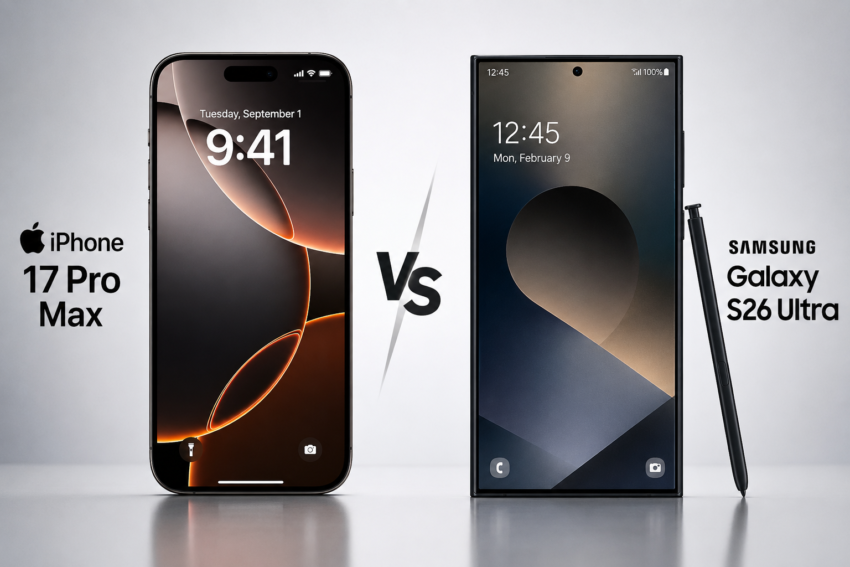
If you’ve narrowed a ₹1 lakh-plus phone purchase down to these two, you already know both are excellent; that’s what makes the decision hard. The iPhone 17 Pro Max and Samsung Galaxy S26 Ultra represent different philosophies: Apple’s consistency-first approach versus Samsung’s everything-included, S Pen-equipped versatility. The right choice depends on which trade-offs actually affect your day-to-day use, not which phone wins more spec-sheet rows.
Quick Verdict: The iPhone 17 Pro Max wins on video consistency, camera predictability, and resale value. The Galaxy S26 Ultra wins on zoom versatility, charging speed, display privacy, and productivity via the S Pen. If you already own a Mac or Apple Watch, the iPhone is the easier call; if you use Windows and want maximum flexibility, the S26 Ultra pulls ahead.
iPhone 17 Pro Max vs Samsung Galaxy S26 Ultra: At a Glance
| Feature | iPhone 17 Pro Max | Samsung Galaxy S26 Ultra |
| India Price (base) | ₹1,49,900 launch / ~₹1,43,990 current (256GB) | ₹1,39,999 launch / ~₹1,18,000–₹1,24,999 current (256GB) |
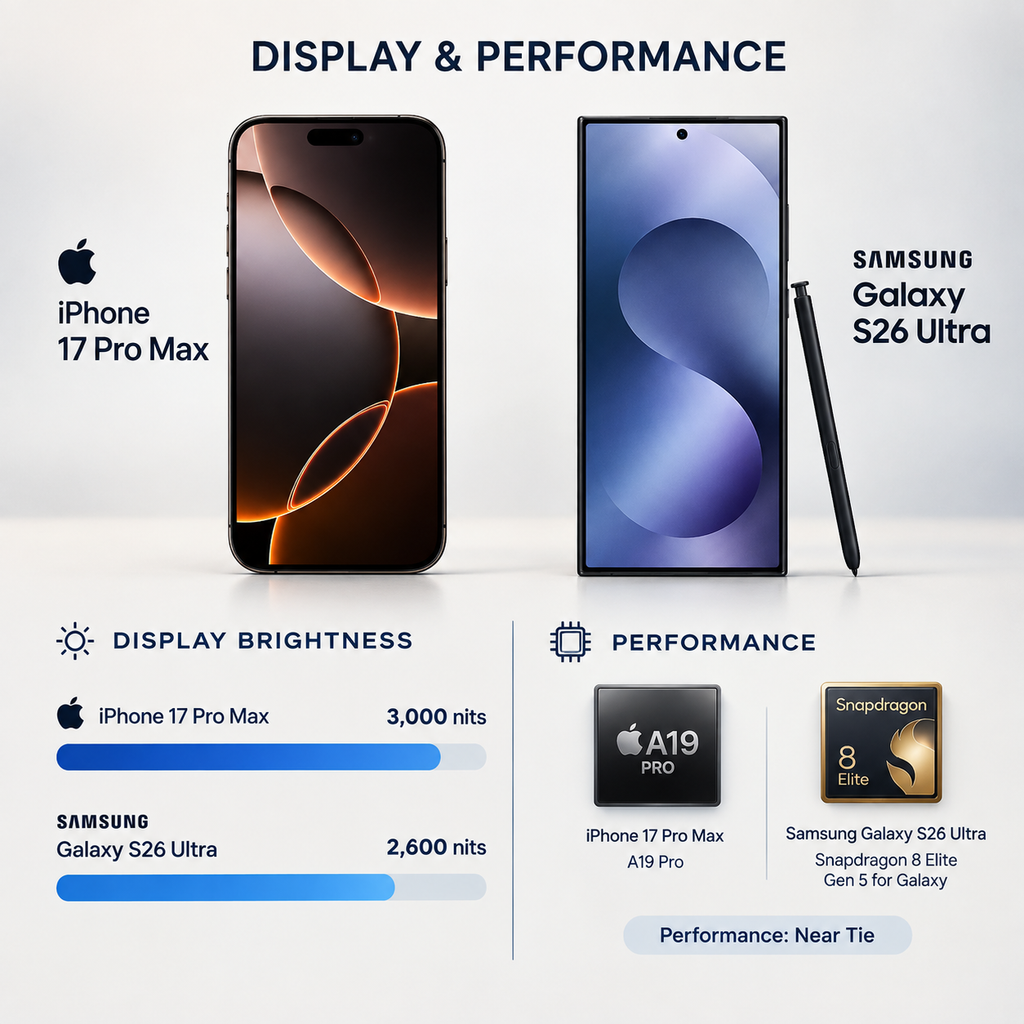
| Display | 6.9″ OLED, 1–120Hz, 3,000 nits | 6.9″ AMOLED 2X, 1–120Hz, 2,600 nits, Privacy Display |
| Processor | Apple A19 Pro (3nm) | Snapdragon 8 Elite Gen 5 for Galaxy (3nm) |
| RAM | ~12GB (unofficial) | 12GB / 16GB (1TB variant) |
| Storage | 256GB / 512GB / 1TB / 2TB | 256GB / 512GB / 1TB |
| Main Camera | 48MP, f/1.78, sensor-shift OIS | 200MP, f/1.4, OIS |
| Ultra-wide | 48MP, f/2.2 | 50MP, f/1.9 |
| Telephoto | 48MP, 4x optical (8x optical-quality), f/2.8 | 10MP 3x + 50MP 5x periscope |
| Front Camera | 18MP Center Stage, f/1.9 | 12MP, f/2.2 |
| Video | 4K Dolby Vision @120fps, ProRes, Log | 8K @30fps, log recording, Nightography |
| Battery | ~4,823mAh, up to 39 hrs video (claimed) | 5,000mAh, up to 31 hrs video (claimed) |
| Charging | 40W wired, MagSafe/Qi2 wireless | 60W wired, 25W wireless (Qi2.2) |
| OS | iOS 26 | Android 16 / One UI 8.5 |
| Software Support | 5–6 years (typical Apple policy) | 7 years OS + security updates |
| Weight | 233g | 214g |
| Water Resistance | IP68 | IP68 |
| Stylus | No | S Pen (built-in) |
| AI Platform | Apple Intelligence | Galaxy AI |
Price in India: Which Phone Gives You More for the Money?
Short answer: The iPhone costs more at every tier, but the Galaxy has depreciated faster since launch; the real-world gap is wider than the launch prices suggest.
Apple launched the 17 Pro Max in September 2025 at ₹1,49,900 (256GB), rising to ₹1,69,900, ₹1,89,900, and ₹2,29,900 for higher storage. A year on, street prices sit around ₹1,43,990–1,44,900 — Apple rarely discounts its current Pro line meaningfully in India.
Samsung’s S26 Ultra launched in March 2026 at ₹1,39,999 (256GB) but has since seen aggressive promotional pricing, with current listings around ₹1,18,000–₹1,24,999 for the same variant — often ₹20,000–₹25,000 less than the iPhone, once offers are factored in. If you’re also weighing the smaller S26 and S26+ against the Ultra, our full Samsung Galaxy S26 Series Review breaks down what you give up by stepping down a tier. That gap roughly covers Samsung’s 512GB variant against Apple’s 256GB one. If you keep a phone four-plus years, though, the iPhone’s stronger resale value (see the ownership section below) claws some of it back.
Design and Build Quality
Both use a 6.9-inch display and IP68 aluminium-and-glass construction, but they feel different in hand. The S26 Ultra is lighter (214g vs 233g) and thinner (7.9mm vs 8.75mm), and Samsung’s more rounded corners make it easier to hold one-handed than its predecessor. The iPhone’s squared-off frame and camera plateau feel denser and more deliberate — a preference, not a functional edge.
Samsung uses Gorilla Armor 2; Apple uses Ceramic Shield 2, both well ahead of the Gorilla Glass Victus still common on mid-range phones (our breakdown of how smartphone glass has evolved explains what actually changes between generations). The built-in S Pen adds no real bulk but is one more component to eventually service.
Verdict: Lighter, more pocketable S26 Ultra for one-handed use; a more rigid, symmetrical feel on the iPhone if you don’t need a stylus.
Display Comparison
Which display is better in everyday use?
Short answer: The iPhone is brighter (3,000 vs 2,600 nits), better for outdoor visibility; the Galaxy has a sharper QHD+ panel and the unique Privacy Display, which narrows the viewing angle so only you can read the screen in public.
Both run adaptive 1–120Hz panels that look excellent for video, gaming, and scrolling; differences show up mainly in direct sunlight and privacy-conscious situations, not general sharpness. Samsung’s Privacy Display is a genuine hardware feature, not a software trick, and a real reason to prefer the S26 Ultra if you handle banking apps or work email in public often.
Verdict: Slight edge to iPhone for brightness; a situational but genuine edge to Samsung for privacy.
Performance: A19 Pro vs Snapdragon 8 Elite Gen 5
Which phone is faster, and will you notice?
Short answer: Both chips handle anything a flagship buyer needs today. Apple’s A19 Pro typically leads single-core CPU and sustained GPU benchmarks; Samsung’s Snapdragon 8 Elite Gen 5 for Galaxy holds its own in multi-core and AI workloads. In daily use, neither will feel like a bottleneck.
The gap shows up in sustained heavy tasks, long 4K/8K exports, extended gaming, and running several AI features at once. Samsung’s redesigned vapor chamber reduces throttling versus the S25 Ultra; Apple’s own vapor chamber cooling keeps the A19 Pro near peak clocks for longer than previous Pro Max generations.
Apple doesn’t officially disclose RAM, but teardowns put the 17 Pro Max at roughly 12GB, matching the S26 Ultra’s base tier (the 1TB Galaxy variant gets 16GB). iOS manages memory more aggressively than Android, so the platforms don’t need identical RAM for comparable multitasking. Our guide on whether 16GB RAM actually matters in 2026 explains why the number alone predicts little.
Verdict: Effectively a tie for most buyers. Decide on camera and ecosystem instead.
Camera Comparison
Main camera: Samsung’s 200MP sensor with a wider f/1.4 aperture gathers more light, producing brighter, punchier daylight shots straight out of the camera. Apple’s 48MP sensor, paired with an updated Photonic Engine, delivers flatter, more neutral colour and, per multiple independent comparisons, slightly sharper detail and more consistent exposure across repeated shots.
Ultra-wide: Both are competent rather than exceptional. Samsung’s larger pixels edge ahead in low light; Apple holds detail slightly better at frame edges.
Telephoto and zoom: The widest gap on paper. Samsung’s dual-telephoto (10MP 3x + 50MP 5x periscope) gives genuine reach and flexible framing. Apple’s single 48MP tetraprism lens covers native 4x, extending to 8x “optical-quality” via its larger sensor. Reviewers found the iPhone holds detail more reliably up to roughly 8–10x, while Samsung pulls ahead beyond that, though its marketed 100x “Space Zoom” is realistically usable only to about 20–30x.
Low light: Samsung’s wider aperture and Nightography produce brighter stills and faster autofocus lock; independent testing found the iPhone slightly ahead on clean detail retention.
Selfies and portraits: Both render natural skin tones with accurate edge detection. Apple’s 18MP square-sensor front camera captures a wider frame automatically, useful for group shots and video calls; Samsung’s 12MP is more conventional but well-tuned.
Video: The iPhone remains more editing-friendly; native 4K Dolby Vision at up to 120fps, ProRes, Log, and ProRAW give far more post-production flexibility. The Galaxy shoots up to 8K/30fps with log recording built into its stock camera app and Horizon Lock for automatic stabilisation while moving. For how both stack up against the wider camera-phone field, see our Best Camera Phones in India (2026) guide.
| Camera Category | Winner | Why |
| Daylight | Tie | iPhone sharper; Samsung brighter |
| Portraits | Tie | Different rendering styles, both natural |
| Low Light | Samsung | Brighter results, faster autofocus |
| Zoom | Samsung | Longer reach, flexible framing |
| Ultra-wide | Tie | Samsung ahead only at night |
| Selfies | iPhone | Wider frame for groups/calls |
| Video | iPhone | ProRes/Log editing workflow |
| Overall Camera | Tie | Depends on zoom vs. editing priorities |
Battery Life and Charging
Short answer: The iPhone lasts longer per charge; the Galaxy charges dramatically faster. Independent testing (Tom’s Guide’s web-browsing benchmark) recorded 17h54m for the iPhone against 16h10m for the Galaxy, consistent with Apple’s claimed 39 hours of video playback versus Samsung’s claimed 31.
Samsung pulls ahead on charging speed: 60W Super Fast Charging 3.0 reaches 75–80% in 30 minutes and a full charge in about 50 minutes. The iPhone’s 40W wired charging hits 50% in roughly 20 minutes but takes noticeably longer to top up fully. Neither ships a charging brick, so budget for one.
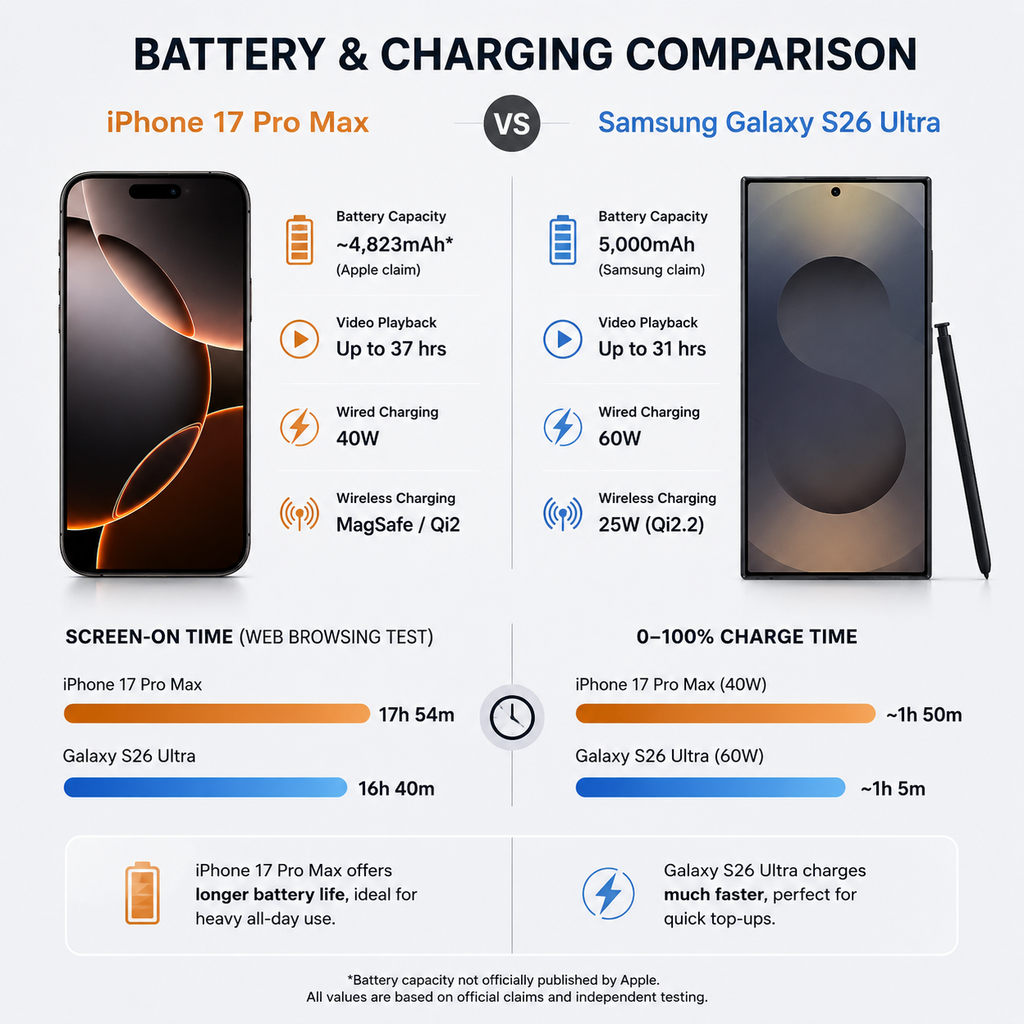
Verdict: Galaxy for quick top-ups before heading out; iPhone if you’d rather charge once overnight and not think about it again.
Software and AI: iOS vs One UI
iOS 26 stays simple and consistent — Apple Intelligence handles writing tools, photo cleanup, and notification summaries mostly on-device, routing sensitive requests through Apple’s Private Cloud Compute. It does fewer things, but predictably across every app.
One UI 8.5 is more customisable, with a broader Galaxy AI set on the S26 Ultra: Now Brief for daily summaries, Now Nudge for context-aware suggestions, Circle to Search, and Cross-App Actions that can draft a calendar reply automatically from a screenshotted invite. Our breakdown of which AI features actually matter is worth reading before weighing AI heavily. Several headline features on both platforms are genuinely useful; others are closer to demo-day novelty.
Better for whom: Casual users lean iOS for simplicity; power users and multitaskers get more from One UI’s customisation and DeX.
Ecosystem: Apple vs Samsung
This is the single biggest factor most buyers underweight. If you already own a Mac, Apple Watch, or AirPods, the iPhone plugs into Handoff, Universal Clipboard, and Find My in ways Android can’t replicate. Buying the S26 Ultra as an existing Apple-ecosystem user means reduced functionality or gradually replacing other devices, an expensive proposition.
The reverse holds too: Galaxy + Windows PC + Galaxy Watch users get Quick Share (which now interoperates with AirDrop), Phone Link for Windows, and Galaxy Watch health integration, none of which needs an Apple device.
The practical rule: a small camera or performance edge rarely outweighs an existing ecosystem investment. Own two or more Apple devices already? The iPhone is usually the sensible buy regardless of individual spec wins above — and the same logic runs in reverse for an established Samsung/Windows household.
S Pen and Productivity
Is the S Pen a genuine reason to choose Samsung?
Short answer: Yes, for a specific user. If you take handwritten notes, annotate PDFs, or sketch regularly, the built-in S Pen has no iPhone equivalent. If you’d never use it, it’s dead weight you’re still paying for.
Beyond notes, the S Pen enables quick markup, screen-off memo capture, and precise selection that’s faster than a finger for detailed work. Paired with Samsung DeX, the S26 Ultra can act as a lightweight desktop replacement on an external monitor for email and document editing, something Apple pushes to a Mac or iPad instead.
Gaming Comparison
Both handle current titles at high settings without difficulty. Samsung’s improved vapor chamber and ray-tracing support give strong sustained performance in long sessions; Apple’s A19 Pro generally posts higher raw GPU scores with tighter optimisation for games built for Apple silicon. Battery drain is roughly comparable given the Galaxy’s larger cell offsetting the iPhone’s typical efficiency edge.
Verdict: Narrow edge to iPhone on graphics benchmarks; Galaxy’s faster charging means less downtime between long sessions.
Connectivity and Everyday Features
Both support 5G, Wi-Fi 7, Bluetooth 6, USB-C, NFC payments, and dual biometrics (Face ID on iPhone; face and under-display fingerprint on Galaxy). Samsung includes UWB for Nearby Share; Apple’s Ultra Wideband serves Precision Finding within its own ecosystem. Both support eSIM alongside physical SIM in India and offer emergency satellite/SOS features, though availability varies by carrier.
Software Updates and Long-Term Ownership
Which phone makes sense for a 4–5 year hold?
Short answer: Samsung’s 7-year OS and security update commitment (through 2033) technically outlasts Apple’s typical 5–6 years, but iPhones have historically held resale value better in India, partly offsetting that gap for buyers who upgrade every few years.
Plan to run the phone into the ground? Samsung’s longer support window is the stronger paper commitment. Tend to sell within two to three years? The iPhone’s stronger resale value usually lowers effective ownership cost despite the higher sticker price. Our guide on whether it’s worth upgrading every year walks through calculating that effective cost properly rather than anchoring on launch price alone.
Which Phone Is Better for You?
Buy the iPhone 17 Pro Max if: you already own a Mac, Apple Watch, or AirPods; video is your primary creative use case; you prioritise resale value and simpler software; you want the brighter display; you prefer predictable camera results over versatility; you don’t need a stylus; you plan to upgrade within 2–3 years.
Buy the Samsung Galaxy S26 Ultra if: you need the S Pen for notes or sketching; you want the most flexible zoom for travel or wildlife; you use Windows and want DeX; fast charging matters more than maximum runtime; you want deeper customisation and a broader AI set; you’re price-sensitive and can use current promotions; you want the longest guaranteed update window.
Category Winners
| Category | Winner |
| Design | Tie |
| Display | iPhone (brightness) / Samsung (privacy) |
| Performance | Tie |
| Camera | Tie |
| Zoom | Samsung |
| Video | iPhone |
| Battery Life | iPhone |
| Charging | Samsung |
| Gaming | Tie |
| Software | Tie |
| AI | Samsung (breadth) |
| Productivity | Samsung (S Pen/DeX) |
| Ecosystem | Depends on existing devices |
| Long-Term Value | Tie |
| Overall | Depends on ecosystem and priorities |
Final Verdict
Neither phone is objectively “better”; that framing doesn’t survive contact with the spec sheet. Buy the iPhone 17 Pro Max for video-editing flexibility, simpler software, and existing Apple ecosystem investment. Buy the Samsung Galaxy S26 Ultra for camera versatility, the S Pen, faster charging, and Android customisation or Windows integration.
Switching platforms specifically for this purchase? Weigh the ecosystem cost honestly; replacing a Mac, Watch, or a household’s Galaxy accessories is a bigger long-term expense than the price gap between these two phones. For buyers not locked into either ecosystem, the S26 Ultra’s current pricing and S Pen make it the easier value recommendation; for buyers already inside Apple’s world, the 17 Pro Max remains the sensible upgrade despite costing more upfront.
Frequently Asked Questions
Is the iPhone 17 Pro Max better than the Samsung S26 Ultra? Neither is universally better; iPhone wins on video tools, brightness, and resale value; Galaxy wins on zoom, charging speed, and S Pen productivity.
Which has the better camera? Situational: iPhone gives more consistent, editing-ready results and stronger video; Galaxy offers more zoom flexibility and brighter low-light stills.
Which has better zoom? The Galaxy S26 Ultra, via its dual-telephoto system, versus the iPhone’s single 4x/8x tetraprism lens.
Which has better battery life? iPhone lasts slightly longer per charge in independent testing; Galaxy charges to full nearly twice as fast.
Which phone is faster? A19 Pro generally leads raw benchmarks, but Snapdragon 8 Elite Gen 5 for Galaxy is close enough that neither feels like a bottleneck.
Which is better for gaming? A narrow edge to iPhone on graphics benchmarks; Galaxy’s faster charging reduces downtime in long sessions.
Which is better for video recording? iPhone, due to native ProRes, Log, and ProRAW support built for professional editing.
Is the Samsung S26 Ultra better value than the iPhone 17 Pro Max? At current Indian street prices, yes, Galaxy typically costs ₹20,000–₹25,000 less at equivalent storage.
Which phone should I buy for long-term use? Samsung’s 7-year update commitment is the stronger paper guarantee; Apple’s better resale value often lowers effective cost for buyers who upgrade every 2–3 years.
Should I switch from iPhone to Samsung S26 Ultra? Only if the S Pen, zoom, or DeX solves a real problem, switching for marginal camera gains rarely justifies losing Apple integration.
Should Samsung users switch to the iPhone 17 Pro Max? Only if video editing workflow or Apple ecosystem integration matters. Otherwise, the S26 Ultra offers more phone-specific versatility for the price.
Which flagship is better for photography and content creation? Zoom and low-light brightness favour Samsung; a ProRes/Log editing pipeline favours iPhone.

Harry S is a digital marketing expert with 19+ years of experience. He created Reviews-4u.com to share simple, research-backed product insights that help users make better buying decisions.