
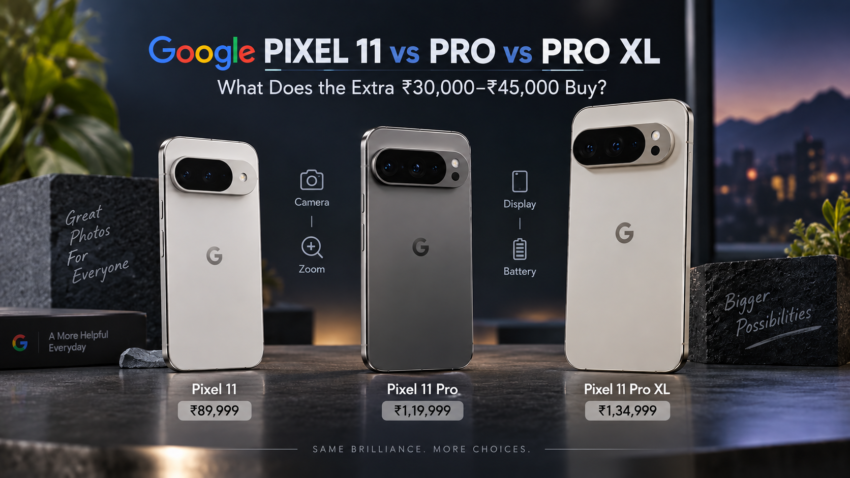
A ₹45,000 gap separates the cheapest and most expensive phone in Google’s own Pixel 11 lineup, enough to buy a genuinely good mid-range phone on the side. The Pixel 11 starts at ₹89,999. The Pixel 11 Pro costs ₹1,19,999, ₹30,000 more. The Pixel 11 Pro XL tops the range at ₹1,34,999, a further ₹15,000 up.
All three use Tensor G6 and receive seven years of OS, security, and Pixel Drop updates, so the price gap isn’t buying a faster or longer-lived phone; it’s buying camera hardware, screen size, and battery capacity. Whether that’s worth it depends on how you’d actually use it.
This guide works through what the Pro and Pro XL genuinely add over the standard Pixel 11, who would notice each upgrade, and who’s better off saving the difference. Google’s Pixel 11 lineup also includes a foldable model, the Pixel 11 Pro Fold, but this guide focuses on the Google Pixel 11 Vs Pro Vs Pro XL, the three conventional flagship models most buyers are actually choosing between.
Pixel 11 Series India Price
| Model | Storage | Price |
| Pixel 11 | 256GB | ₹89,999 |
| Pixel 11 | 512GB | ₹1,04,999 |
| Pixel 11 Pro | 256GB | ₹1,19,999 |
| Pixel 11 Pro XL | 256GB | ₹1,34,999 |
| Pixel 11 Pro XL | 512GB | ₹1,49,999 |
Last updated: September 2026. Retailer pricing, bank cashback, and exchange-offer discounts change frequently; treat these as base reference prices from Google’s own store and check current listings before buying.
Google Pixel 11 vs Pro vs Pro XL: At a Glance
| Feature | Pixel 11 | Pixel 11 Pro | Pixel 11 Pro XL |
| India starting price | ₹89,999 | ₹1,19,999 | ₹1,34,999 |
| Display | 6.3″ Actua OLED, 3,000 nits peak | 6.3″ Super Actua LTPO OLED, 3,600 nits peak | 6.8″ Super Actua LTPO OLED (QHD+), 3,600 nits peak |
| Refresh rate | 60–120Hz | 1–120Hz (LTPO) | 1–120Hz (LTPO) |
| Processor | Tensor G6 | Tensor G6 | Tensor G6 |
| RAM | 12GB | 12GB (256GB); 16GB (512GB) | 12GB (256GB); 16GB (512GB) |
| Storage | 256GB / 512GB | 256GB / 512GB | 256GB / 512GB |
| Main camera | 48MP, 1/1.56″ sensor | 50MP, 1/1.3″ sensor | 50MP, 1/1.3″ sensor |
| Ultrawide | 13MP | 48MP | 48MP |
| Telephoto/zoom | 10.8MP, 5x optical, 30x Super Res Zoom | 48MP, 5x optical, 120x Pro Zoom | 48MP, 5x optical, 120x Pro Zoom |
| Battery | 4,985mAh | 4,850mAh | 5,115mAh |
| Wired charging | 30W | 30W | 45W |
| Wireless charging | 25W (Qi2.2) | 25W (Qi2.2) | 25W (Qi2.2) |
| Weight | 197g | 204g | 226g |
| Key AI/camera extras | Magic Capture, Camera Looks, Rambler dictation | + HiLight, Instant Night Sight, Video Boost, 6-month Google AI Pro, Wi-Fi 7/UWB | Same as Pro |
| Software support | 7 years OS, security & Pixel Drops | 7 years OS, security & Pixel Drops | 7 years OS, security & Pixel Drops |
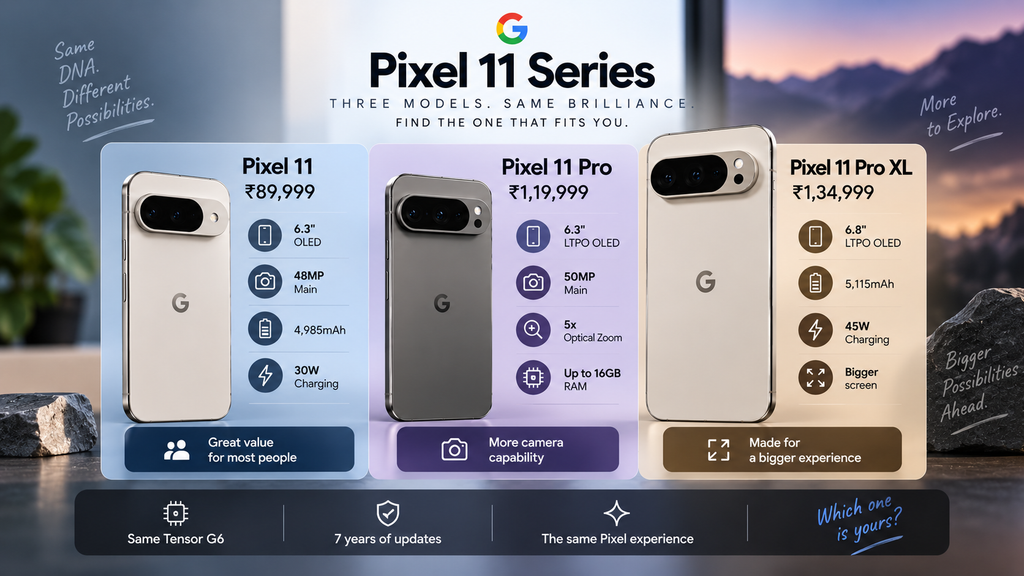
What Does the Extra ₹30,000–₹45,000 Actually Buy?
Strip away the marketing, and the Pro premium mainly buys better camera hardware, a brighter LTPO display, and on the Pro XL, a larger screen, bigger battery, and faster wired charging. Moving from 256GB to 512GB on the Pro models also increases RAM from 12GB to 16GB. The Tensor G6, seven-year update policy and much of the core Pixel software experience remain shared across the lineup.
That’s a narrower list than the spec sheets suggest. Camera and zoom are the upgrades most buyers will actually feel day-to-day; display brightness and RAM mostly matter in specific situations (outdoor shooting, heavy multitasking) rather than constantly. Screen size and battery capacity, meanwhile, are really just the trade-off you accept for choosing the Pro XL specifically, not a reason on their own to pick a Pro model over the base phone.
Google Pixel 11: Who Should Buy It?
The Pixel 11 keeps last generation’s compact 6.3-inch size, adds a genuine third rear lens the Pixel 10 base model lacked, and starts at 256GB now that Google has dropped 128GB as an entry tier.
Independent reviews are largely positive with reservations. Expert Reviews called it “a great phone with a mediocre processor,” praising the display and camera while noting performance and battery still trail rivals. 91mobiles’ India review described it as “a refinement rather than a major generational upgrade,” pointing out the Tensor G6 still lags Qualcomm’s Snapdragon 8-series and MediaTek’s Dimensity 9500-series in raw performance. BGR was blunter: “an excellent smartphone that plays it too safe.”
Battery reports diverge. BGR measured close to seven hours of screen-on time on busy days, calling it the best battery in the lineup outside the Pro XL. Trusted Reviews had a rougher run, ending demanding days at roughly 30% after five hours, and found real-world charging noticeably slower than Google’s claimed figures.
Best suited to: anyone upgrading from a Pixel 8 or earlier, buyers who want a compact phone, and anyone who wants Google’s camera and AI experience without paying for zoom range they won’t use.
Less suited to: mobile gamers, video creators who specifically want 8K recording, ProStable or the Pro-series camera hardware, and existing Pixel 10 owners (more in the upgrade section below).
Google Pixel 11 Pro: Is It Worth ₹30,000 More?
Camera hardware. The Pro moves to a larger 50MP main sensor (1/1.3-inch vs. 1/1.56-inch), a proper 48MP ultrawide instead of 13MP, and a redesigned telephoto that reaches 120x Pro Zoom instead of 30x. Who notices: anyone who shoots landscapes, architecture, events, or distant subjects regularly. Who probably won’t: casual point-and-shoot users, since Google’s processing already makes the standard Pixel 11 punch above its price bracket in ordinary conditions.
Display. Same 6.3-inch size, but LTPO variable refresh and a brighter 3,600-nit peak versus 3,000. Noticeable outdoors in harsh sun; nearly identical indoors.
RAM and storage. A detail most buyers miss: at the same 256GB tier, the Pro has the same 12GB of RAM as the standard Pixel 11. Moving to 512GB also increases RAM to 16GB. If larger RAM is your main reason for considering the Pro, our guide on whether 16GB RAM is worth paying for is worth reading first.
Connectivity. The Pro adds Wi-Fi 7 and ultra-wideband, over Wi-Fi 6E on the base phone, minor but real if your router supports it.
HiLight and the Google AI Pro subscription. The Pro adds HiLight, a ring of coloured LEDs that light up for calls and Gemini activity. Nearly every reviewer dismissed it; GSMArena called its functionality “very limited,” and BGR called it “a near-useless feature as shipped.” Don’t factor it into your decision. The Pro and Pro XL also include six months of Google AI Pro, which Google values at ₹11,700. Treat that as an included benefit rather than the primary reason to choose a Pro model.
Worth ₹30,000 more? If you shoot photos or video often enough to use the zoom and sensor upgrades, yes. If your use is mostly messaging, social apps, and casual snapshots, the standard Pixel 11 delivers nearly the same everyday experience for less.
Google Pixel 11 Pro XL: Is the Extra ₹15,000 Worth It?
Camera hardware, chip, software, and update policy are identical to the smaller Pro. The extra ₹15,000 buys a 6.8-inch QHD+ display instead of 6.3 inches, a bigger 5,115mAh battery, and faster 45W wired charging against the Pro’s 30W — at the cost of 22 extra grams (226g versus 204g).
BGR called it “an excellent daily driver… with the best camera on any Android phone I have tested,” while noting Pro Zoom past 80x, Magic Capture’s picks, and HiLight all fall short of their marketing. GSMArena was more measured: “a solid smartphone and worth considering. But at this price, you’d better check out the alternatives first.”
Who benefits: buyers who want the largest screen Google sells and the longest battery life and fastest charging in the lineup. Who doesn’t: anyone who finds 6.8 inches unwieldy in one hand, or who won’t use the camera hardware any differently than they would on the smaller Pro, since that hardware is identical either way.
The Pro XL shouldn’t be treated as automatically “best” simply because it costs the most; it’s the right choice only when its specific additions, screen size, and battery line up with your priorities.
Google Pixel 11 vs Pixel 11 Pro vs Pro XL: Camera Comparison
Hardware: The Pro and Pro XL share identical camera hardware, a larger 50MP main sensor, a 48MP ultrawide (versus 13MP), and a redesigned 48MP telephoto capable of 120x Pro Zoom versus the standard phone’s 30x Super Res Zoom. The Pro models also add Instant Night Sight, which Google says captures low-light photos up to 4.5x faster than standard Night Sight on the base Pixel 11.
Software: Camera Looks and Magic Capture, which automatically pulls the best still frames from a short video recording, are available across the entire lineup, standard Pixel 11 included, per Google’s own support documentation and multiple hands-on reviews. Where the Pro models differ is Video Boost, which sends Magic Capture footage through cloud processing for a 4K version; the standard Pixel 11’s output stays on-device.
Low-light and portraits: the standard Pixel 11’s 48MP sensor reportedly captures over 50% more light than last year’s, a real improvement for casual low-light shots. The Pro’s larger sensor and Instant Night Sight push this further for genuinely dark conditions.
Zoom and travel/wildlife photography: this is where the Pro’s hardware gap is largest. 30x on the standard Pixel 11 handles moderate zoom; 120x Pro Zoom opens up distant subjects, though DXOMARK and BGR both noted zoom past roughly 80x increasingly relies on AI reconstruction rather than captured detail.
Video: 8K recording, ProStable and Night Sight Video are the meaningful Pro-series video advantages. The standard Pixel 11 also supports Video Boost, so don’t treat Video Boost itself as a reason to move to the Pro.
Who should pay for the Pro camera system: enthusiasts and regular travel, event, or wildlife photographers, and anyone who shoots video often. Who shouldn’t: casual shooters posting mainly to social media; the standard Pixel 11’s camera is already capable for typical everyday photography.
Pixel 11 AI Features: Which Ones Actually Matter?
Available across the entire lineup: Gemini Nano runs on-device on all three models, alongside Gemini Live, Magic Cue, Circle to Search (now working from the camera viewfinder), Live Translate, and Call Assist. BGR’s side-by-side testing found these features “identical” between the standard and Pro phones. Rambler dictation and the new Gemini Intelligence task-offloading feature also ship lineup-wide. Camera Looks and Magic Capture are also on the standard Pixel 11, not just the Pro, an important correction to how this feature is sometimes described, since Magic Capture is a Pixel 11-series feature, not a Pro-exclusive one.
Features that differ between models: the Pro and Pro XL add Video Boost (cloud-processed 4K), Instant Night Sight, and HiLight’s ambient lighting.
Genuinely useful: Rambler’s dictation, Call Assist’s scam-call screening, and Magic Capture’s automatic best-frame selection, all lineup-wide. More experimental: HiLight, which multiple reviewers called “near-useless as shipped,” and Pro Zoom past roughly 80x, which trades accuracy for reach.
Does paying more for the Pro get you significantly better AI? No, the core Gemini experience is identical. The Pro adds better source material (a larger sensor, longer zoom, cloud video processing) for the same AI models to work with, not smarter AI itself. Our deeper breakdown of which AI smartphone features actually matter covers this distinction across the wider market, not just Pixel.
Pixel 11 Performance and Gaming
All three phones run the identical Tensor G6 chip, so there’s no performance tier to buy into; the Pro and Pro XL will not run games or heavy apps meaningfully faster than the standard Pixel 11. Everyday tasks (browsing, messaging, Gemini processing, multitasking) feel smooth across the lineup according to every review we found.
Gaming is the consistent weak spot. Trusted Reviews called Pro XL gaming performance “pitifully bad” and advised regular mobile gamers to look elsewhere; GSMArena and PhoneArena both found the Tensor G6’s graphics silicon throttles quickly under sustained load and doesn’t compete with Snapdragon- or Dimensity-powered rivals. Since the chip is identical across the range, buying a Pro model does not solve this; a Pro XL under sustained gaming load faces the same thermal ceiling as the base Pixel 11, just inside a slightly larger chassis. If gaming is a priority, look elsewhere in this price bracket, or at least go in with realistic expectations.
Pixel 11 Battery and Charging
On paper: 4,985mAh (Pixel 11), 4,850mAh (Pro), 5,115mAh (Pro XL), 30W wired charging on the Pixel 11 and Pro, 45W on the Pro XL, and identical 25W Qi2.2 wireless charging across all three.
| Model | Wired charging |
| Pixel 11 | Up to 55% in ~30 min with 30W charger |
| Pixel 11 Pro | Up to 55% in ~30 min with 30W charger |
| Pixel 11 Pro XL | Up to 75% in ~30 min with 45W charger |
Note: Chargers sold separately.
Capacity alone doesn’t tell the real story. BGR measured close to seven hours of screen-on time on the standard Pixel 11 during busy days, better than its own testing of the Pro, despite the Pro’s smaller-on-paper battery advantage disappearing next to its brighter, more power-hungry LTPO display. Trusted Reviews had a rougher experience with the standard phone, ending demanding days around 30% remaining, and found real-world charging speeds slower than Google’s claimed figures on all three models, a gap worth expecting rather than being surprised by.
The Pro XL’s larger battery and faster 45W charging exist mainly to offset its bigger 6.8-inch display’s extra power draw, rather than delivering more battery life per screen-on hour than the smaller Pro meaningfully.
Pixel 11 256GB vs 512GB: Which Should You Buy?
For the standard Pixel 11, 256GB is enough for most buyers — it’s now the base tier, doubled from last generation’s 128GB, and RAM stays at 12GB regardless of which storage size you pick.
On the Pro and Pro XL, the calculation is different: stepping up to 512GB doesn’t just double your storage; it also bumps RAM from 12GB to 16GB. If you’re choosing the Pro specifically for its camera hardware and shoot a lot of 8K video or Video Boost footage, that combined storage-and-RAM upgrade is worth considering. If you’re buying the Pro mainly for the zoom or display and don’t generate large video files, 256GB with 12GB RAM is unlikely to feel restrictive for typical two-to-three-year ownership. Our guide on whether 16GB RAM is worth paying for covers this trade-off in more depth.
Should You Upgrade From Pixel 10?
Upgrade if:
- You’re coming from a Pixel 9 or earlier, where the year-on-year gains compound
- You specifically want the standard Pixel 11’s new telephoto lens, which the Pixel 10 base model lacked
Consider keeping your Pixel 10 if:
- You already own a Pixel 10 or Pixel 10 Pro/Pro XL. Digital Trends, Android Authority, and Android Central all independently concluded this isn’t a worthwhile upgrade, since the display is unchanged and Tensor G6’s real-world gains are incremental
- If gaming or sustained performance is your priority, the chip generation gap isn’t large enough to matter
Upgrade if your Pixel 10 has: visibly degraded battery life or storage that’s consistently full, since every Pixel 11 now starts at 256GB.
Don’t upgrade solely for: HiLight, RAM bumps at the same storage tier, or marginal AI feature additions; none justify the cost alone.
If you’re unsure whether an annual upgrade makes sense at all, our guide on whether it’s worth upgrading your smartphone every year walks through calculating the real cost after trade-in.
Pixel 11 vs Samsung Galaxy S26
The Galaxy S26 Ultra launched at ₹1,39,999 but, per our Samsung Galaxy S26 series review, now sells meaningfully below that, undercutting the Pixel 11 Pro XL on street price while adding an S Pen, faster 60W charging, and a 200MP main sensor.
Camera: Samsung leans on resolution and versatility; Pixel leans on computational processing and colour science. Performance: the S26 Ultra’s Snapdragon 8 Elite Gen 5 beats the Tensor G6 in sustained load and gaming by a clear margin. AI: Google’s Gemini integration is more consistent across the Pixel range; Samsung layers Galaxy AI on top of Gemini, which some prefer, and others find redundant. Charging: Samsung’s 60W wired beats every Pixel 11 model. Long-term support: both now offer seven years of updates.
Pixel 11 vs iPhone 17
The standard iPhone 17 starts at roughly ₹82,900 in India, close enough to the Pixel 11’s ₹89,999 for a fair comparison. It runs Apple’s A19 chip, 8GB RAM, a 6.3-inch OLED display at up to 3,000 nits, and a dual 48MP camera with no telephoto lens at all a real gap against the Pixel 11’s 5x optical zoom.
Camera: Pixel’s telephoto is the clearest advantage for anyone who zooms regularly; iPhone’s video codecs (ProRes, Log) remain stronger for editing flexibility. Performance: the A19 comfortably outperforms the Tensor G6 in sustained tasks and gaming, a genuine edge over the entire Pixel 11 lineup, not just the base model. AI: Apple Intelligence has expanded but remains narrower than Gemini’s feature set. Ecosystem: the deciding factor for most buyers already invested in either platform. Software support: Apple’s typical five-to-six years trails Google’s seven.
Which Pixel 11 Should You Buy?
| If you care most about | Model to consider | Why |
| Compact size and lower price | Pixel 11 | Same chip and software as the Pro, at the lowest entry cost |
| Better camera hardware in a compact phone | Pixel 11 Pro | Pro sensor and zoom without the larger 6.8″ footprint |
| Largest display and battery | Pixel 11 Pro XL | Only model with the 6.8″ panel and 5,115mAh cell |
| Long-range zoom or travel/wildlife photography | Pro or Pro XL | 120x Pro Zoom versus the base phone’s 30x |
| Casual, everyday photography | Pixel 11 | Camera already outperforms its price bracket for typical use |
| Regular video shooting | Pro or Pro XL | 8K, Video Boost, ProStable are Pro-exclusive |
| Gaming | Compare alternatives too | All three share the same chip and its gaming limitations |
| Long-term software support | Any of the three | Identical seven-year update policy across the lineup |
Who Should Skip the Pixel 11 Series?
Dedicated mobile gamers will be better served elsewhere, since every Pixel 11 model shares the same gaming limitations. Existing Pixel 10 owners, particularly Pro and Pro XL owners are unlikely to find enough here to justify the cost of switching. And anyone who’s already compared current Galaxy S26 or iPhone 17 pricing and found a better fit for their specific priorities (charging speed, gaming performance, ecosystem) shouldn’t feel obligated to default to Pixel just because this guide is about Pixel.
Frequently Asked Questions
Is Google Pixel 11 worth ₹89,999? It can be, particularly for buyers who want a compact Pixel with a strong camera, 256GB starting storage, and seven years of software support without paying Pro pricing.
Which Pixel 11 model should I buy? The standard Pixel 11 suits most buyers. Choose the Pro or Pro XL only if you’ll regularly use the longer zoom, the ultrawide upgrade, or want a bigger screen.
Is Pixel 11 Pro worth ₹30,000 more? Only if photography or video is a genuine priority; the chip, software, and update policy are identical to the standard Pixel 11.
Is Pixel 11 Pro XL worth buying? Yes, specifically for buyers who want Google’s largest screen and longest battery life, not simply because it’s the most expensive option.
Pixel 11 vs Pixel 11 Pro: what’s the difference? Camera hardware, display brightness, Wi-Fi 7/UWB, and on higher storage tiers, RAM. Chip and software are identical.
Pixel 11 vs Pixel 11 Pro XL: which should I choose? Choose the Pixel 11 unless screen size and battery capacity specifically matter to you; choose the Pro XL if they do and budget allows.
Is Pixel 11 good for photography? Yes, for casual and everyday use. For serious zoom, ultrawide, or low-light work, the Pro or Pro XL’s larger sensors are a meaningful step up.
Is Pixel 11 good for gaming? Not particularly; all three share the Tensor G6, which independent testing found throttles under sustained gaming load regardless of model.
Should Pixel 10 owners upgrade to Pixel 11? Generally no, unless your battery has degraded or you specifically want the standard Pixel 11’s new telephoto lens.
How long will Pixel 11 receive software updates? Seven years of OS upgrades, security patches, and Pixel Drops, across all three models.
Is 256GB enough for Pixel 11? For most users, yes. Heavy 4K/8K video shooters on the Pro or Pro XL may benefit from 512GB, which also unlocks 16GB RAM there.
Which Pixel 11 has the best zoom? The Pro and Pro XL are tied with identical telephoto hardware and 120x Pro Zoom, versus 30x on the standard Pixel 11.
Final Takeaway
The standard Pixel 11 covers most of what makes a Pixel worth buying: a strong camera for everyday use, Google’s full Gemini AI feature set, and seven years of updates, at the lowest entry price in the range. The Pro adds meaningfully better camera hardware and a longer zoom, genuinely useful if you photograph or film often, but its chip, software, and core AI experience are no different from the base phone. The Pro XL adds a larger screen and battery on top, for buyers who specifically want Google’s biggest display.
Paying more only makes sense if the specific thing that extra money buys- sensor size, zoom range, screen size- solves a problem you actually have. Gamers and heavy performance users should look beyond this lineup entirely, since all three share the same limitations. Existing Pixel 10 owners have little reason to switch this year.
The right Pixel 11 is the model whose additional hardware solves a problem you actually have.

Harry S is a digital marketing expert with 19+ years of experience. He created Reviews-4u.com to share simple, research-backed product insights that help users make better buying decisions.