
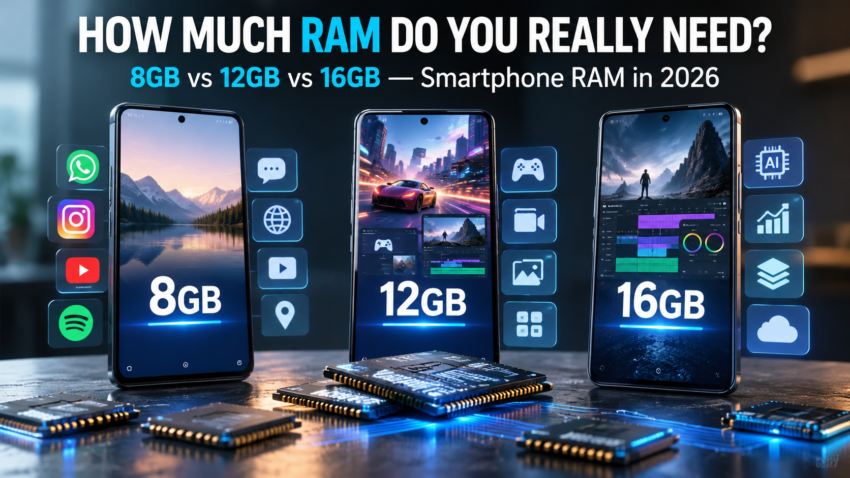
Look at any phone listing today, and the RAM number sits in the headline spec: 8GB, 12GB, 16GB, and higher on some gaming phones. The message is simple: bigger number, better phone.
Real life is less tidy. So how much RAM do you need in a smartphone in 2026? Does the average person need 12GB or 16GB, or is 8GB still enough?
For most people, 8GB is still enough. 12GB suits heavy users, and 16GB is for a small group with specific needs. But RAM is only one part of the picture. The processor, software, storage speed, and what you actually do on your phone all decide how a phone feels day to day.
There is also an interesting 2026 trend. Rising mobile DRAM costs have pushed smartphone manufacturers to rethink memory configurations. TrendForce reported that 12GB was becoming the mainstream high-end configuration, while 16GB adoption was declining and 8GB remained important in the mid-range.
What Is RAM in a Smartphone?
RAM (random access memory) is your phone’s short-term working space. Think of it as a desk. The apps you are using, or used a moment ago, are laid out on it so you can pick them up instantly. Storage is the cupboard where everything is kept permanently: apps, photos, videos, and files.
More desk space means more apps can stay ready in the background. Jump from WhatsApp to Instagram and back, and a phone with enough RAM resumes exactly where you left off. When memory pressure increases, Android may reclaim memory by stopping or killing background processes, which can cause some apps to reload when you return to them.
One common mix-up: people say “memory” when they mean storage, as in “my phone memory is full”. Storage is the 128GB, 256GB, or 512GB figure. RAM is a separate, much smaller number, usually 4GB to 16GB, and it empties when you restart.
How Much RAM Do You Need in a Smartphone? A Guide by User Type
Here is a rough breakdown of smartphone RAM in 2026:
| RAM | Suitable for | Typical user |
| 4GB | Basic use | Calls, messaging, a few light apps |
| 6GB | Basic to moderate use | Social media, streaming, everyday apps |
| 8GB | Most users | Multitasking, social media, photography, streaming |
| 12GB | Heavy users | Gaming, demanding apps, extensive multitasking |
| 16GB+ | Power users, specialised use | Heavy gaming, demanding workloads, extra headroom |
Treat these as guides, not rules. A phone’s chipset, software, and memory management change how far a given amount of RAM goes. This article focuses on 8GB vs 12GB vs 16GB, since those are the choices most buyers actually face.
Is 8GB RAM Enough for a Phone in 2026?
For a lot of people, yes. 8GB comfortably handles:
- WhatsApp and other messaging apps
- Web browsing
- YouTube, Netflix, and music streaming
- Instagram, Facebook and other social apps
- Photos and everyday video
- Navigation and video calls
- Normal day-to-day app switching
Where it can feel tight: keeping many apps alive at once, running a demanding game while chat and music sit in the background, or using memory-hungry on-device AI features, which can set aside a few gigabytes of RAM on some phones.
Not every 8GB phone behaves the same. A well-tuned phone with a capable chipset can feel smoother than a heavier, less optimised one with more RAM. iPhones can also deliver strong multitasking performance without matching the RAM capacities advertised by many Android phones, partly because iOS uses its own memory-management approach.
Is 12GB RAM Worth It?
12GB gives you extra headroom, and some people will actually use it. It helps if you:
- Keep a lot of apps open and switch between them constantly
- Play graphics-heavy games and want to keep them alive while replying to messages
- Edit photos or video on the phone
- Want a comfortable buffer for future software updates
The key is separating useful headroom from specification inflation. If you mostly use WhatsApp, YouTube, and Instagram, you may never see a difference, and paying a big premium for 12GB would be money spent on a number. If you regularly notice apps reloading on your current phone, 12GB is a reasonable step up.
If you are shopping around the ₹50,000 mark, it helps to see how RAM is paired with everything else on the phone. Our guide to the best smartphones under ₹50,000 in India puts phones at that price side by side, which is a useful reality check before you pay extra for a bigger RAM figure.
Do You Really Need 16GB RAM in a Smartphone?
For most buyers, no. Is 16GB RAM necessary? Only in specific situations.
It can make sense for heavy gamers, people who run many demanding apps at once, and anyone who wants maximum headroom and will happily pay for it. If you keep phones for several years, extra RAM may age better, though no one can say how much future apps will need.
For everyday use, the benefit is small. Opening Instagram, watching videos, and replying to messages does not use anywhere near 16GB. And 16GB will not automatically make a phone faster. If the processor is mid-range, the storage is slow, or the software is poorly tuned, more RAM will not fix that. The bottleneck stays where it is.
8GB vs 12GB vs 16GB RAM: What Is the Real Difference?
The better question is who will notice the difference. Here is how it plays out:
| 8GB | 12GB | 16GB | |
| Everyday multitasking | Smooth for most people | Smooth, with more apps kept open | Rarely noticeable over 12GB |
| Gaming | Fine for most games | Better at keeping games in memory | Helps mainly in long, heavy sessions |
| App switching | Occasional reloads if you juggle many apps | Fewer reloads | Fewest reloads |
| Long-term use | Adequate for many | More comfortable buffer | Most headroom, no guarantee |
| Value for money | Usually the best | Good if you will use it | Hard to justify for most |
If you use your phone for social media, streaming and photos, 8GB and 12GB will feel almost identical. The gap between 12GB and 16GB is smaller still and needs a genuinely demanding workload to feel.
Does More RAM Make a Smartphone Faster?
Not by itself. RAM decides how much your phone can keep ready. It does not decide how fast it works. That comes from several parts:
- Processor (chipset): does the actual computing. A faster chipset speeds up apps, games, and camera processing.
- Storage speed: how quickly apps and files load. Faster storage means quicker launches.
- Software optimisation: how well the operating system manages memory and background apps.
- App optimisation: how efficiently each app is built.
Adding RAM to a slow chipset does not make the chipset faster. This is why a well-optimised 8GB phone can sometimes give a better everyday experience than a poorly optimised 12GB or 16GB one.
What About Virtual RAM or RAM Expansion?
Many phones offer a feature called Virtual RAM, RAM Expansion, Memory Extension, RAM Plus, or Extended RAM. The idea is that the phone reserves part of its storage and uses it as extra working space when physical RAM fills up.
Storage is much slower than real RAM, so virtual RAM should not be treated as equivalent to physical RAM. Adding 4GB of virtual RAM to an 8GB phone does not turn it into a 12GB phone.
That said, it is not useless either. Depending on the phone, the software, and what you are doing, it can help keep a few more apps from reloading. Think of it as a small extra, not a substitute.
Does RAM Matter for Gaming?
It matters, but less than people expect. RAM affects how well a game loads, how many other apps stay alive while you play, and whether you can return to a match after checking a message.
But gaming performance mostly depends on the chipset and GPU (graphics processor), plus thermal management (how well the phone stays cool) and the display. A phone with strong cooling and a top chipset will usually beat one that simply has more RAM but throttles when it heats up. As a rough buying guide, 8GB is sufficient for many casual gamers, while 12GB provides additional headroom for regular gaming and multitasking. 16GB is mainly relevant to enthusiasts and users with unusually demanding workloads.
How Much RAM Should You Buy Based on Your Usage?
If you are a basic user
Calls, messaging, a few social apps? 6GB is a workable minimum, and 8GB gives breathing room.
If you are a normal user
8GB is likely sufficient. You get smooth multitasking without paying extra for capacity you will not use.
If you are a heavy multitasker
Constantly switching between many apps, or working from your phone? 12GB makes more sense, because fewer apps reload.
If you are a serious mobile gamer or power user
12GB is a sensible baseline. 16GB is worth considering if you play demanding games for long sessions or run heavy workloads, but check the chipset and cooling first.
If you plan to keep your phone for 4–5 years
Extra RAM may give you a useful buffer as apps grow. But a good chipset and a long software update promise usually matter more than the RAM figure. If you’re buying a new phone today, 8GB should be your baseline target. Move to 12GB if the price difference is reasonable and you multitask heavily or plan to keep the phone for several years. Don’t pay a large premium just to move from 12GB to 16GB unless you have a workload that can actually benefit from it.
Each of these is a trade-off, not a rule.
Does More RAM Help Future-Proof a Smartphone?
A little, but not as much as marketing suggests. Apps and operating systems tend to demand more resources over time, and on-device AI features are adding to that. Apps and operating systems can become more resource-intensive over time, while newer on-device AI features may also increase memory requirements on some phones.
Look at the whole package instead:
- Chipset: how capable it is now and how it will age
- Software support: how many years of Android and security updates you get
- Storage: capacity and speed
- Battery health: how it holds up after a couple of years
- Camera hardware: sensors and lenses, not just megapixels
- Display: brightness, refresh rate, and quality
- Build quality: durability and water resistance
A phone with 8GB RAM and five years of updates can be a better long-term buy than one with 12GB and two.
To see how a recent flagship balances chipset, memory, and software, our Google Pixel 11 series coverage is a useful example.
Cameras are a good example of a spec that affects daily use more than RAM does. If photography matters to you, start with our roundup of the best camera phones in India rather than a RAM comparison.
Common Smartphone RAM Buying Mistakes
- Assuming more RAM automatically means better performance
- Comparing RAM without looking at the processor
- Treating virtual RAM as the same as physical RAM
- Paying a large premium for RAM you will never use
- Ignoring software optimisation
- Choosing a phone based only on specifications
- Assuming 16GB RAM is necessary for everyone
So, How Much RAM Do You Really Need in 2026?
Here is the practical takeaway:
- 8GB: likely sufficient for many everyday users
- 12GB: a sensible choice for heavy multitasking, gaming, and anyone who wants extra headroom
- 16GB: mainly useful for power users and specific demanding workloads, not the average buyer
These are guidelines, not laws. The right amount depends on how you use your phone and how good the phone is overall.
Before you pay extra for RAM, ask what you would use it for. Then compare the whole phone, not one number on the spec sheet.

Harry S is a digital marketing expert with 19+ years of experience. He created Reviews-4u.com to share simple, research-backed product insights that help users make better buying decisions.